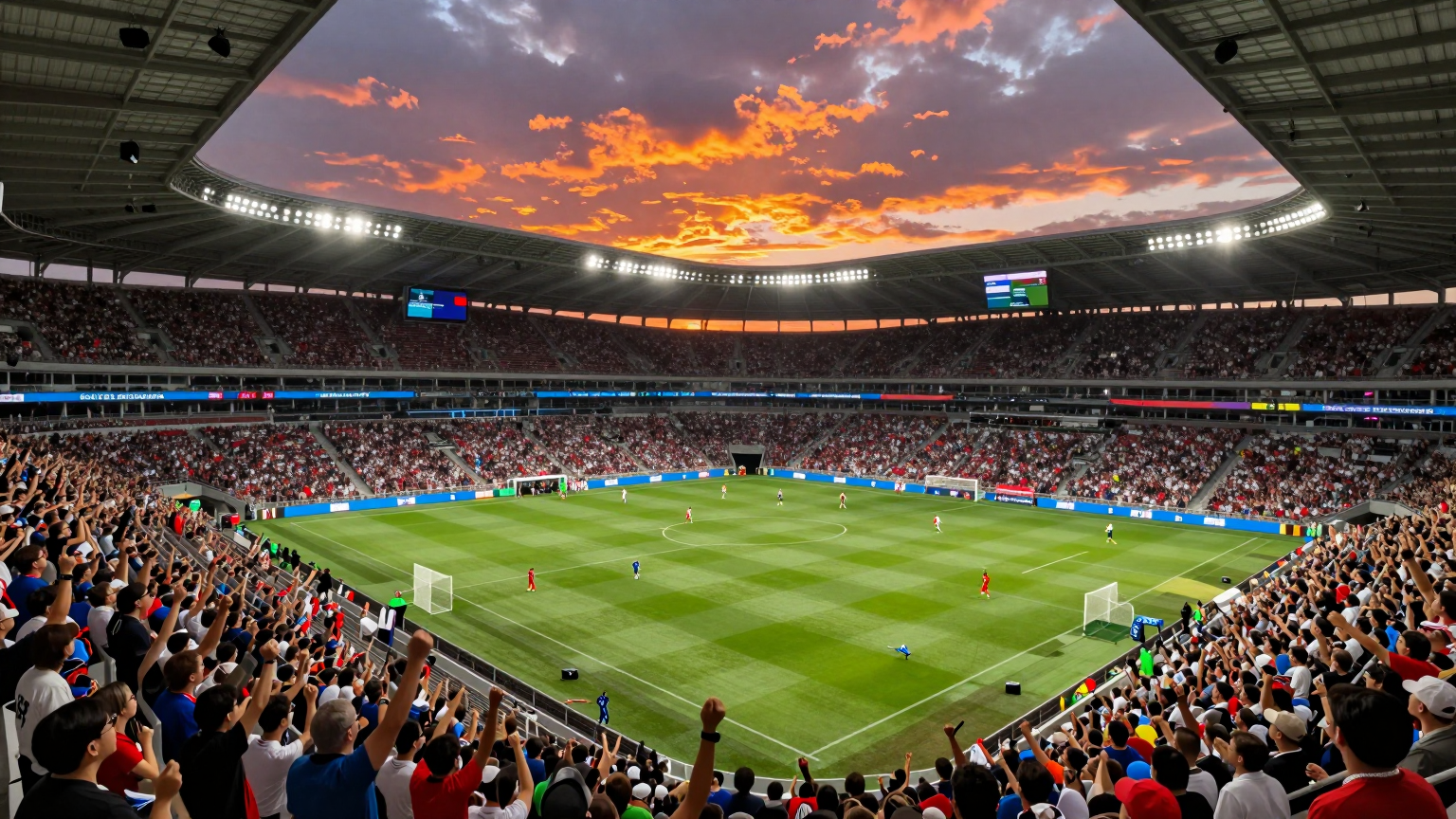
June 11 and the world is about to go to the World Cup — again. But not like you’ve ever seen it before.
The 2026 FIFA World Cup, co-hosted across the United States, Canada, and Mexico, kicks off on June 11 and runs through July 19. It’s a tournament with records waiting to be broken, technologies I’ve never before encountered in a football match, and an England side looking to deliver after a qualification campaign that was, frankly, too comfortable for their own good.
As someone who’s watched football with a football manager and coded the same matchday analytics dashboards, this one excites me in a way few tournaments since 2022 ever have. Let’s unpack why.
A Record-Breaking Format
The first thing you need to know is that 2026 is the biggest World Cup ever, and I don’t mean the ticket revenue (though that’ll be huge). We’re talking 48 teams — up from 32 — across 16 groups of three, playing 104 matches, from June 11 to July 19.
Here’s the format in plain English, because FIFA’s official diagram might as well be written in Sanskrit:
- Group stage: 16 groups (FIFA calls them “pods”) of three teams each. Each team plays two matches. The top two in each group (32 teams) advance automatically.
- The 3rd place play-offs: The eight best third-placed teams earn knockout berths too. Yes, this means a team could finish third and still go home — unless they’re one of the eight best thirds. It’s a slightly bonkers system designed to keep every match interesting (and slightly cynical). But it’ll make the final group-stage matches absolutely gripping.
- Knockout stage: Round of 32, quarter-finals, semi-finals, a third-place play-off, and the final.
The final takes place at MetLife Stadium in East Rutherford, New Jersey — the kind of 82,500-capacity sports coliseum that’ll host its first-ever World Cup final in front of a sea of jerseys that won’t know whether they’re at a football match or a Taylor Swift concert.
Host Cities Across Three Nations
The scale of this thing is almost hard to grasp when you read it as a list. We’ve got 16 cities spread across North America:
United States (11 venues): Los Angeles (SoFi Stadium), New York/New Jersey (MetLife Stadium), Pasadena (The Rose Bowl), Santa Clara (Levi’s Stadium), Dallas (AT&T Stadium), Houston (NRG Stadium), Atlanta (Mercedes-Benz Stadium), Miami (Hard Rock Stadium), Boston (Gillette Stadium), Kansas City (GEHA Field at Arrowhead Stadium), Philadelphia (Lincoln Financial Field).
Canada (2): Vancouver (BC Place), Toronto (BMO Field).
Mexico (3): Mexico City (Estadio Azteca — the only stadium to host a third World Cup, having previously hosted 1970 and 1986), Guadalajara, Monterrey.
One of these stadiums — Estadio Azteca — has already hosted two World Cup finals. Now Mexico’s got that chance again. The man-who-was-born-to-see-his-team-win-a-final-in-that-stadium thing didn’t work out in 1986, so maybe 2026’s the one.
What’s New in Technology This Time?
Right, the tech stuff — because that’s what makes this year’s tournament genuinely different from anything before it.
The Adidas TRIONDA: A Smart Ball with an Embedded AI Chip
FIFA has unveiled the Adidas TRIONDA, and it’s not just a pretty face. Embedded inside is an AI-powered sensor chip that transmits data about spin, velocity, and exact ball trajectory in real-time to the VAR operation room. This is a generational leap from the sensor-ball experiments of 2022.
Why does this matter? Because the semi-automated offside technology (SAOT) goes from good to scary-precise. The new system uses AI-generated 3D player avatars to track every joint, every limb, every millimetre of a player’s position. It’s like FIFA’s built a computer game overlay on top of reality, and using it to referee the game.
AI as a Full Team Staff Member
This is the one that genuinely impressed me: FIFA, in partnership with Lenovo, has launched Football AI Pro — a generative AI knowledge assistant designed specifically for all 48 participating teams. It’s the first time a World Cup has treated AI as an actual coaching tool rather than just a stats spreadsheet.
Think about that for a second. You’ve got national teams from everywhere — Japan, Morocco, Canada (making their first-ever World Cup appearance), Ecuador — all with potentially different access to this AI infrastructure. The playing field isn’t just level; it’s been redesigned by machine learning.
Verizon 5G and Stadium Fan Experience
Right here in the homeland, Verizon’s been contracted specifically for the fan experience layer: 5G network infrastructure, Fixed Wireless Access, and broadcast solutions powering live engagement across all 16 host cities. AR and VR experiences are being built into fan zones — interactive games, live streaming at stadium scale, AI-powered moments that can be personalised in real-time.
As someone who’s built fan engagement dashboards, the idea of being inside a MetLife Stadium, looking at a phone through an AR overlay that shows passing routes, player heatmaps, and the next 30 seconds of predicted play — that’s not sci-fi anymore. That’s being built right now.
IoT Tracking and Real-Time Analytics
The 2026 World Cup is being described as “the most data-dense sporting event ever built.” Every player wears tracking technology that streams telemetry in real-time — positional data, sprint speed, heart-rate-adjacent load metrics — feeding into both team analytics AND broadcast overlays.
The old-school fans might grumble about yet another graph on the TV screen, but honestly? The ability to watch a match and see exactly where an attacking midfielder’s pressing patterns are breaking down, in real-time, as it happens — it’s transformed how I watch the beautiful game.
Green Stadiums: Actually Sustainable This Time
Mercedes-Benz Stadium in Atlanta leads the charge with its own on-site solar generation, rainwater harvesting, and strict sustainability metrics it publishes publicly. A lot of the 2026 venues are LEED-certified or working toward net-zero by 2040. It’s not perfect — the carbon footprint of 48 teams, millions of fans, and the media circling across three nations will be enormous — but at least FIFA’s trying harder this time.
Cybersecurity: The Invisible Match
Here’s the angle most people won’t talk about: the 2026 World Cup cybersecurity challenge. CISA and federal and state security professionals are fortifying digital infrastructure across major host cities — traffic lights, ticketing systems, stadium Wi-Fi, broadcast feeds, payment systems, everything.
According to Politico, over 78 matches will be hosted in the US alone, and the attack surface is massive. Cybersecurity Dive has noted that the World Cup offers “huge platforms” for cyberattacks — from simple DDoS on ticketing platforms to more sophisticated targeting of broadcast infrastructure. It’s fascinating that the same people building smart balls with AI chips are the ones defending against state-level cyber threats. It’s a tournament happening on two layers simultaneously: the one visible on the pitch, and the one invisible in the data infrastructure holding it all together.
England: Qualified. Too Easily. Let’s See What’s Next.
England have done their qualification — won UEFA Group K, as expected. They dominated a fairly lightweight group (Albania, Andorra, Latvia, Serbia). That’s the good news and the bad news.
The good news: they’re going to the World Cup and they look strong on paper. The squad, under the current setup, has Harrison Ramsay, Bukayo Saka, Jude Bellingham, Jamie Vardy, and the evergreen Harry Kane (finally going to his fourth major tournament — or is it his first World Cup?).
The bad news: qualifying was supposed to be routine for England, and it was — but the tournament itself is where the real test begins. And 2026 throws curveballs none of us expected.
Key England storylines:
- Home advantage for their rivals: Many of England’s group-stage opponents will have home legs in Mexico or the US. That crowd noise isn’t a metaphor anymore.
- Kane’s final World Cup: If he hasn’t won it by 2026, do we keep talking about it forever?
- Saka and Bellingham’s emergence: They’re in their peak years by June. The England team of 2026 will be built around them.
Who’s the Favourite?
I’ve been reading predictions for weeks, and the consensus keeps shifting as qualification finishes. Here’s where I land:
Argentina are always dangerous at a World Cup. Their DNA is built on winning tournaments at the highest level, even without Messi (he’s not in this World Cup — aged 39, past it). They’re the team with the most experience.
France are the strongest team on paper — Mbappé-led, deep squad everywhere, and they play the kind of fast, high-pressing football that suits a tournament where one match can decide your fate.
Spain are the dark horse that could become the horse. Lamine Yamal is barely old enough to buy a ticket but already terrorising top-level defenders.
Mexico at the Azteca for the final? The man-who-was-born-to-see-his-team-win-a-final-in-that-stadium thing has a 2026 callback written all over it.
And England? We’re always the team you pick in the quarter-final and cry about in the same breath. Don’t let me be right this time.
The Verdict: Why 2026 Feels Different
The 2026 World Cup isn’t just bigger — it’s different in ways that go beyond the format expansion. We’re watching the first football tournament that’s simultaneously:
- A sport event
- A technology showcase (AI coaching, smart balls, AR fan experiences, IoT player tracking)
- A sustainability experiment
- A cybersecurity test-bed
- A cultural moment spanning three continents
That’s a lot of words for “football is getting smart.” But honestly? It’s exciting. It’s the kind of convergence of tech and sport that I’ve been waiting to see for years. The game’s about to get faster, the decisions about to get fairer, the experiences about to get richer.
So when June 11 comes round — whether you’re cheering for England, Argentina, the USA as hosts, or just watching because the beer’s cheap — remember you’re not just watching a football tournament. You’re watching the future of the game arrive in person.
Let’s go. World Cup, here we come again.