There’s a particular kind of shop that only exists for a few weeks a year. The window is plastered with a single image — a red poppy, about the size of a double bed, printed so many times it stops looking like a flower and starts looking like a texture. Inside, an old woman in a black coat stands behind a little counter, and in front of her, arranged in neat rows on a sheet of greaseproof paper, are hundreds of tiny paper cones. She doesn’t sell them. She gives them. You hold one out, you drop a coin in, and she slides a small red flower across the counter like a dealer who’s decided, after a long career, to run the game for free.
The whole thing is older than it looks. The poem it’s built on — “In Flanders Fields” — was written by a Canadian doctor, John McCrae, on 3 May 1915, the day after he buried a friend named Alexis Helmer in a muddy field outside Ypres. He was so unimpressed with it that he threw the draft away, and a colleague fished the crumpled page out of the bin. It was published anonymously in Punch on 8 December 1915, and by the time the war was over it had become the most famous poem of the whole thing. The poppy itself took a bit longer to catch on. In 1921 a Frenchwoman called Madame Guérin — “the Poppy Lady from France,” she was known — turned up at the newly formed British Legion with a box of silk poppies and the quiet confidence of someone who has a good cause and no intention of taking no for an answer. Earl Haig backed her, and on 11 November 1921, the third anniversary of the Armistice, Britain held its first Poppy Day. The shops, the cones, the old women, the small change — all of it has been running on the same programme ever since.
Every November, then, Britain buys millions of paper flowers and donates the money to a very good cause. Every November, Britain also eats a frankly unreasonable amount of cake. This recipe does what the poppy shop does, but with the conscience switched off: a poppy seed and orange cake that funds nothing, commemorates nothing, and is simply very good. It’s the poppy shop’s conscience, minus the penny.
Ingredients
- 125g unsalted butter, softened
- 125g caster sugar
- 2 eggs, beaten
- 125g self-raising flour
- 1 tsp baking powder
- a pinch of salt
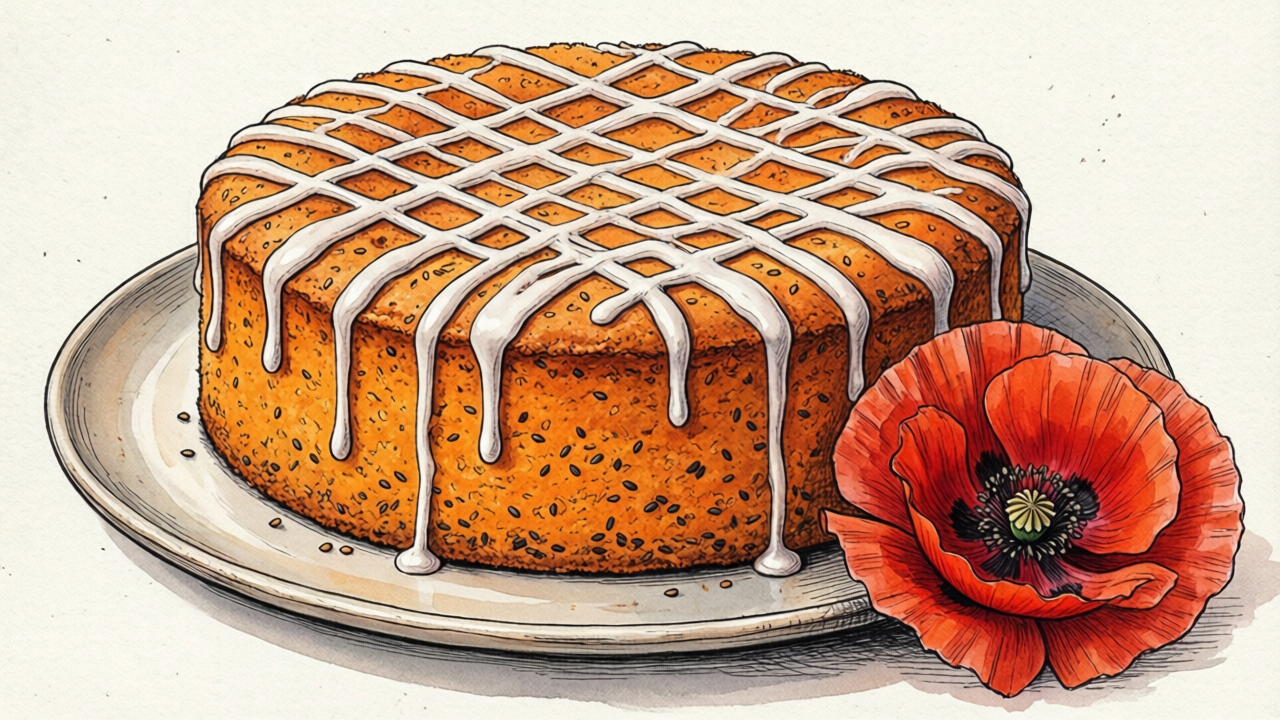
- 1 tbsp poppy seeds (the only thing in this list that’s actually in the shop — the rest is the queue)
- 1 orange, zest and juice
- icing sugar, for the drizzle
Method
- Preheat the oven to 180°C (160°C fan), and line a 18cm round tin with greaseproof paper. This tin is the cone. It holds the flower.
- Cream the butter and sugar together until pale and fluffy. This is the only part of the poppy shop that actually pays you, so take your time with it.
- Beat in the eggs one at a time, and if the mixture splatters, add a spoonful of flour to stop it. A splatter in the poppy shop is a small scandal; a splatter in your kitchen is just a Tuesday.
- Sift in the flour, baking powder and salt, then fold in the poppy seeds. The seeds are the poppy. Everything else is the queue.
- Grate the orange zest and squeeze the juice into a jug — you want roughly three tablespoons of it — and fold that through the batter. The orange is the only thing in the shop you can actually eat. The rest is a paper flower and a sense of duty.
- Pour the mixture into the tin and bake for 35 to 40 minutes, until a skewer comes out clean. The skewer should come out the way the old woman’s hands come out of the till: full of small change, and a little bit tired.
- Leave the cake in the tin for ten minutes, then turn it out onto a wire to cool. The cone holds the flower; the tin holds the cake. Same job, different material.
- For the drizzle, mix the icing sugar with a splash of orange juice until it’s just runny enough to fall off a spoon, and drizzle it over the top in a cross-hatch. This is the poppy’s centre — the dark dot in the middle of the flower. Without it, it’s a cake. With it, it’s a poppy, and you’ll be lying to people if you tell them it’s not.
Serve it plain, with a cup of tea, at a time of day when nobody is asking you to explain yourself. It keeps for three or four days in a tin, which is more than can be said for most British fortunes. The poppy shop closes at the end of November. The cake doesn’t have to — but it’s at its best on the day the cones come out, when the whole street is doing the small, quiet thing, and you’re doing yours, with a piece of cake and a conscience you’ve left at home.