There are few things more quintessentially British than the Marmite debate. You meet someone for the first time, ask what they put on toast, and within thirty seconds you know whether they’re friend or foe. The marketing department at Unilever has built a billion-pound empire on the phrase “love it or loathe it,” and honestly, it’s a stroke of genius — even the haters are talking about the product. Marmite has been a staple since 1902, originally brewed as a by-product of Burton Ale at the Bass Brewery, and it somehow survived the Great Depression, two World Wars, and the rise of avocado toast. That’s resilience.
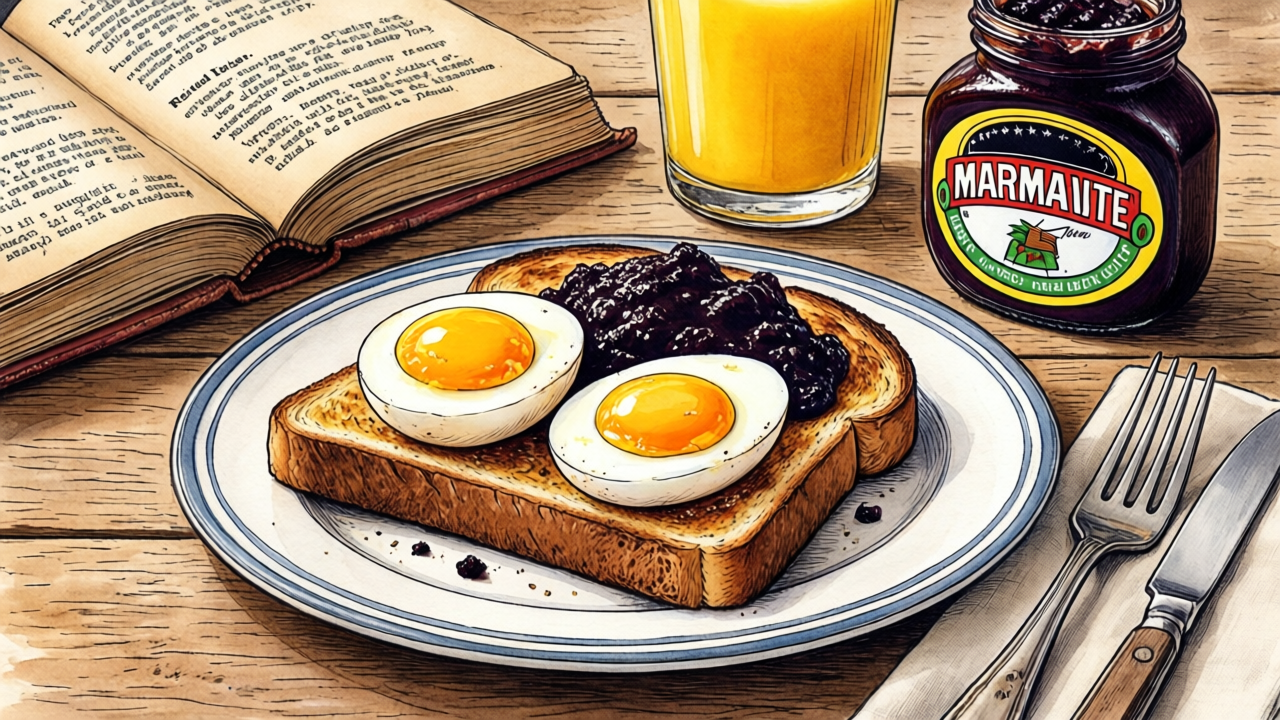
This recipe leans into the umami. Marmite is packed with B vitamins, yeast extract, and enough glutamates to make your taste buds stand at attention. Paired with softly scrambled eggs, it transforms a humble breakfast into something that tastes like it came out of a London brunch café charging £18. The secret is the Marmite butter — just a teaspoon whipped into softened butter — which gives everything a deep, savoury richness without overwhelming the eggs. Serve on properly toasted sourdough, and you’ve got breakfast that would make George Marmite himself nod in approval.
Ingredients
- 4 large eggs, preferably free-range (the hens should be well-compensated)
- 25g unsalted butter, softened
- 1 teaspoon Marmite (generous — don’t be shy, this isn’t caviar)
- 2 thick slices sourdough bread, toasted
- 1 tablespoon double cream
- Freshly ground black pepper, plenty
- Finely chopped chives, for scattering
- Optional: a pinch of smoked paprika for warmth
Method
- Start by making the Marmite butter. Take your softened butter and whip in the teaspoon of Marmite with a fork until it’s a smooth, dark paste. Spread this generously over your toasted sourdough while it’s still warm — the Marmite should almost melt into the crumb.
- Crack the eggs into a cold, heavy-based saucepan. Add a good glug of water — about 3cm above the eggs.
- Place on medium heat and bring gently to a simmer. As soon as the water starts to move, reduce to low and leave for exactly 4 minutes. This gives you that perfect soft-set centre — still runny enough to pool on the toast, but not so liquid that you’re fishing for yolks with a fork.
- While the eggs cook, heat a small non-stick pan on low. This is for finishing the eggs — you’ll need it in the next step.
- Drain the eggs and transfer them to the warm non-stick pan. Add the tablespoon of double cream and a crack of black pepper. Now here’s the technique: stir gently with a wooden spoon or silicone spatula, not too fast, not too slow. You’re looking for soft curds, not the dry rubbery mess you get from overcooking. Take the pan off the heat while the eggs still look slightly underdone — they’ll continue cooking from residual heat for another 30 seconds.
- Pile the scrambled eggs onto the Marmite-buttered toast. Scatter with chives and, if you’re feeling adventurous, a light dusting of smoked paprika.
- Eat immediately. The toast softens fast, and nobody wants soggy sourdough.
Quick note: if you’re one of the unfortunate souls who genuinely cannot stomach Marmite (and yes, that’s a valid position), substitute with a teaspoon of Vegemite — it’s the Australian cousin, slightly sweeter, slightly less depressing — or just use wholegrain mustard. But come on, give Marmite another chance. You’re missing out.