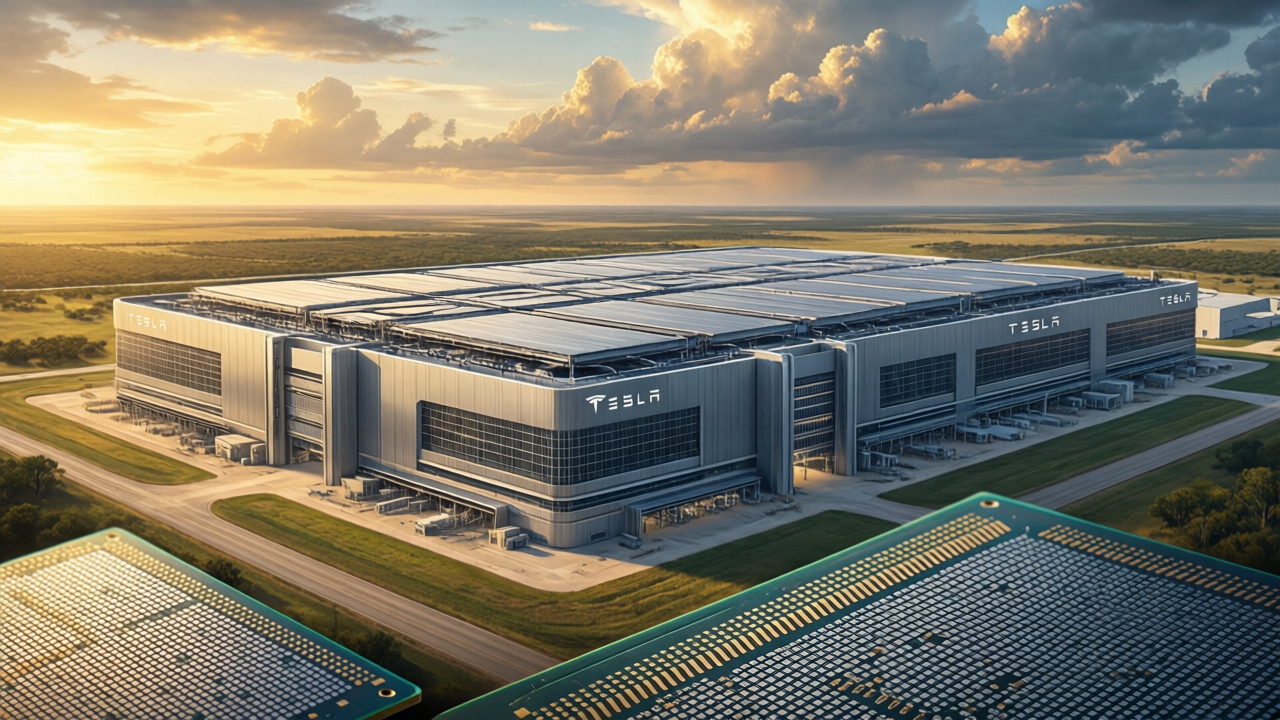
The chip factory that could power your toaster, your car, and your rocket
SpaceX and Tesla have announced Terafab, a jointly developed semiconductor fabrication plant in Grimes County, Texas, with an initial investment of $16.8 billion and over 100 million square feet of manufacturing space. That is roughly 20 football pitches of chip-making real estate in a county whose population is approximately the same as Colchester United’s away section on a good day.
The facility will produce two classes of chips: edge-inference chips for Optimus robots and Cybercabs, and high-power compute chips for SpaceX’s Starlink and autonomous spacecraft systems. In other words, the same factory is expected to make the brains of your future household robot and the navigation systems on rockets that leave the atmosphere.
The scale is genuinely staggering. For context, TSMC’s latest flagship fab in Arizona covers around 99 acres with a $40 billion price tag over multiple phases. Terafab is proposing to match that footprint with less than half the capital and deliver chips for both automotive and aerospace in one shot. Whether this is visionary integration or an engineering nightmare waiting to happen is the question that has everyone from semiconductor veterans to Texas property developers losing their minds.
Why this matters
The semiconductor industry has spent the last decade building fabs that cost more than most mid-sized countries spend on defence. The economics of chip manufacturing demand scale — you need billions in revenue just to keep the lights on — which is why companies like TSMC, Intel, and Samsung have essentially cornered the market on advanced nodes.
Elon Musk’s approach is characteristically different: bypass the traditional supply chain entirely. Instead of buying chips from TSMC or Intel, Terafab will produce them in-house for Tesla’s autonomous vehicle fleet, its Optimus humanoid robot programme, and SpaceX’s growing constellation of Starlink terminals and launch vehicles.
This vertical integration strategy has worked for SpaceX with rocket engines and hardware — they build almost everything themselves now. Applying it to semiconductors is a much higher bar. Chip fabs require a supply chain of specialised gases, ultra-pure silicon wafers, photolithography equipment (much of it from ASML’s €350 million EUV machines), and an engineering workforce that’s thinner than a motorway service station coffee.
Grimes County was chosen for its proximity to existing Tesla and SpaceX facilities in the Austin area, access to Texas’s increasingly strained power grid, and — presumably — the relative affordability of land compared to the Silicon Valley metro area.
The edge-inference angle
The most interesting part of Terafab for most people isn’t the rocket chips — it’s the edge-inference chips. These are the processors designed to run AI models locally on devices, without needing a constant connection to the cloud.
Tesla has been pushing towards full autonomy for years, and their current FSD (Full Self-Driving) hardware relies on chips that are becoming increasingly obsolete compared to what competitors are shipping. Optimus, their humanoid robot programme, requires even more compute density — processing sensor data, vision models, and motor control all in real-time on a battery-powered chassis.
A dedicated fab means Tesla can iterate on chip architecture as fast as they iterate on their vehicle software, rather than waiting for TSMC’s production schedule. It also means they control the entire stack from silicon to software — something very few automotive companies can claim.
The risk profile
The semiconductor industry has a graveyard of companies that tried to build their own fabs and failed. Intel itself — the original chip maker — is now struggling to compete on advanced nodes despite decades of experience and hundreds of billions in capital. AMD outsourced to TSMC and is now winning. The lesson the industry learned: building fabs is almost always a mistake unless you are the government of Taiwan.
Then again, nobody expected SpaceX to land rockets on boats either. The Musk strategy of “what if we just tried it” has produced results in aerospace that would have been laughed out of any traditional engineering review board. Whether that same approach translates to semiconductor manufacturing is the $16.8 billion question.
Construction is expected to begin immediately, with the first wafers potentially rolling off the line within three years. If Terafab succeeds, it could reshape not just the semiconductor industry but the entire relationship between AI hardware and the companies that deploy it. If it fails, it will be one of the most expensive lessons in tech history.