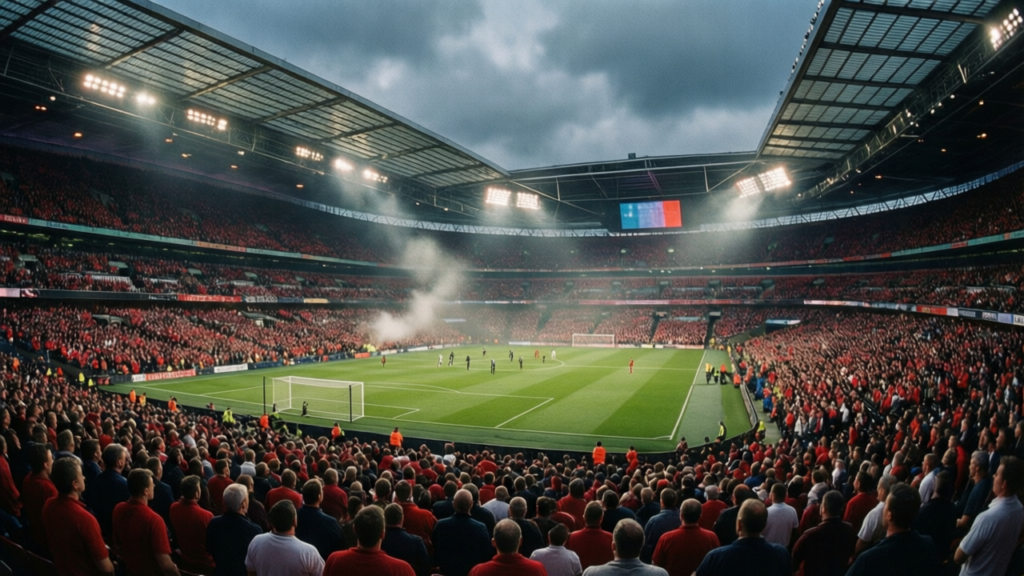
The final whistle at MetLife Stadium didn’t just end a World Cup final. It ended an era — and for Argentina, it exposed the same old contradiction that has haunted their football identity since the days of Maradona: you cannot play with fire and not get burned.
Spain won 1-0 after extra time thanks to Ferran Torres. Lionel Messi said goodbye with tears in his eyes. And then, because this is Argentina, because this is always Argentina, the pitch erupted into chaos. Punches were thrown. Leandro Paredes was sent off. Scaloni himself had to break up a fight between his own players and the Spanish squad. One Argentine player grabbed a Spaniard by the throat.
It wasn’t an aberration. It was the culmination of 120 minutes — and 90 years — of a footballing DNA that refuses to change.
The Numbers Don’t Lie (And They Never Do)
Let’s start with the data, because the numbers tell a story that words often obscure.
At the 2026 World Cup, Argentina committed 87 fouls — the most of any team in the tournament. They drew 14 bookings from their opponents — also the most. Their own yellow card count? Just six — the lowest in the competition.
Translation: Argentina didn’t just play rough. They played rough without getting caught. This is a team that has accumulated 134 World Cup yellow cards — the most in tournament history — yet somehow managed to keep their own disciplinary record relatively clean through sheer tactical subtlety.
This isn’t incompetence. This is a system.
Scaloni’s System: The Beautiful Game with Teeth
Lionel Scaloni’s Argentina doesn’t play a single formation. That’s the first thing you notice watching them at this tournament. 4-3-3 morphs into a 4-4-2 diamond mid-game. The back line shifts between a three and a four depending on who has the ball. There is no nailed-down shape because shape implies stability, and Argentina doesn’t do stable.
Scaloni himself said after the semi-final against England: “This team plays best when they are facing adversity.”
That’s not a quote you hear from Pep Guardiola’s Manchester City or Julian Nagelsmann’s Germany. That is a confession of identity. Argentina doesn’t win because their passing is cleaner or their pressing is more sophisticated. They win because when the going gets hard, something switches on in them that other teams cannot replicate.
But here’s the thing about playing with adversity as your default setting: eventually, it stops being an advantage and becomes a liability. Because adversity breeds frustration. Frustration breeds aggression. And aggression — unchecked — breeds chaos.
La Nuestra: The Beautiful Style That Isn’t Just About Football
To understand Argentina, you have to understand La Nuestra.
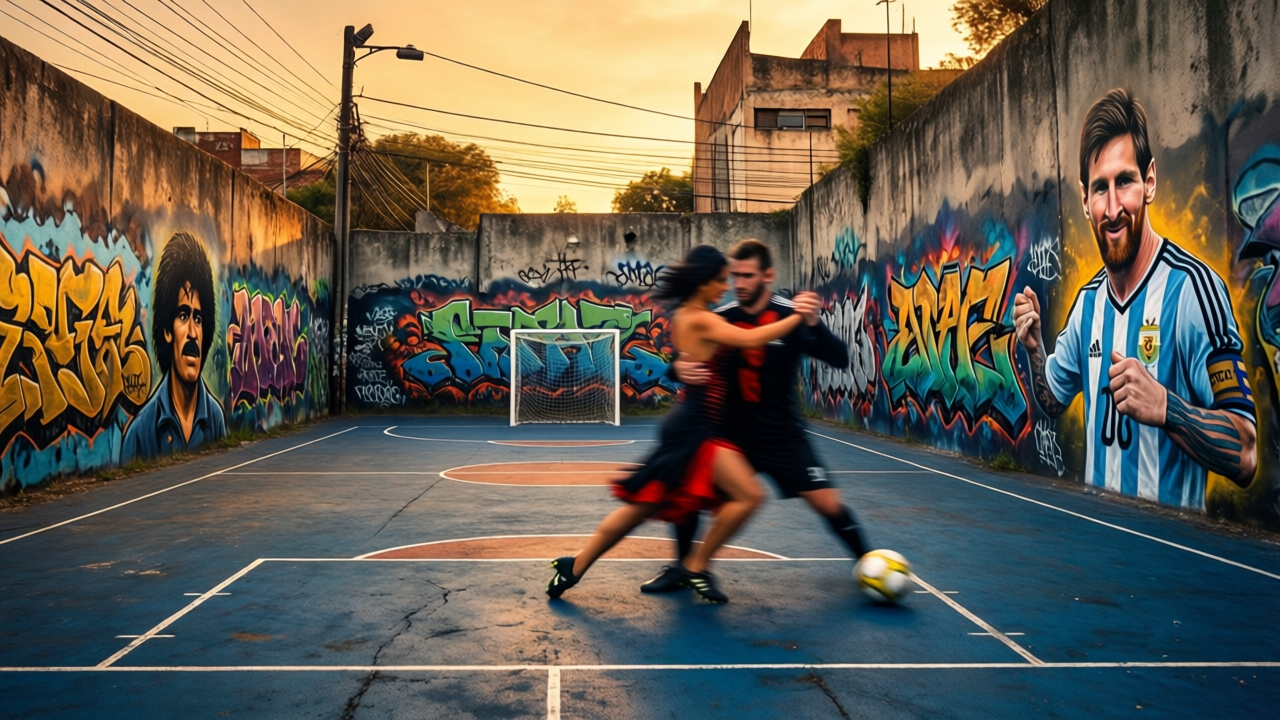
It’s a phrase that appears everywhere in Argentine football culture, from the barrio pitches of Buenos Aires to the commentary boxes of Madrid. It translates roughly as “our way” — but it means something far deeper than tactical preference. La Nuestra is the belief that Argentine football is not merely a system for winning matches, but a way of expressing national character.
It was born in the streets and patios of Argentina’s working-class neighbourhoods, where the ball bounced unpredictably off uneven ground and every game was a fight. The English brought football to Argentina in the late 19th century as an exercise in “manliness” — but the Argentines didn’t absorb it passively. They remade it in their own image: technical, yes, but with bite. Creative, absolutely, but always with teeth.
The concept of garra — claw, grip, tenacity — runs through this same cultural vein. It’s not just about trying hard. It’s about refusing to be moved. Uruguay has its Garra Charrúa, born from the psychology of a tiny nation perpetually fighting larger neighbours. Argentina has its own version, forged in a different fire: the belief that talent alone is not enough, and that every match is a personal statement.
This is why street football remains central to Argentine youth development. This is why the barra bravas — those notoriously violent supporter groups — exist at all. Football in Argentina isn’t a sport. It’s an identity argument you have with the world every time you put on the shirt.
The Historical Pattern: From Rattin to Paredes
The 2026 final brawl was not an isolated incident. It was the latest chapter in a pattern that stretches back decades.
In the 1966 World Cup quarter-final against England, Argentina’s captain Antonio Rattin was sent off after just 33 minutes — a decision so controversial that the referee had to be physically shielded by English players because the Argentine team threatened to walk off the pitch in protest. It was Maradona’s turn in 1986, when his “Hand of God” goal and his solo goal past five Englishmen represented two sides of the same coin: Argentina doesn’t play by your rules.
The 1990 final against West Germany was decided by a marginal penalty decision that Argentines still believe robbed them — another chapter in the narrative of injustice that fuels their approach. Diego Simeone’s career as a player was defined by aggression, red cards, and an almost pathological refusal to be intimidated. He carried that DNA into coaching, and Scaloni has inherited it wholesale.
Argentina’s all-time World Cup disciplinary record tells the story: 134 yellow cards, the most of any nation. Not because they’re bad players. Because they play a game where the boundary between competitive intensity and personal conflict is always one decision away from being crossed.
South American Bite vs European Precision
There’s a reason why South American football feels different to watch, even when the technical quality is similar. A comparison of European and South American styles reveals something fascinating: South Americans have more bite with their technical play. Europeans have more tactical knowledge with their technical execution.
It’s not that one is better than the other. It’s that they’re playing different games with the same ball.
European football — particularly the Spanish model that dominated this World Cup — is built on control. Possession as a weapon. Structure as a shield. Spain won 1-0 because they controlled the tempo, suffocated Argentina’s creativity in midfield, and waited for the mistake. They didn’t need to be aggressive because their system was aggressive enough.
Argentina, by contrast, has always played best when someone else controls the ball. Their game is reactive, explosive, built on moments rather than processes. When it works — as it did against Australia in the quarter-final, or against the Netherlands in 2022 — it’s beautiful. When it doesn’t, it collapses into chaos.
The Final: A Game of Two Argentinas
The 2026 final was Argentina at its most contradictory. For 120 minutes, they were the team that “plays best when facing adversity” — except Spain denied them the adversity they needed to thrive. Without a clear pathway to victory, without a moment of individual brilliance to fall back on, Argentina’s identity became their enemy.
They couldn’t control possession like Spain. They couldn’t outfight Spain in the physical battles — and when they tried, they lost those battles too. Paredes was sent off not for passion but for losing his temper against opponents who had already won. The throat-grabbing incident wasn’t an aberration; it was the logical endpoint of 120 minutes of frustration with no release valve.
And then, of course, there was the brawl after the whistle — full footage showing scenes even uglier than what television broadcast. Players being sent flying. Scaloni trying to calm his own team down. A World Cup final ending not with a handshake but with a fight.
Is This Fixable? Or Is It Who They Are?
The question that hangs over Argentine football after this World Cup is whether their approach is something that can be changed — or whether it’s simply who they are.
Scaloni’s Argentina won the 2022 World Cup and the Copa América using exactly this DNA. The aggression, the psychological warfare, the refusal to be intimidated — these were strengths in those tournaments. They turned Argentina into a team that opponents dreaded facing, not because of their technical superiority but because of what happened when the game got difficult.
But there’s always a cost. And as we saw at MetLife Stadium, the bill always comes due eventually.
The problem isn’t that Argentina plays with heart. The problem is that they’ve conflated heart with hostility. La Nuestra was supposed to be about expression — about finding beauty in the barrio pitch and bringing it onto the world stage. Somewhere along the way, it became an excuse for everything else.
The Messi Factor
And then there’s Messi. His final World Cup ended not with the coronation he deserved but with a tearful goodbye on a pitch that had descended into chaos around him. He carried Argentina through this tournament — leading the scoring, playing through pain, embodying everything La Nuestra was supposed to stand for. And his farewell was marred by players throwing punches and grabbing opponents by the throat.
It’s hard not to feel that Messi deserved better. Not just from the result, but from his teammates. From a system that asked him to carry them on their best days and couldn’t even hold it together on their worst.
The Aftermath: A Crossroads
The 2026 World Cup final will be remembered for many things: Spain’s clinical victory, the first-ever halftime show featuring Madonna, BTS, Shakira and Robbie Williams, Trump and Infantino getting booed onto the pitch. But in ten years’ time, when people talk about this tournament, I suspect they’ll remember what happened after the final whistle.
Because Argentina’s problem isn’t a tactical one. It’s an identity crisis disguised as a footballing philosophy. La Nuestra and garra are beautiful concepts — but they become dangerous when they’re used to justify behaviour that has no place in the modern game.
Spain won because they played football as a system. Argentina lost because they played it as a personality contest. And in 2026, systems beat personalities. Every time.
The question for Scaloni and the Argentine FA is whether they can build on their 2022 triumph without letting the same DNA that got them there drag them down again. Or whether Argentina will remain forever caught between who they are and who they need to be — a team that plays with fire but keeps burning itself in the process.
This is a draft blog post based on research into Argentina’s playing style, cultural identity, and disciplinary record at the 2026 World Cup.