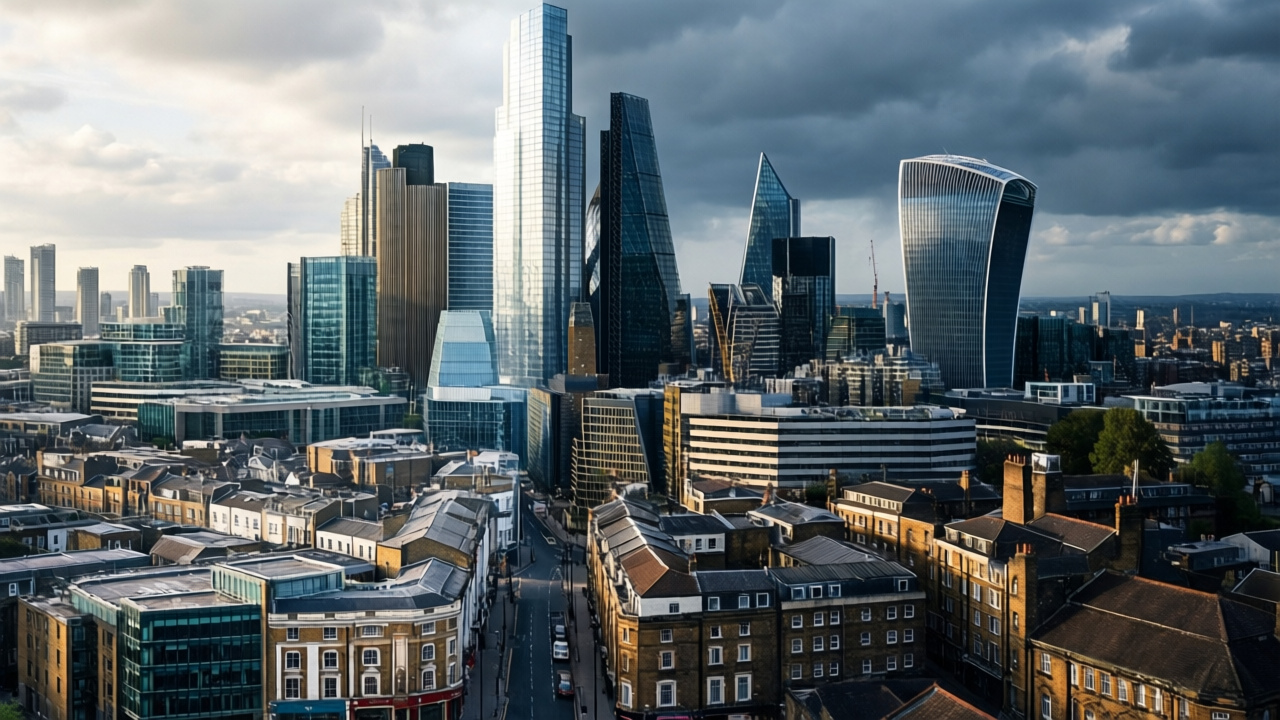
The UK economy is growing. By every measure that fits on a spreadsheet, it’s growing. And yet it feels like the country has been hollowed out from the inside.
In 2024, the UK economy expanded by 1.1%. Not exactly breathless growth, but growth nonetheless. The ONS reported steady GDP increases through into 2025, with quarterly growth holding above 0.3% for much of the year. The service sector — which now accounts for roughly 80% of UK economic output — has been the engine, buoyed by a resilient consumer sector and a booming financial services industry in the City. London alone contributes more to GDP than many European countries, and its financial sector has shown remarkable resilience in a post-Brexit world where so much was predicted to collapse.
Employment tells a similarly rosy tale. The UK labour market has absorbed workers at a clip that would make most Continental economies envious. In early 2025, unemployment sat around 4.2% — near historic lows. The claimant count fell, workplace vacancies remained elevated, and the participation rate inched upwards as more people entered (or re-entered) the workforce. The government can point to tens of thousands of new jobs created, sector by sector, and declare victory.
But here’s the thing about growth that doesn’t feel like growth: you can add to the pie while the slices everyone else gets stay the same size.
The paradox of the modern British economy isn’t that it’s shrinking. It’s that it’s growing in ways that leave most people feeling poorer. Real wages — wages adjusted for inflation — have been stuck in neutral for years. Even when nominal pay rises tick upwards, they haven’t kept pace with the cost of living in anything but the most technical sense. Between 2021 and 2024, inflation hit levels not seen since the 1970s, peaking above 11% in late 2022. By 2025, it had come down to the 2-3% range, but the damage was done. Households had absorbed billions of pounds in higher costs for energy, food, and housing — costs that, while they came down, never went back to where they were.
Energy bills, which were artificially suppressed by government support schemes during the height of the crisis, revealed their true market price when those schemes expired. The Energy Price Cap, set by Ofgem, has been reset repeatedly — from a peak of around £3,500 per year in 2022 down to roughly £1,600-£1,700 by 2025. That’s relief, yes, but it’s also a reminder of how far household energy costs had climbed from the £1,200-£1,300 range that felt normal a few years prior. And that’s just energy. Food inflation has been particularly brutal, with the cost of a typical supermarket shop remaining significantly higher than pre-pandemic levels.
Housing is the structural wound that never closes. The UK has a chronic housing shortage — millions of units below what’s needed — and the result is rents that have become the single largest expenditure for a growing proportion of households. Private rents in the UK rose by over 10% in 2023-2024 alone, the sharpest increases in a generation, as a combination of reduced supply (following changes to the right-to-buy scheme and planning restrictions), increased demand from a post-Brexit tightening of the labour market, and a surge in people who couldn’t afford to buy pushed more households into the rental sector. In London, the average monthly rent for a two-bedroom flat sits around £1,800-£2,000, and that’s not an anomaly — it’s the norm. In Manchester, Bristol, Birmingham, the figures are lower but following the same trajectory.
The UK is growing because the top of the economy is growing. London’s financial sector is thriving. The tech industry, despite the AI disruption narrative, continues to attract investment — the UK remains Europe’s second-largest market for tech investment after France, with hubs in London, Cambridge, and Edinburgh. The professional services sector — law, accounting, consulting — generates enormous GDP with relatively few employees, each of whom is highly paid.
But strip away the top 10% of earners and the top 10% of earners’ employers, and the UK looks like a country that’s been running on economic fumes for decades. Productivity — output per hour worked — has been essentially flat since 2008. The “productivity puzzle” is one of the most studied phenomena in modern British economics. Other advanced economies recovered their pre-2008 productivity trends within a few years of the financial crisis. The UK didn’t. And it hasn’t since. The ONS estimates that UK productivity is roughly 20% below what it would have been if pre-crisis trends had continued. That’s not a gap that growth papers over. That’s a structural deficit.
Why? The answers are depressingly mundane. Underinvestment in infrastructure, education, and R&D. A planning system that makes it nearly impossible to build new homes, offices, or factories at scale. A regional divide where the South East and London pull away from the rest of the country at a rate that “levelling up” rhetoric can’t touch. The UK spends roughly 1.7% of GDP on R&D — below the EU average of 2.2% and well below the OECD target of 3%. Compare that to South Korea (4.8%), Israel (5.3%), or even Germany (3.1%), and you can see where the growth disconnect originates. The UK economy adds value in the short term — financial services, professional services, consumer spending — but it doesn’t invest in the things that create long-term productivity growth.
The service economy that drives UK GDP is also its vulnerability. Services are inherently harder to automate, harder to scale, and harder to export than manufactured goods. The UK’s manufacturing sector has shrunk from roughly 25% of GDP in the 1970s to around 10% today. The loss isn’t just about factory jobs — it’s about the innovation ecosystem that manufacturing creates. Manufacturing R&D tends to have higher spillover effects than service R&D. Manufacturing creates supply chains, supplier clusters, and skills ecosystems that benefit the wider economy. When you hollow out manufacturing, you don’t just lose the factories — you lose the innovation pipeline that fed them.
The UK’s trade balance reflects this structural weakness. The country has run a persistent current account deficit for decades, importing more goods than it exports and relying on financial services and foreign investment to balance the books. In 2024, the UK’s goods trade deficit stood at roughly £100 billion, offset partially by a surplus in services. This isn’t sustainable as a model. It means the UK economy is fundamentally dependent on foreigners being willing to lend it money — to invest in UK assets — at levels that can cover the gap between what it produces and what it consumes. When global financial conditions tighten, when foreign investors lose confidence, or when geopolitical uncertainty rises, that model becomes fragile.
Brexit compounded these structural weaknesses without fixing any of them. The post-Brexit trade regime created new barriers between the UK and its largest trading partner (the EU), reduced trade volumes by an estimated 15-20%, and introduced friction that has hit small and medium-sized businesses particularly hard. The government’s promise of a global trading empire has yielded a handful of deals — with Australia, New Zealand, and Japan — whose combined impact on UK GDP is measured in fractions of a percentage point. The loss of frictionless trade with the EU, where the UK had decades of integrated supply chains, has not been compensated by new trade relationships anywhere near as significant.
None of this is to say the UK economy is a disaster. It isn’t. The numbers genuinely are better than they were two years ago. The service sector is resilient. Labour markets are tight. Consumer spending, while stretched, hasn’t collapsed. The UK has avoided the recession that many predicted in 2023-2024.
But the growth that exists is of a particular kind. It’s growth at the top, growth in services, growth that adds to GDP while leaving productivity, investment, and living standards largely where they were. It’s the economic equivalent of rearranging the furniture in a room that’s slowly falling apart.
The real question isn’t whether the UK economy is growing. It’s whether the kind of growth it’s having is the kind that makes people’s lives better. And on that score, the numbers tell a different story from the ones the Treasury likes to cite.