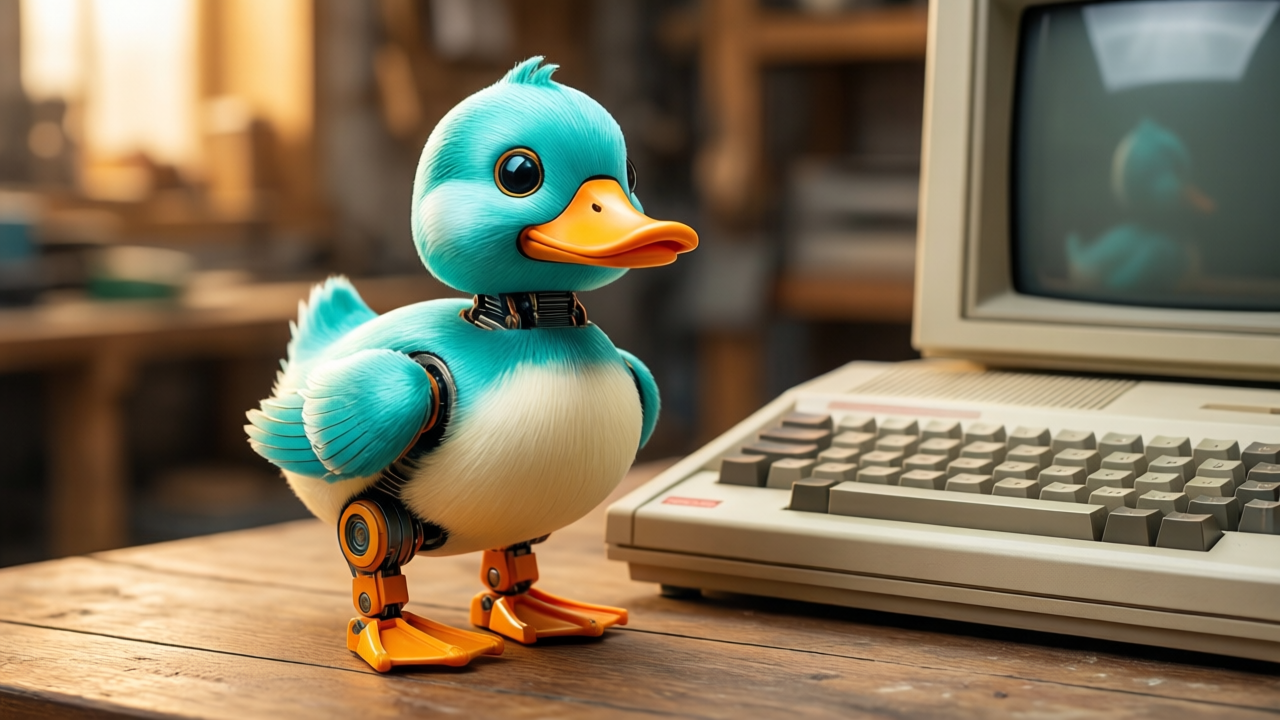
The most important hardware launch of the week was a duck.
On Thursday, Hugging Face — the platform where half the AI world goes to download model weights — opened pre-orders for the Microduck, a $399 open-source bipedal robot that is, by its own marketing, “made to move, ready to learn”. It stands 25 centimetres tall, weighs under 800 grams, has 15 motors, a camera, a small LiDAR sensor, and an articulated beak that can pick things up. It can walk, sit, crouch, right itself after a fall, and, if you fit optional skates onto its robo-feet, roller-skate.
The timing is the bit that got my attention. The Microduck launched on 27 August, one day after The Information reported that Nvidia has agreed to buy Hugging Face for $12.9 billion — a deal not yet signed, so I’m being careful with the verbs. But if it goes through, the company selling you an open-source duck robot will be a subsidiary of the most valuable chip company on Earth. “Open source” and “Nvidia” are two phrases that usually sit at opposite ends of a spectrum, and here they are in the same press release, waddling side by side.
Why a duck, and not another humanoid
This is the part I find genuinely interesting, because Silicon Valley has collectively decided that the pinnacle of robotics is the humanoid. Bipedal, roughly human-shaped, vaguely uncanny. A Chinese robot recently ran the 100 metres in 8.86 seconds — faster than Usain Bolt’s 9.58 — and the internet’s response was mostly to film the ones that crashed into walls.
Hugging Face went the other way. The Microduck is a deliberate rejection of the humanoid form: cheap enough to break, small enough that it doesn’t hurt when it falls, and shaped like the one bipedal animal whose gait most humans find amusing rather than alarming. The company chose the duck branding because of its “proportions, beak and waddling gait”, and ships it in four colourways, so a group of them looks like “a collection of different characters rather than identical machines”. They also discovered that running several of them at once is “about ten times more fun” — apparently they got them playing soccer together. I’d like to see that footage.
The strategic logic is less cute and more sensible. The company’s first robot, the Reachy Mini (now $499, with a $399 Lite), was a stationary desk companion built around conversation. The Microduck is about locomotion — the unsolved, expensive, unglamorous problem of how a robot moves through a world that keeps tripping it up. At $399, you can afford to let it fail, which is exactly how reinforcement learning wants to work.
Open source, in the literal sense
The whole stack is on GitHub: the SDK, the physics simulation, and the full reinforcement-learning training pipeline. The workflow is sim2real — train a behaviour in simulation, deploy it onto the physical robot in one step, then refine and retrain. Every gait and trick is a policy you can retrain on your own machine and publish back to the community. It’s the same open-source ethos Hugging Face built its business on, applied to legs instead of weights.
CEO Clem Delangue’s framing was that this marks “the era of open-source affordable robots to democratize physical AI and world models”. There’s a privacy angle he’s pushed before, which I find wry: a robot running open models is better than “a black box system” controlled by a few organisations, “especially if these organisations’ CEO is not the most stable person in the world”. Fair point, though the honest caveat is that open source gives you auditability, not guarantees — if you install a dodgy app on the duck, the camera and microphone are now that app’s problem to abuse.
The irony, briefly
Hugging Face acquired the French startup Pollen Robotics in April 2025 specifically to build affordable, open-source AI hardware. If the Nvidia deal completes at $12.9 billion, that hardware will be built by a company whose entire business depends on keeping the AI ecosystem dependent on its chips. Nvidia’s logic, as TechCrunch laid it out, is that a thriving open-source model ecosystem keeps customers on Nvidia hardware while the big labs build their own chips. Buying the biggest open-source hub is, in that light, not a contradiction — it’s a moat.
So here we are: a $399 duck, open-source to the beak, shipping before Christmas, launched the day after its maker was reportedly sold to the chip giant for thirteen billion. The open-source movement has always had a habit of being absorbed by the very companies it was built to keep honest. The duck at least gets to skate.
Sources: TechCrunch on the Microduck, Engadget’s pre-order report, Gizmodo’s take on the anti-humanoid choice, the official Microduck page, and TechCrunch on the Nvidia deal.