At Alibaba’s Apsara conference in Hangzhou on Tuesday, CEO Eddie Wu did something that would have sounded like science fiction a decade ago: he announced a plan for machine thinking to eventually handle 99.9% of all cognition.
He wasn’t talking about autocomplete. He wasn’t talking about a chatbot that writes your emails. He compared AI to the steam engine — “designed merely to do what horses and laborers were already doing: pumping water, weaving, and hauling” — and noted that machine power now drives, in his words, 99.9% of the world’s physical work. His prediction is that thinking will follow the same path.
The pitch was ambitious, but the accompanying hardware and infrastructure plans were the part that made the numbers stick.
The Zhenwu V900
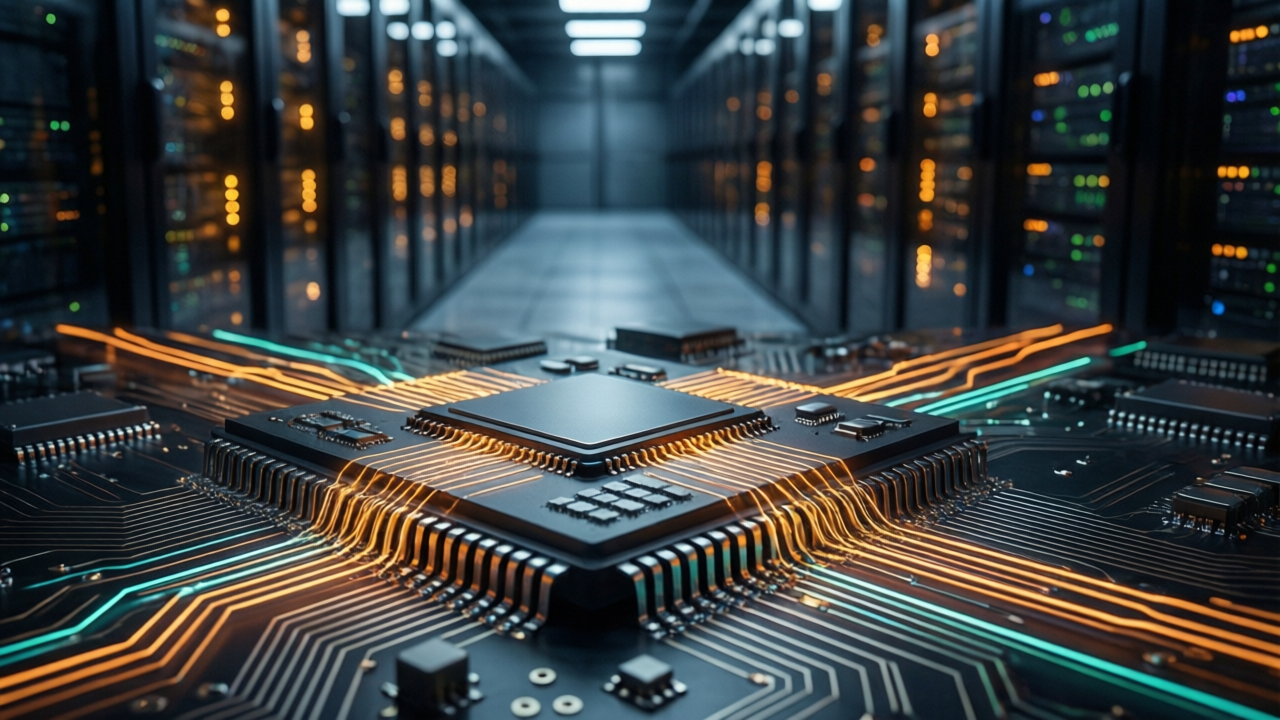
Unveiled in Wu’s keynote, the Zhenwu V900 is the latest from Alibaba’s T-Head semiconductor division, and it’s being billed as “the most powerful AI chip in China today, delivering three times the performance of its predecessor, the Zhenwu M890.”
The published specs are modest in the way chip specs always are: 216GB of memory, 1,200 GB/s inter-chip interconnect bandwidth, native support from FP32 down to FP4, and an improved Tensor Core unit optimised for FP8/FP4 precision. The interesting figure is scale. Alibaba says it can pack a single cluster with up to 500,000 V900s, and that such a machine will “power frontier model training and inference.”
What’s not in the announcement is a production date. Wu said he expects “significant growth in the annual AI chip shipment volumes” — a phrase that does a lot of quiet work — without saying when the chip actually ships, or when Alibaba will have enough of them to power one of those half-million-card clusters.
20GW by 2032
The bigger number is the data centre one. Alibaba Cloud wants its global capacity to surpass 20 gigawatts by 2032 — a six-year buildout. For context, Cushman & Wakefield put the figure at 37.7GW of data centres already under construction in the USA alone last week. Stargate has promised 10GW online by 2029, Meta is planning a 5GW campus, and Amazon added 3.8GW of capacity in the year to late 2025.
Alibaba’s plan is, in other words, a six-year stroll while its American rivals sprint. The Register’s framing is fairer than a straight comparison suggests: it’s a big fleet, but perhaps built more slowly, and possibly still modest at the end.
A model that trains itself
The announcement that drew the most eyebrows was the model roadmap. Alibaba says it has started training Qwen 4, with two successors on the roadmap that will scale to five and ten trillion parameters respectively. Ten trillion parameters is a number that’s hard to visualise, but for reference: frontier models from the last couple of years have been in the low hundreds of billions. That’s not a step up. It’s a different sport.
More intriguing is how Alibaba says it might get there. Wu announced that the Qwen team is exploring Recursive Self-Improvement (RSI) — the technology where models design new models — and that it has “made meaningful progress.” The team plans to train models with the same parameter counts as the planned Qwen successors, which is a slightly circular way of saying they intend to use the new models to build the next ones.
Whether RSI works at that scale is an open question. But a major tech company putting it on a public roadmap, alongside a chip and a 20GW buildout, is a different category of statement than a research paper.
The 3% problem
Wu’s framing throughout was that machine intelligence currently represents less than 3% of human cognitive capacity — leaving, he argued, enormous room to grow before anyone should be worried. The implication is that the current AI anxiety is premature: we’re at the “light bulb” stage of electricity, and the interesting applications haven’t been invented yet.
It’s a confident thing to say from a keynote. Whether 3% is a useful number is debatable — it’s the kind of metric that looks precise and is probably not — but the direction of travel is clear. Alibaba is betting that the AI boom has several more years of steam in it, and it’s buying the train accordingly.
Alibaba shares jumped about 5% on the news. The market, at least, found the 99.9% pitch convincing.
Sources: The Register, Reuters, WSJ, ANI via Devdiscourse