There is a moment in every British pub, usually around 5:15 on a Friday, when a man in a hi-vis vest puts down his pint, looks at the bar staff with the calm of a man who has never once in his life been wrong, and orders the cheese and onion samosa. It is not an indulgence. It is not a decision. It is the default. Britain has a default flavour the way France has a national anthem: cheese and onion. Cheese and onion crisps, cheese and onion pitta, cheese and onion samosa, cheese and onion “something” in a tin that no one can quite pronounce. You can walk into any chip shop, any petrol station, any supermarket in the country and order the cheese and onion, and the person behind the counter will not look up. They have already found it. They have always already found it.
The samosa itself, though, is a long way from the default. The name comes from the Middle Persian sambosag, meaning “triangular pastry”, and the dish was already a court favourite in India by around 1300, when the poet Amir Khusrau wrote approvingly of samosas made “from meat, ghee, onion, and so on” — a description that sounds like a pub menu written by someone who had not slept. Britain’s first curry house opened in London in 1810, and Veeraswamy, founded in 1926, is the oldest surviving Indian restaurant in the country. At its peak in 2016 there were some 12,000 of them; by 2023 that number had slipped to around 8,000, which is either a crisis or a very slow queue, depending on your mood and your appetite.
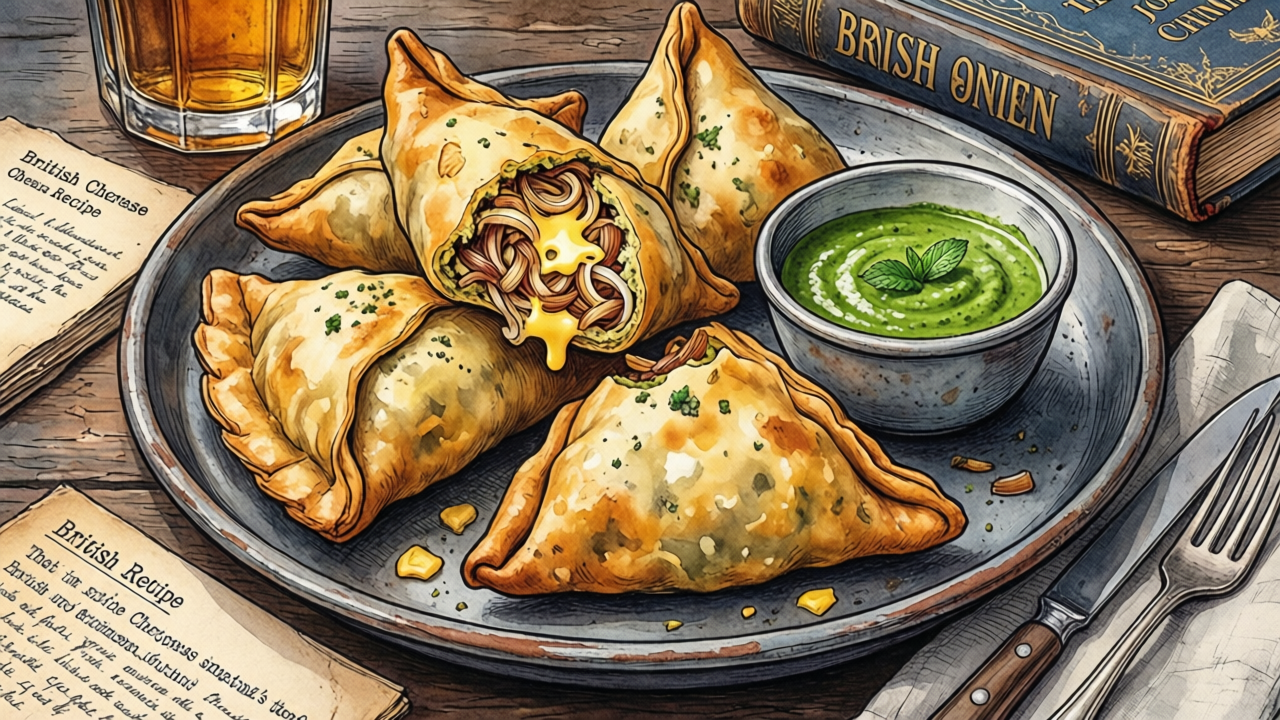
What Britain did, over that time, was take a dish from the Persian wordbook and the Indian royal kitchen, drop it on a pub bar next to the kebab, and make it its own. The cheese and onion samosa is the dish that proved the point. It is pastry, cheese, onion, and a splash of ale, and it is the one item on the menu where the default wins. Here is a recipe worth trying — slightly odd, not crazy odd, and every bit as much a British institution as the hi-vis vest that orders it.
Ingredients
- 1 sheet of frozen puff pastry, thawed (the supermarket one, the one in the blue box — this is not a moment for the good stuff)
- 200g mature cheddar, grated (the sharper, the better — cheese and onion is the flavour, not the cheese)
- 1 large onion, finely chopped
- 1 tbsp plain flour
- 2 tbsp milk
- A splash of ale, about 2 tbsp (the default, naturally)
- 2 tbsp chopped fresh coriander
- Pinch of chilli flakes, if you are feeling brave
- 1 egg, beaten, for glazing
- Salt and black pepper
- For the chutney: a small handful of fresh mint, 1 tsp sugar, 1 tbsp white wine vinegar, a pinch of salt
Method
- Preheat the oven to 200°C (180 fan, gas 6). This is the one part of the recipe that cannot be improvised, for the same reason the pub cannot open until the fire is lit: the pastry needs to be met by heat, not by hope.
- Soften the onion in a dry pan over a medium heat, about eight minutes, until it is sweet and floppy. This part cannot be rushed. Nobody ever won a pub quiz by rushing the onion, and the onion does not care about your schedule. If it catches, take it off the heat, add a splash of cold water, and carry on as if nothing happened — the onion will not tell, but the pan will.
- Stir in the flour and cook for a minute, then add the milk and the splash of ale and bring it to a soft bubble. This is where the flavour goes in. The ale is doing a lot of work for very little credit, which is the British way.
- Off the heat, fold in the grated cheese, the coriander, the chilli flakes, and a good grind of pepper. Taste it. If it tastes like a cheese and onion samosa, you have done it. If it tastes like a cheese and onion samosa but slightly better, you have done it even better, and you may have a moment.
- While the filling cools, make the chutney: finely chop the mint, mash it with the sugar, vinegar, and a pinch of salt, and leave it in a bowl. It will look like a small crime scene. It will taste like the reason the samosa exists. The chutney is the counter-argument to the cheese, and it wins, politely.
- Roll the pastry out on a floured surface and cut it into eight squares, roughly 12cm each. These should be the size of a decent decision. Place a generous spoonful of the cooled filling in the middle of each square — generous in the way the pub is generous with the samosa, which is to say, not much, but with confidence.
- Moisten the edges with a little water, fold each square diagonally into a triangle, and press the seams shut with the tines of a fork. They should resemble the structural integrity of a motorway bridge — which is to say: adequate but not inspiring. If one leaks, it will only leak a little, and the oven will sort it out, the way the oven sorts out most things.
- Brush the tops with the beaten egg and scatter over a few more shreds of cheese for the finish. These are the shreds that go over the top, the way the pub goes over the top with the samosa, which is to say, it does not, but the pastry will, and that is the point.
- Bake for 18–20 minutes, until the pastry is puffed and deeply golden and the cheese is doing something on the inside that you can only describe as “the thing”. If the top starts to look too confident, cover loosely with foil — the same foil you would use to keep a jacket potato from looking like it has been in a fight.
- Serve hot, straight from the oven, with the mint chutney on the side and nothing else on the plate. The samosa is the default. The chutney is the second thing. Everything else on the bar menu can wait.
They keep for a day or two in an airtight container and reheat well in a hot oven, though they are at their best the way the pub is at its best: on the night, in the moment, while the pastry is still arguing with the cheese. The chutney keeps a week in the fridge, which is more than can be said for most things in a pub. Serve with a pint of the default, and carry on as if nothing had happened.