There was a time when every British shop that sold anything that had been alive had a counter at the back for the potted things: the tins and crocks of meat, each one sealed under a film of its own clarified fat, cold as a church hall and smelling faintly of the shop. The label said Pork. You turned it over, you pressed the side of it with a knuckle, and if it gave you a slow, confident wobble — the good kind, the wobble of a thing that had set itself properly — you knew you’d bought the right tin. If it jiggled like it had a personal problem, you put it back and looked for a different shelf. That wobble test is how generations of housewives judged a potted meat before they’d so much as opened it.
The practice was so entrenched that “potted meat” became a byword for exactly the sort of food other people might find slightly alarming, and the grocer’s counter was where Britain went to feel a little more civilised than it actually was. By the 1950s the tin had lost the war to the supermarket and the prepackaged, but the wobble test hasn’t gone away — it’s just moved indoors, into a cold, quiet pan, and it’s the single best quality check in the kitchen. This is how to make a proper jellied pork, and how to know, by the wobble, that it’s done.
Because the wobble test is the oldest quality check in British cooking, and it works just as well on your own pan of jellied pork as it did on the tin in the counter. The only skill required is the ability to wait, which is the one skill the potted-meat people had in abundance.
Ingredients
- 1 lb (450 g) pork knuckle or pork shin, tied — the knuckle is the classic, but any good shin will do
- 3 large onions, halved
- 1 large carrot, roughly chopped
- 1 celery stick, roughly chopped
- 2 bay leaves
- 6 black peppercorns, crushed
- 1 small bouquet of herbs (thyme and parsley, tied with string if you have any, a twist-tie otherwise)
- 1.5 litres water (enough to just cover the meat)
- Salt — about 2 teaspoons to start, to taste at the end
- A squeeze of lemon juice (optional, but it helps the jelly set clear)
No stock cubes, no gelatine, no “available from good health food shops.” The set comes from the collagen in the meat, the same way a good gravy thickens itself. If you don’t fancy a knuckle, a good pork leg end works just as well — it just takes a little longer to be patient with.
Method
- Set the pork in a large pot and cover it with the cold water. Cold, not hot — you want to coax the collagen out of the meat slowly, not shock it into a fight. This is the long game. The wobble you’re chasing at the end is earned here, in the quiet, over a lot of minutes.
- Bring it on, just, to a bare simmer. You’re looking for the occasional lazy bubble, not a proper boil. The moment it starts frothing hard, drop the heat — a hard-boiling pan turns the water to the colour of dishwater and the meat to the colour of regret. Gentler than the 2 pm, more patient than the 4 pm.
- Lower in the onions, the carrot, the celery, the peppercorns and the bunch of herbs. Let it simmer, lid half on, for about three hours. The liquid should just kiss the meat, not swallow it — you’re making stock, not a bath.
- After roughly an hour, skim off the grey, unlovely foam that floats up. It’s the unlovely stuff the pot is trying to get rid of. Nobody ever won a wobble test by skipping the skimming.
- Take the meat out and set it aside to cool, just enough to handle. The liquid is now the thing that matters: it should be a proper, clear, slightly golden stock. If it’s cloudy and grey, don’t panic — that’s the fat, and it separates as it cools. It’s the wobble’s future, still in disguise.
- While the meat cools, skim the surface of the stock once it’s cold. A cold pan has sorted itself out for you — a neat cap of fat on top, clear stock underneath. Lift the fat off, leave the stock. This is the part of the recipe that requires no skill and a certain amount of faith, like standing at the bus stop and knowing the bus is coming even though you can’t see it yet.
- Shred or slice the meat — pull the flesh from the bone, keep the pieces substantial. Set it back in the pot, in a single even layer, like you’re seating guests for dinner and you’ve decided which side of the room is better. Add the salt now, and the squeeze of lemon if you have it.
- Pour the clear, cold stock over the meat, just enough to cover it, and get the lot into the fridge. Then, and this is the important part, leave it be. The wobble test can’t be rushed. The only thing you can do to a jelly is wait, the way you’d wait for a decision — except the decision is a lot more likely to turn out in your favour.
- After four to six hours in the fridge, the wobble test. Press the top of the set jelly, gently, with a fingertip or a spoon. If it springs back with a slow, satisfied bounce — that’s the good wobble, the wobble of a thing that knows what it is — it’s set. If it quivers like it’s received some disappointing feedback, it needs another hour or so. This part cannot be rushed. Nobody ever won a wobble test by rushing.
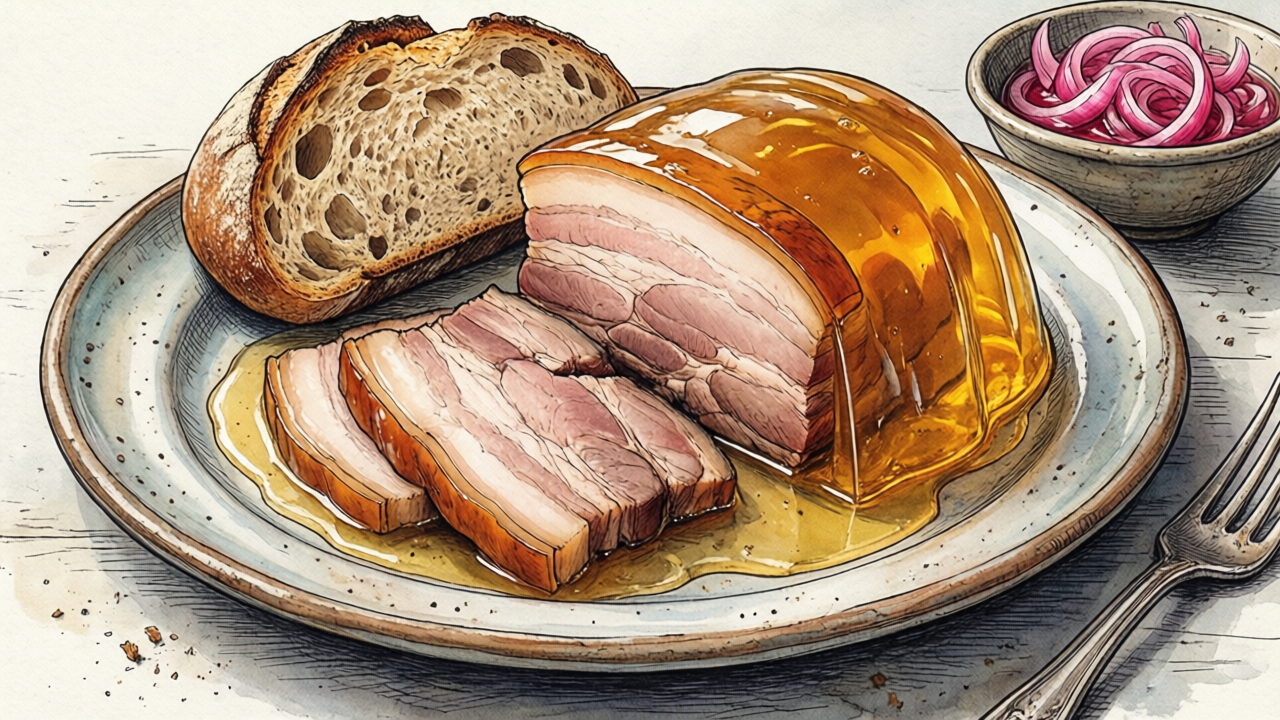
- Carve it from the pan in neat slices, or, if you’re doing this properly and for an occasion, turn the lot out onto a plate and let it stand in the shape of the pan, a proper wobbly dome of a thing. Serve it cold with crusty bread and whatever’s in the pickle jar. The best company is the one that shows up to the wobble test already dressed for it.
The veggie version, if the pork isn’t your thing: roast a good leg of courgette or a chunky piece of aubergine until it’s gone soft and sweet, then follow the same method with vegetable stock instead. The set still comes from the collagen, which, in the vegetable case, means you’d add a little gelatine or a well-cooked, well-reduced vegetable stock to do the wobble’s job for you. Everything else is unchanged, and the wobble test applies with the same impartiality.
It keeps happily for three or four days in the fridge, which is more than can be said for most British institutions. And if the wobble test goes against you, remember: the wobble test has been wrong before, and it has a way of righting itself by the morning.