There was a time when a British breakfast had a specific smell, and it wasn’t toast or bacon — it was a kipper going grey at the edges in the pan. Samuel Pepys was doing it on 28 February 1660: “had some red herrings to our breakfast, while my boot-heel was a-mending.” Which tells us two things. One: kippers were breakfast furniture. Two: Pepys had his shoe repaired at the breakfast table, a man who had never once considered that a bad idea.
The word itself is a red herring. Most etymologists trace “kipper” to the Old English cypera — copper — for the colour of the cured fish; others to the kip, the little beak male salmon grow during the breeding season, which is to say the fish’s name might come from another fish’s moustache. The red herring is genuinely ancient: a mid-thirteenth-century poem has a man refusing to eat any fish “But heryng red”. And by the First World War the red was being faked — curers dyed their kippers with a coal-tar colour called brown FK, the FK standing for “for kippers”, which is the most British abbreviation since the A&E. Today the dye is annatto, a natural one. The lie went organic.
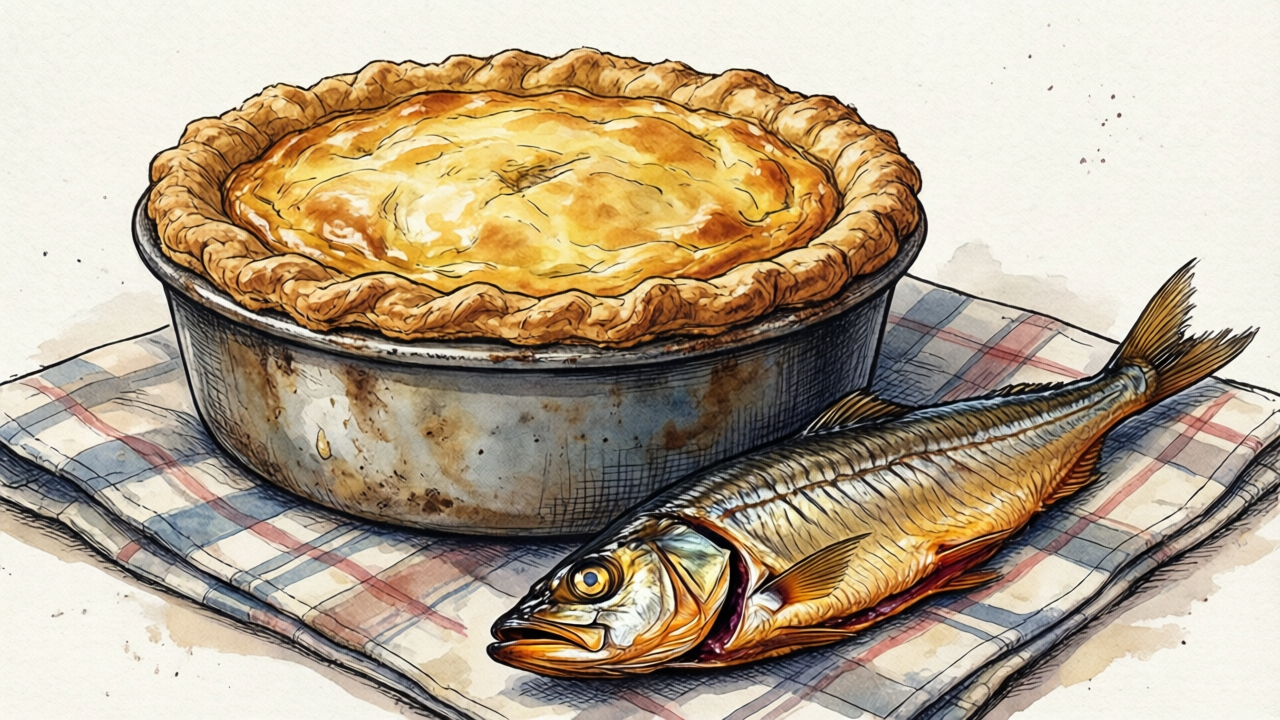
The kipper is a herring butterflied from tail to head, salted and cold-smoked over oak. Leave the same fish whole and cold-smoked and it’s a bloater; whole and hot-smoked and it’s a buckling. Three names for one fish, like three suspects with the same alibi. And the kipper breakfast — once a working-class supper staple across the country — has mostly packed up and gone, reduced to a gleaming orange row on the fish counter, waiting for someone to care.
Which is why the kipper deserves a pie. A red herring’s whole job is to hide in plain sight, and the kipper is the only red herring in Britain that has never once lied to anybody. The proper tribute is to hide it inside something else entirely: under mash, in the open, in front of everyone.
Ingredients
- 2 large kippers (if your counter is out, a thick smoked haddock fillet does the same job — the pie doesn’t need to know)
- 600ml whole milk, for poaching
- 900g floury potatoes, peeled and chopped (Maris Piper; any floury type)
- 75g butter, plus a few extra dots for the top
- 2 tbsp plain flour
- 1 tbsp English mustard
- 100g mature cheddar, grated
- 3 eggs, hard-boiled and chopped
- A small bunch of parsley, chopped
- Grated nutmeg; black pepper
- No added salt — the kipper has already done the shouting
Method
- Lay the kippers in a wide pan, cover with the milk, and bring it to the barest simmer. Eight to ten minutes, no longer — overcooked kipper turns to sawdust with opinions. The milk is the alibi: it takes the smoke into itself, and you will use it as evidence later. Do not pour it down the sink. Detectives never destroy evidence.
- Lift the fish out, keep the milk, and flake the flesh off the skin, checking for bones as you go with the suspicion of a detective who trusts nobody. Use your fingers, not a fork — bones hide under flakes like a witness under a pseudonym.
- Meanwhile, boil the eggs: nine to ten minutes from cold, then cool and chop. Hard-boiled, not soft. This pie has enough plot twists already.
- Boil the potatoes, drain them, put the pan back on the heat for a minute to steam off the water, then mash with the butter and a good splash of the kipper milk — never plain milk from the carton. A mash with its own backstory is a mash whose alibi doesn’t hold.
- Make the sauce: melt 50g butter, stir in the flour, cook a minute or two, then whisk in the kipper milk a ladle at a time until it thickens like a reluctant confession. Off the heat: mustard, a grating of nutmeg, black pepper, most of the cheddar, and most of the parsley.
- Assemble. Flaked kipper and chopped egg into an oven dish, sauce over the top, mash spread across it, then a fork to give the surface some ridges — the ridges are where the cheese will hide. The mash is the disguise. The kipper is still in there. That is the entire trick.
- Scatter the remaining cheddar and a few butter dots over the mash. Bake at 200°C for 25 to 30 minutes, until the top has blistered gold like a suspect under studio lighting.
- Give it five minutes out of the oven before serving. Everyone deserves five minutes before the verdict.
Serves four people who suspect nothing. The veggie variant, if you must interrogate the fish out of it: swap the kipper for 400g of thickly sliced, pan-fried portobello plus a sheet of crumbled nori in the poaching milk — the pie keeps its smoke, changes its witness statement. Leftovers keep two days in the fridge, which is longer than most misdirections hold up.
Every good mystery hides the answer in plain sight. This one hides it under mash — and unlike every other red herring in the history of the genre, this one turns out to have been telling the truth the whole time.