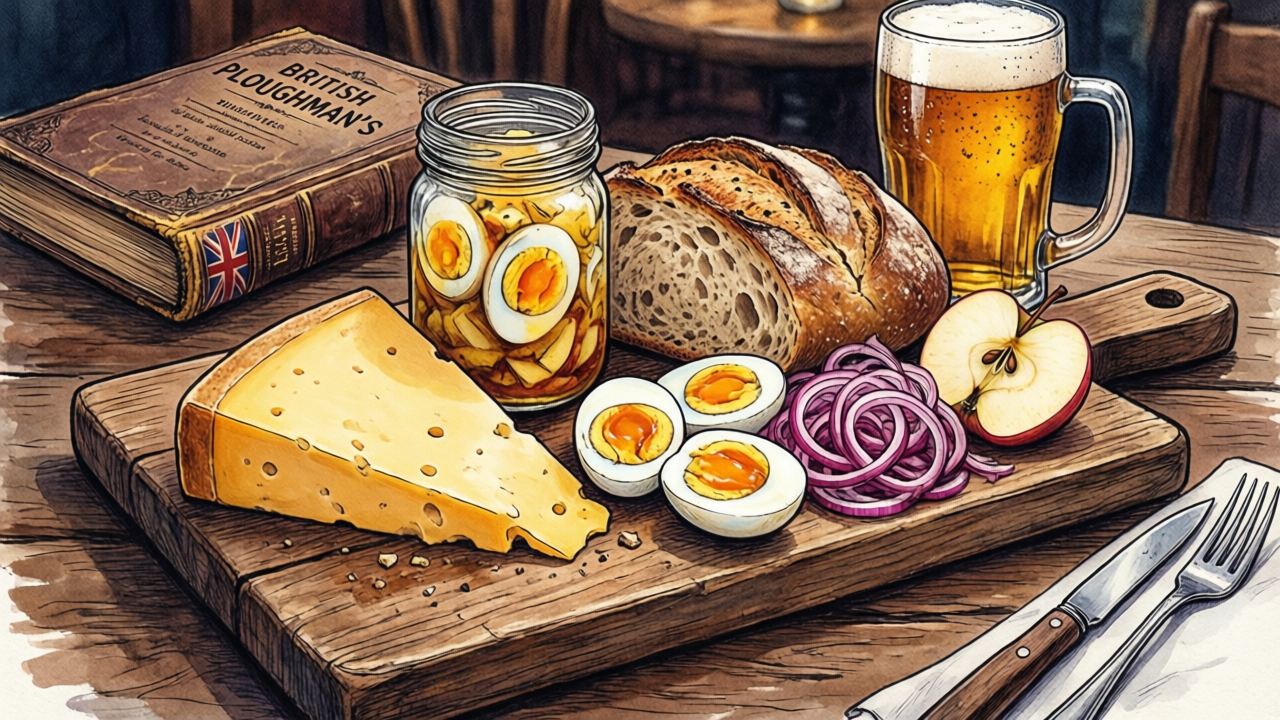
Picture the counter. A jar of pickled eggs the colour of golf balls, floating in vinegar, older than most of the regulars. A wedge of cheddar under a glass dome, sweating politely. A crusty bloomer with a floury shoulder. A dish of silver-skin onions gleaming like sequins at a reunion. Nobody ordered this plate into existence — it simply appeared, the way traditions do, looking as though it has been there since the plough was new.
Except this tradition has a birth certificate, and the birth certificate is a marketing document. The phrase “ploughman’s luncheon” appears exactly once in 1837, in John Lockhart’s memoir of Walter Scott, and then goes quiet for over a century. What woke it up was the Cheese Bureau — a marketing body affiliated with the J. Walter Thompson advertising agency — which spent the 1950s promoting bread, cheese and beer in pubs to shift more cheese now that rationing had ended. The Brewers’ Society’s own Monthly Bulletin of July 1956 said the Bureau hoped to “effect a remarriage” between cheese and beer. The Milk Marketing Board then ran the meal nationally through the 1960s, and by the 1970s caterers had embraced it for reasons no press release ever mentioned: no cooking, no meat, excellent margins.
So the ploughman’s lunch is the most successful invented tradition in British food — a campaign so good that an entire country grew up believing it had been eating this plate for centuries. The raw materials are genuinely old; Trollope had a character rhapsodise about the rural labourer on bread, cheese and an onion in a ditch-side, and Devon farmworkers were still doing it in the 1870s, with “very washy and sour” cider. The branding is new. Ian McEwan wrote the screenplay for a 1983 film called The Ploughman’s Lunch that is literally about the way countries rewrite their own history to suit the present. The film is about the menu.
The only appropriate response to a fabricated tradition, then, is to over-compensate with real cooking. Here is the plate built entirely from scratch — pickled eggs, soda bread, onion chutney — a marketing campaign you can run in your own kitchen, complete with the confidence to call it tradition afterwards.
Ingredients
- For the pickled eggs: 12 eggs (a week old is ideal), 500ml malt vinegar, 2 tbsp sugar, 1 tbsp salt, 1 tsp mustard seeds, 1 tsp black peppercorns, 1 onion, sliced
- For the soda bread: 350g self-raising flour, 1 tsp bicarbonate of soda, 1 tsp salt, 400ml buttermilk (or 400ml milk with 2 tbsp lemon juice, left five minutes)
- For the onion chutney: 3 large red onions, sliced, 25g butter, 2 tbsp soft brown sugar, 100ml malt vinegar, 50g raisins, 1 tsp mustard powder
- For the board: a proper wedge of mature cheddar, butter, a crisp apple, extra pickled onions or silver skins
The whole plate is vegetarian as it stands — the only animal present is the one that was pickled. A slice of ham on the side is historically optional and culinarily defensible.
Method
- Start with the eggs, because the eggs start with you: they want two weeks in a jar and they will not be rushed. Put the eggs in a pan of cold water, bring to the boil, then nine minutes exactly, then cold water until you can handle them. Harry would have done this the night before. Harry is right.
- Peel them under a thin trickle of running water. A very fresh egg fights back; a week-old egg peels like it’s given up. This is food science, and also very British.
- Make the brine: vinegar, sugar, salt, mustard seeds, peppercorns and the sliced onion in a pan, brought to the boil, then poured over the eggs in a clean jar. Seal it and leave it two weeks. The jar is the most patient appliance in the house — it asks nothing of you but time, and it will outlast every slogan on the chalkboard.
- Soda bread, day of: flour, bicarbonate of soda and salt in a bowl; buttermilk in; mix with a knife for thirty seconds, no longer. Do not knead it. Kneading soda bread is like focus-grouping a slogan — technically possible, spiritually wrong.
- Turn it out, pat it into a round about 4cm thick, and cut a deep cross in the top. The cross is traditionally there so the devil can get out, or so the heat can get in, depending on which pub you’re in. Either way every soda bread in the country has one, which makes it a tradition — admittedly only about 180 years old, so barely out of its campaign period.
- Bake at 200°C (180°C fan) for 20–25 minutes, until it sounds hollow when you tap the base. Tap it like you’re tapping a pub table to see if it’s real wood. Hollow means done.
- Chutney: melt the butter, soften the red onions on a low heat for ten minutes, then add sugar, vinegar, raisins and mustard powder and simmer 30–40 minutes, until jammy and holding a clean line when you drag a spoon across the pan. Stir occasionally, like a slogan refresh.
- The cheese is the one component you cannot improve, only damage: take the wedge out of the fridge an hour before serving. Cold cheddar tastes of nothing but the fridge, and the fridge is a location, not a flavour.
- Build the board: bread, cheese, a pickled egg, a spoon of chutney, sliced apple, butter — and a pint if you’re being historically accurate. The Brewers’ Society called the cheese-and-beer pairing a remarriage. You are officiating.
- Serve, and if anyone asks how long the tradition has been going, say 1837, then change the subject. The eggs keep for months in the fridge; the chutney for weeks; the bread is best the day it’s made, which makes it the only perishable part of the whole operation.
Two weeks from now you’ll open the jar, lay out the board, and the entire fabricated tradition will hold together — which is more than can be said for most things invented by a marketing department, and proof that a story told confidently enough eventually gets served on a slate with a sprig of parsley. All you have to do is say the words. Ploughman’s lunch, Harry, please. Adrian Bell recorded exactly that order in 1956, which makes Harry the oldest named participant in the campaign, and Harry, one suspects, never once mentioned the margins.