Microsoft Teams Adds Deepfake Detection to Meetings — Because You Can’t Trust Your Colleagues Anymore
There was a time when “who’s on the call?” was a straightforward question. You saw a face, heard a voice, and assumed it was the person on the other end. Microsoft has now admitted that assumption is no longer defensible, and its answer is a button called “Report a concern” — because apparently the solution to deepfake colleagues is to flag them like suspicious emails.
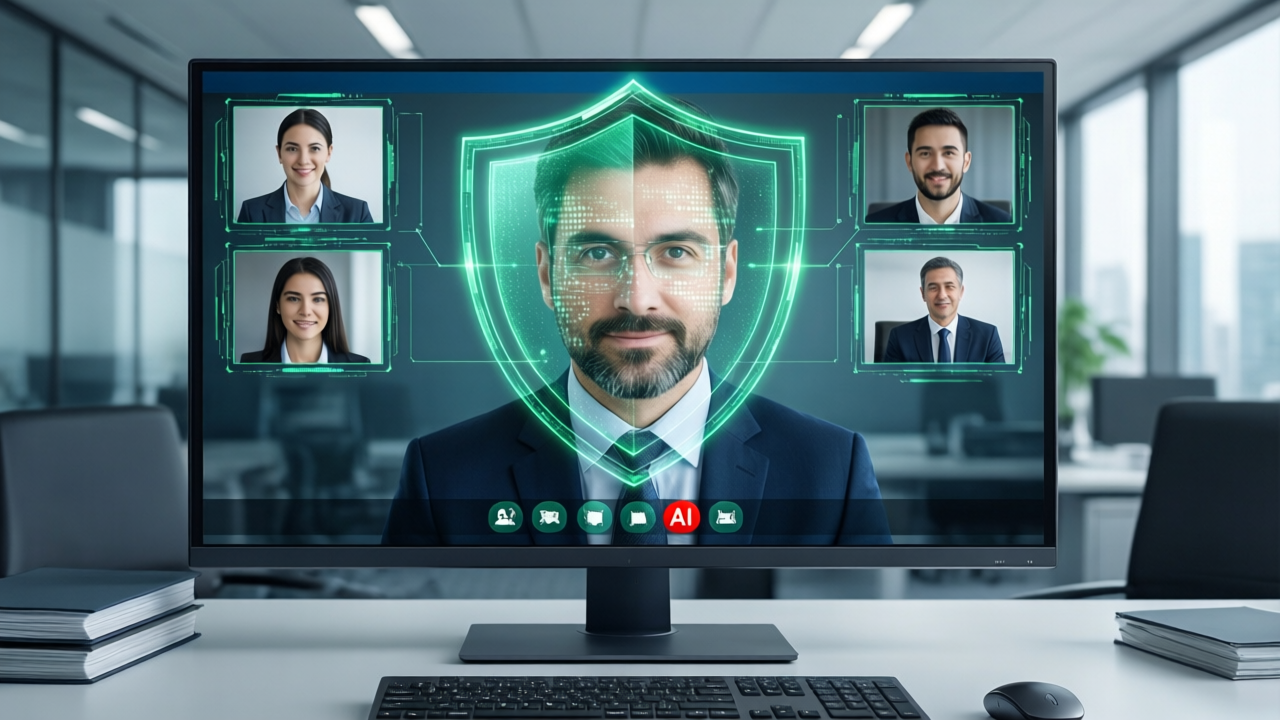
The feature is rolling out in Teams across August 2026. It lets participants flag potentially fraudulent behaviour during a meeting, with reports routed to the Microsoft Defender portal and Teams admin centre for investigation. It’s not detection — it’s crowd-sourced suspicion.
The problem Microsoft’s own research identified
This isn’t Microsoft being alarmist. In a research report published in 2025, the company documented that attackers can use AI to scrape the web for company information, create authentic-looking deepfake participants, and clone voices from publicly available audio. Their wording was specific: “AI-powered fraud attacks are happening globally, with much of the activity coming from China and Europe.” They flagged Germany as a particular hotspot, citing its status as the EU’s largest e-commerce market.
In other words, the attack surface isn’t theoretical. A bad actor with access to a CEO’s earnings call, a few LinkedIn videos, and an AI voice clone tool can construct something that looks and sounds like a legitimate executive on a Teams call. And the barrier to entry keeps dropping.
The detection arms race is already in motion
Microsoft’s approach — give people a button to flag something — is the bare minimum. The real story is that a whole industry is springing up around the question “is the person on this call actually real?”
Polygraf AI launched Meeting Guard in July 2026, a real-time deepfake detection system that joins virtual meetings (Zoom, Google Meet, Teams) as a visible participant and analyses whether voices, faces, and responses show AI-generated artefacts. CEO Yagub Rahimov put it bluntly: “Every meeting is now a security event.” His company also announced a USPTO patent grant for AI detection at RSAC 2026.
Google took a different angle with Fake Call Detection, rolling out globally in June 2026 to Android 12+ devices. It uses an end-to-end encrypted RCS cryptographic handshake to verify whether a call from a saved contact is actually coming from that person’s device — not a deepfake spoofing their number. It started with Pixel devices and is expanding.
Scam.ai partnered with Qualcomm at Computex 2026 to bring on-device deepfake detection to desktop video calls via their Halo model — pushing detection to the silicon level rather than the cloud.
Even the UK government announced in February 2026 that it would work with Microsoft, academics, and experts to develop a deepfake detection system for online content, setting what it hopes will become standards.
The irony nobody’s going to mention at the next board meeting
Microsoft is simultaneously one of the biggest promoters of AI (it owns a 10% stake in OpenAI and has integrated Copilot across its entire product line) and one of the biggest warners about what AI enables. It’s the equivalent of a car company campaigning for stricter speeding laws.
The deeper irony is that Microsoft’s “Report a concern” button is essentially a social engineering solution to a technological problem. It puts the burden of detection on the participants — the very people who may not know they’re looking at a deepfake. As AI-generated video and audio improve, that gap between what looks real and what is real will only widen.
What this means for the rest of us
For organisations: if you’re still assuming that a face on a video call is who it says it is, you’re behind the curve. The vendors building detection tools — Polygraf, Scam.ai, and others — are operating on the assumption that deepfake impersonation in enterprise meetings is no longer a matter of “if” but “when.”
For individuals: the era of “seeing is believing” is over. Video evidence, voice recordings, and even live appearances can no longer be taken at face value. The cryptographic handshake approach that Google is using for phone calls — verifying the device, not just the number — is probably the model that will win long-term.
The question isn’t whether AI will make deepfakes better. It already has. The question is whether the detection tools can keep up, or whether we’re all going to end up with a “Report a concern” button for everything.
Sources: WindowsLatest (Aug 4, 2026) · Polygraf AI / Business Wire (Jul 14, 2026) · TechCrunch on Google Fake Call Detection (Jun 2, 2026) · Reuters on UK deepfake detection (Feb 5, 2026)