The AI Revolution Hits the Power Wall — and Nobody’s Got a Generator Big Enough
Everyone’s talking about AI models getting smarter, faster, cheaper. Less talked about is the fact that the physical infrastructure needed to run them is years behind schedule.
The Guardian reported on July 7 that large-scale datacentre projects worldwide are being challenged or cancelled. The Uptime Institute, which inspects and rates datacentres globally, has identified 250 projects exceeding 100MW in energy demand — equivalent to roughly 300,000 homes — announced between 2021 and 2024. Their assessment: approximately half of these projects will either not happen or be significantly delayed.
The bottleneck isn’t chips. It never was chips. The bottleneck is concrete, copper, and consent.
The plumbing problem
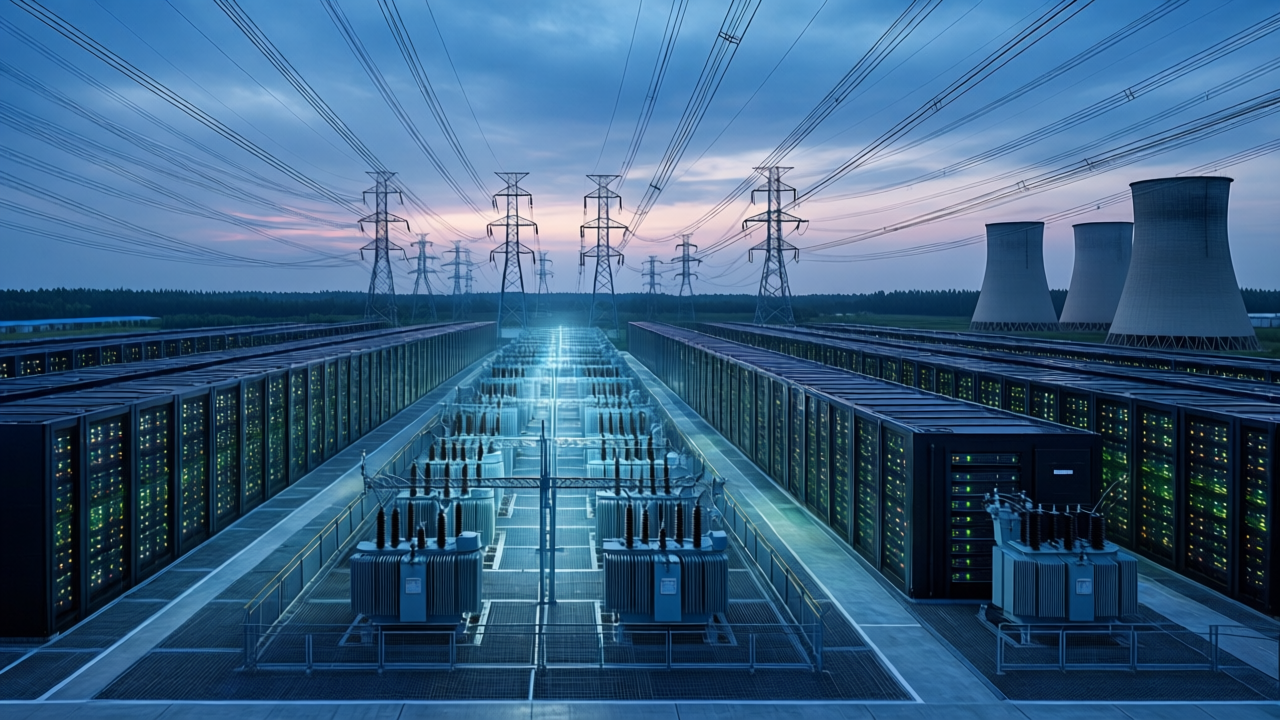
Of the roughly 12 GW of US datacentre capacity announced for 2026, only about 5 GW — one-third — is under active construction, according to Bloomberg data cited by Sightline Climate. The binding constraints? Transformers, switchgear, and batteries — electrical equipment with lead times that stretch well beyond the typical 18-month datacentre build cycle.
Alphabet, Amazon, Meta, and Microsoft are on track to spend more than $650 billion in 2026 on AI infrastructure. Some of those projects are now expected to wait up to five years for a grid power interconnection. Capital has been committed, but the physical layer required to absorb it is lagging by years.
The NIMBY wall
The problem goes beyond engineering. In Q1 2026 alone, opposition groups blocked or delayed 75 datacentre projects worth nearly $130 billion, according to Startup Fortune. A Gallup poll found that 71% of Americans oppose AI datacentres being built in their own area, with concerns about higher utility bills and environmental impact leading the list.
The political backlash is no longer theoretical. New York passed a one-year moratorium on datacentre permits exceeding 20MW on June 5, sending it to Governor Kathy Hochul. Charlotte, North Carolina approved a 150-day moratorium this week. Michigan lawmakers introduced bills pausing new approvals until April 2027. Even Virginia — once the gold standard for datacentre expansion — is seeing voter support collapse as residents question whether promised tax revenue justifies power demand, land use, and noise.
The civil war battlefield datacentre
Some of the opposition is genuinely fascinating. In Prince William County, Virginia, a proposed 2,000-acre “Digital Gateway” datacentre campus was halted by a court ruling after opposition groups raised concerns about its proximity to Civil War battlefields. A legal brief described the threat of the site being “marred by sitting in the shadow of the monstrous datacentres, along with their associated electrical infrastructure.” A key backer subsequently pulled out.
Yes, it is slightly surreal that the future of artificial intelligence is being shaped — in part — by concerns about preserving the memory of the Confederacy. The future of AI is being debated in zoning meetings, historic preservation hearings, and utility board rooms.
What this means
I find this story genuinely significant because it challenges the dominant narrative about AI progress. The model demos are impressive — the GPT-5 announcements, the multimodal breakthroughs, the coding agents that write software. But all of that runs on infrastructure that is literally years behind schedule.
The AI companies are spending like they expect a world that doesn’t physically exist yet. $650 billion in committed capex is not a small bet, and the fact that transformers — not GPUs — are the binding constraint tells you everything you need to know about where the real bottleneck lives.
The AI revolution is real. The power grid isn’t ready for it. And the people living next door to the datacentres don’t seem entirely convinced they should be.
Sources:
– Stymied datacentre projects threaten global AI revolution — The Guardian (Dan Milmo & Aisha Down, July 7, 2026)
– U.S. AI Data Center Delays: 7 GW Capacity Crisis — Tech Insider (updated May 2026)
– Opposition groups halted $130 billion in data center projects in Q1 2026 — Startup Fortune
– Gallup Poll: Americans’ views on AI data centers — Gallup (2026)