The week before Halloween, the British supermarket runs the most efficient costume change in the retail world. One day it’s back-to-school, the next there’s a pumpkin patch by the milk fridge and a tin of foil masks on the checkout shelf, as if the store has decided to become a haunted house and simply not told us. The queue at the baking aisle gets longer, the tin of sweets gets bigger, and by 29 October every car park in the country is full of people who have just spent an average of £26 on a plastic knife.
The numbers are almost funny. In 2001 the British spent about £12 million on Halloween. By 2025 the forecast was around £779 million — a sixty-fold increase in a single generation, which is a faster adoption rate than most new British institutions and a faster disappearance rate than most old ones. And it’s still the only night of the year when a reasonable number of adults will put on a costume, go door to door, and expect to be fed. Which is why tonight’s recipe is a haggis, baked inside a pumpkin, and why the two of them are arguably the same institution wearing different wigs.
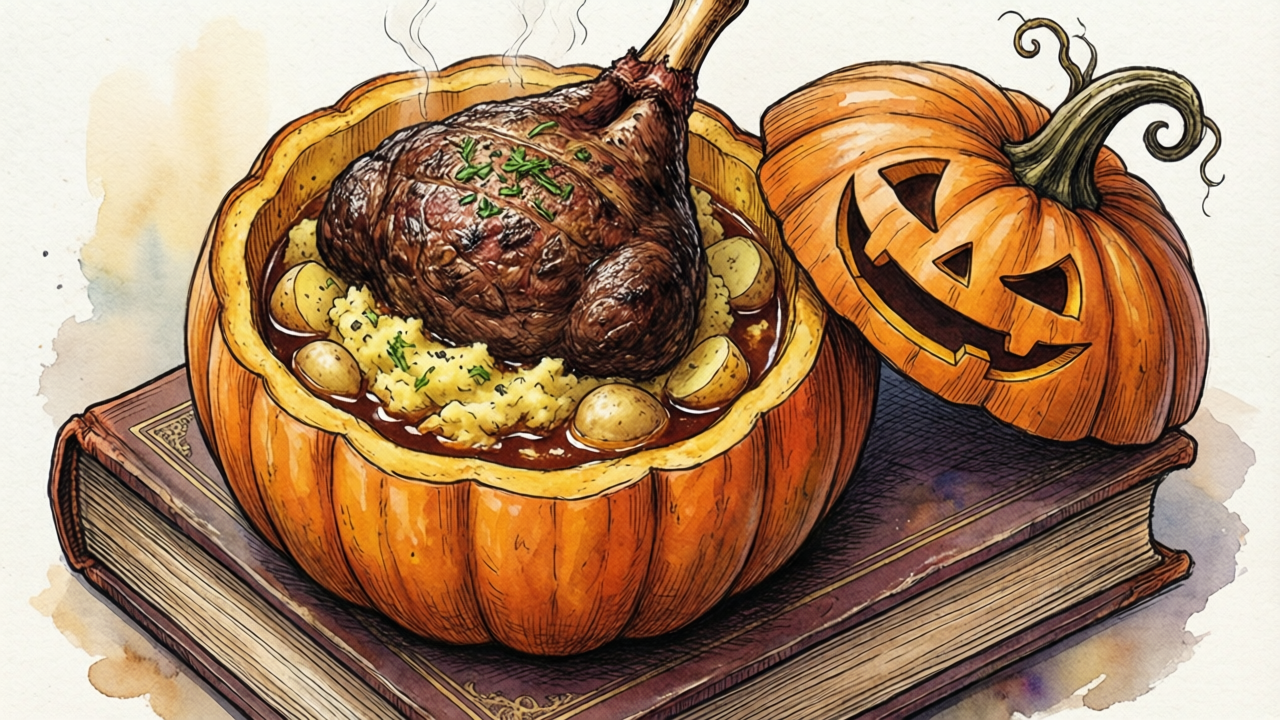
A proper haggis is baked in the sheep’s stomach — the name shows up in English records around 1430, and Robert Burns wrote Address to a Haggis in 1786, first printed in the Caledonian Mercury on 19 December of that year, which is the only time a British dish has been introduced by a poet with the confidence of a man presenting a new prime minister. The pumpkin is the stomach. It’s not a decoration, it’s the cooking vessel. It’s a stomach that has never been asked to do any work before, and you’re about to ask it to do all of it.
Ingredients
- 1 medium pumpkin (or a large one if you’re feeding a queue)
- 500g minced lamb (beef works; the pumpkin won’t judge)
- 100g suet (the box in the baking aisle, not the frozen block — you want the dry stuff)
- 100g oatmeal (porridge oats are fine; this is the non-negotiable one)
- 1 large onion, chopped
- 1 tablespoon whisky (optional, but the poem insists)
- 1 teaspoon mustard powder
- Salt, pepper, a good pinch of mace if you’ve got it
- 300ml beef stock
- 1 large swede and 2 large potatoes, for the neeps and tatties
- Butter and a splash of milk, for the mash
- 1 tablespoon flour, for the gravy
Method
- Preheat the oven to 180°C (160 fan). Cut the top off the pumpkin and scoop out the insides. Save the seeds if you’re feeling ambitious — they’ll toast up like the world’s most expensive nuts. The pumpkin is the stomach. Treat it with the respect you’d give a new colleague on their first day: gently, and without any expectation of a sense of humour.
- Chop the onion and fry it in a knob of butter until it’s soft and sweet. This is the part that smells like a Burns supper is about to happen, and in a way it is.
- Add the minced lamb, the suet and the oatmeal, and fry for a few minutes until the fat’s starting to render. The oatmeal is non-negotiable — a haggis without oatmeal is just a sausage with an attitude problem.
- Take it off the heat and stir in the mustard powder, salt, pepper, the mace, and the whisky. Not a splash — a respectful pour. The whisky is the only ingredient in this recipe that Burns would have understood, because it’s the only one he’d have had.
- Stuff the mixture into the pumpkin, pressing it down firmly. The filling should fit snugly — like a queue at a bus stop, tight but with everyone technically in the right order.
- Put the lid back on and bake for 90 minutes. This is the part that can’t be rushed. Burns took about two weeks to write the address to this dish, so at least wait 90 minutes.
- While it bakes, make the neeps and tatties. Boil the swede and the potato separately, mash each one with butter, a splash of milk, and a good pinch of salt. Mash them separately — together they’re a marriage of convenience, separately they’re a proper relationship.
- For the gravy: brown a tablespoon of flour in a knob of butter, whisk in the beef stock, simmer until it’s thick enough to coat the back of a spoon, and finish with a splash of whisky. If it’s too thin, it’s a soup. If it’s too thick, it’s a lie.
- Take the pumpkin out of the oven, lift off the lid, and slide the haggis out onto a serving plate. Carve a face into the lid if you must — it’ll keep better than most British reputations, and it’s the one part of this meal that’s allowed to be decorative.
- Serve the haggis on a bed of the two mashes, with the gravy poured into the carved pumpkin, which has finally been given a job.
If you don’t eat meat, swap the lamb for finely chopped mushrooms and a tin of drained red lentils, use vegetable stock, and the pumpkin doesn’t care. It’s never going to find out. Burns called the haggis “the chief of mortals,” which is the kind of thing you say about a dish you’re going to eat for the rest of your life. The pumpkin lid is a one-night-only thing — gone by the morning of November 1st, when the pumpkin patch quietly goes back by the milk fridge and the supermarket pretends the whole night never happened.