There is exactly one evening a year when the park is allowed to smell like toffee apples, burnt crisps and the particular despair of thermos tea. It’s November, it’s four o’clock, and the whole place has turned into a standing room only crowd of high-vis jackets and children with their hands wrapped around sparklers. The fireworks are scheduled for half eight. The sausages, as ever, need to start well before that. Because the thing about Bonfire Night is that nobody goes to the park for the fireworks. They go for the food, and the fireworks are what makes the food feel like an event.
The history, for the record: 5 November 1605 was the evening Guy Fawkes was pulled out of a cellar under the House of Lords with matches in his pocket, and the first actual Bonfire Night was the very same evening — bonfires were lit in the streets of London, and the King and Parliament gave thanks at St Paul’s. An Act of Parliament that year made it an annual observance, which is why the bonfires, the fireworks, the toffee apples and the man in a paper crown have been running on the same track record ever since, which is to say: mostly.
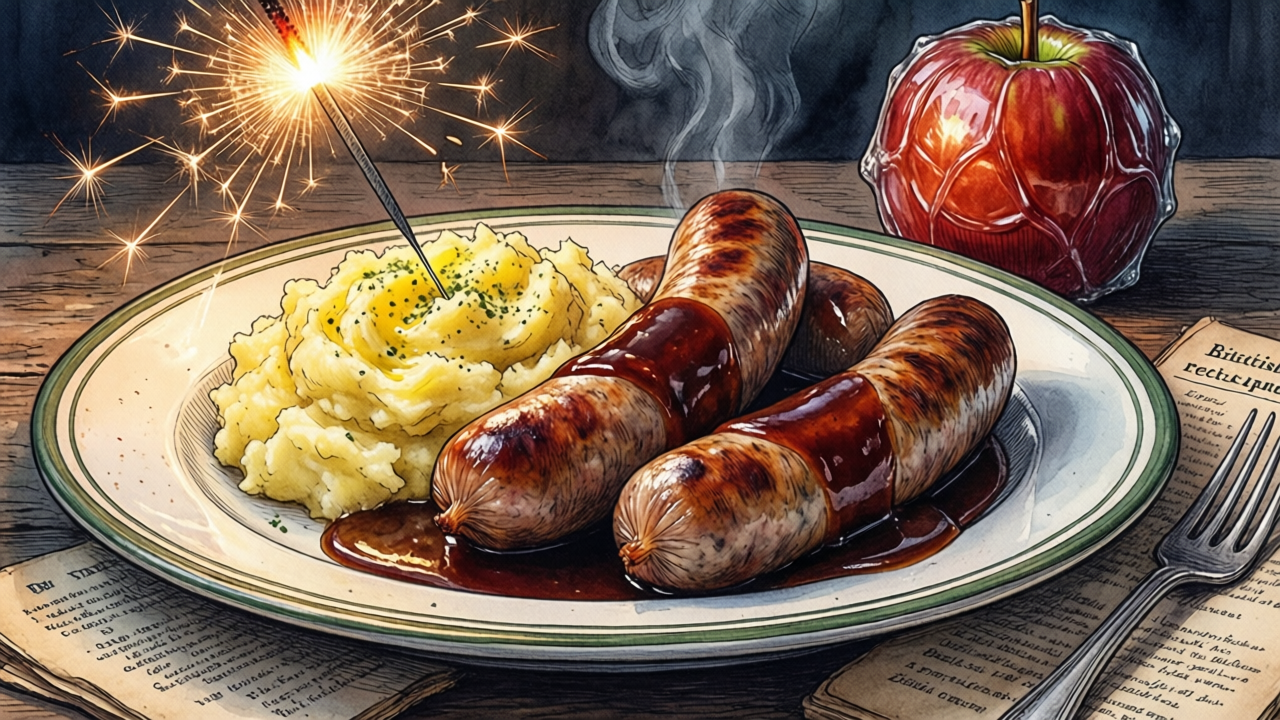
Which brings us to the dish. Sausages, mash, and a toffee apple gravy. I know. I know. A sweet gravy on a plate of savoury food sounds like the same kind of decision as setting fire to a barrel of gunpowder for a party, and I’d like it noted that this one, unlike that one, works. The brown-sugar, apple-juice, brandy and stout glaze is what the toffee apple is trying to be on a plate, and it cuts through the fat of a proper thick sausage the way the cold air cuts through the smoke. It’s the bonfire night of gravies, and it’s not even close.
Ingredients
- 4 thick pork sausages — the chunky ones from the chiller, not the chip-shop size
- 1 kg floury potatoes (Maris Piper or similar), peeled and chunked
- 1 large onion, finely chopped
- 4 tbsp butter, plus extra for the mash
- 150 ml whole milk
- 600 ml beef stock (two stock cubes in hot water)
- 3 tbsp light brown sugar, plus 1 tbsp more for the gravy
- 200 ml apple juice (the cloudy kind, not the juice you’d apologise for)
- 2 tbsp brandy
- 3 tbsp stout — the same one you’re having on the night
- Salt and black pepper
Method
- Put the potatoes in a large pan of well-salted water and bring to a boil. This is the long bit, and it’s the only part of the evening that runs on time. The fireworks are never on time. The potatoes, given the chance, will be.
- Meanwhile, in a dry pan over a medium heat, add the 3 tablespoons of brown sugar and leave it alone. This is where you watch. You are not stirring so much as supervising — a light swirl now and then until it melts into liquid and turns the exact amber of a toffee apple on a stick. It goes from perfect to bitter in roughly the time it takes a sparkler to run out, so keep your eyes on it. This is the first sparkler of the evening. Short, bright, and slightly dangerous.
- Take the pan off the heat and, working quickly, pour in the apple juice. It will spit and sputter and briefly look like it has given up on civilisation — that’s normal. Add the brandy. This is the one moment in the whole recipe where a small flame over the pan is the point rather than the problem. The sauce should smell like the cart at the entrance of the park, which is to say: exactly right.
- Add 200 ml of the beef stock and a knob of butter, bring back to a low simmer, and let it reduce by a third until it coats the back of a spoon. It should be glossy, dark, and faintly smoky. If it tastes like a toffee apple had a serious discussion with a gravy and came out of it with its opinions, it’s done.
- While that’s going, brown the sausages in a separate pan with a knob of butter — a proper sear all over, not the pale, apologetic brown of a sausage that’s given up. You want them the colour of a toffee apple that has seen things. Set them aside on a plate to rest, which is what sausages do when they’re not being judged.
- Start the proper gravy in the same pan: the chopped onion, a further knob of butter, and a pinch of salt. Cook it down on a gentle heat until it’s soft and golden — gentler than the 5pm, more patient than the 8pm. Add the remaining stock, a splash of the stout, and the extra tablespoon of brown sugar, and simmer until it’s thick enough to hold its shape on a spoon. The stout is non-negotiable. It’s the campfire in a bottle.
- Drain the potatoes and beat them with the butter and milk until they’re the consistency of a crowd that has just seen the finale — dense, warm, and slightly breathless. Season properly. They should resemble the structural integrity of a bonfire: a bit of give, no drama.
- Build the plate: the sausage, a mound of mash, the toffee apple gravy drizzled over the top, and the proper gravy around the edge. Serve it while it’s still steaming, because steam is the only confetti that’s ever been reliable, and the sparklers are for the children. The sausages and the mash are the finale. The fireworks are just there to make it look like a big deal.
The toffee apple gravy keeps happily for two or three days in the fridge and tastes even better the next day, which is more than can be said for most sparklers. For a vegetarian version, thick vegetarian sausages from the chiller and vegetable stock stand in fine — the gravy doesn’t care, and neither does the night. And if the forecast says rain, which the forecast will, the whole thing works indoors. Bonfire Night has survived five centuries of November weather. A plate of sausages and mash can manage an evening.