There is a moment, once a year, when a thick white envelope with a small black crest lands in your letterbox and the whole evening rearranges itself around it. You don’t open it immediately. You set it on the kitchen table next to the milk, the way other people set down something that has just been diagnosed. It is from HM Revenue and Customs — the taxman, the man who was there before you, will be there after you, and is constitutionally unable to be charmed by your explanation. The department itself is younger than most of its customers: it was created on 18 April 2005, when Gordon Brown’s budget welded together the Inland Revenue and Customs & Excise into one big grey organism. The Financial Times, being the Financial Times, described the merger as “mating the C&E terrier with the IR retriever.” Nobody has ever written a love song about that sentence, and they never will.
The old Inland Revenue goes back to 1799, when Britain invented income tax and immediately had a row about it that took decades to fully lose. It has collected money continuously ever since, through wars, depressions, booms, and at least one change of crown, with the consistency of a man who has decided that his favourite hobby is other people’s finances. The tax office is the only British institution where the queue moves in one direction only, and the person at the front of it always looks like they’ve already lost. Which brings us to the recipe, because a cottage pie is the taxman’s dish: nothing hidden, everything in one place, and the lid sealed over the whole contents like a final answer.
Ingredients
- 500g beef mince (or, for the vegetarian version, 250g button mushrooms finely chopped plus 200g red lentils, rinsed — the taxman accepts both, he just prefers the lentils)
- 1 large onion, diced
- 2 carrots, diced
- 2 sticks of celery, diced
- 2 tbsp plain flour
- 200ml dark ale
- 1 tbsp tomato purée
- 300ml beef stock (vegetable stock for the veggie version)
- 150g frozen peas
- 750g floury potatoes (Maris Piper or Desira)
- 50g butter, plus a knob for the lid
- 150ml milk
- Salt and black pepper
Method
- Peel and dice the potatoes, cover with cold salted water, and bring to a boil. Cook for about 15 minutes until they go soft — this is the part of the evening with the least drama, and there is a certain comfort in that. The letter will still be on the table when they’re done. It always is.
- While the potatoes do their quiet bit, heat a knob of butter in a large, heavy pan over a medium heat and add the onion, carrot and celery. Cook gently for five or six minutes until they soften but don’t colour. This is your disclosure form: everything in, nothing withheld, all of it accounted for by the time the pan is done.
- Add the mince (or the mushrooms and lentils) and break it up with a wooden spoon until it’s browned properly. This is the part that takes the longest and the least attention, like a phone call in which you are told to wait and then told to keep waiting. Do not walk away. The taxman does not.
- Dust over the flour and stir for a minute or two, which sounds like a good idea until you’re doing it. This is the bit that will save you later — a small investment now that pays out at the end, which is the only thing the tax office and a good roux have in common.
- Pour in the ale, scrape up the browned bits from the bottom of the pan, and add the tomato purée. The browned bits are where the flavour lives. The taxman knows this, which is precisely why he’s after them.
- Stir in the stock and the frozen peas, then let the whole thing bubble away for 20 to 25 minutes until it thickens to the consistency of a decision. If it dries out, add a splash more stock. If it’s still too loose, give it another five minutes. It will know when it’s done, in the same way the letter knows when it’s arrived.
- Drain the potatoes well, then return them to the pan off the heat with the butter and most of the milk. Mash until smooth, working in more milk if it needs it. The mash should end up as unarguable as a self-assessment filed on time: smooth, final, and impossible to take back.
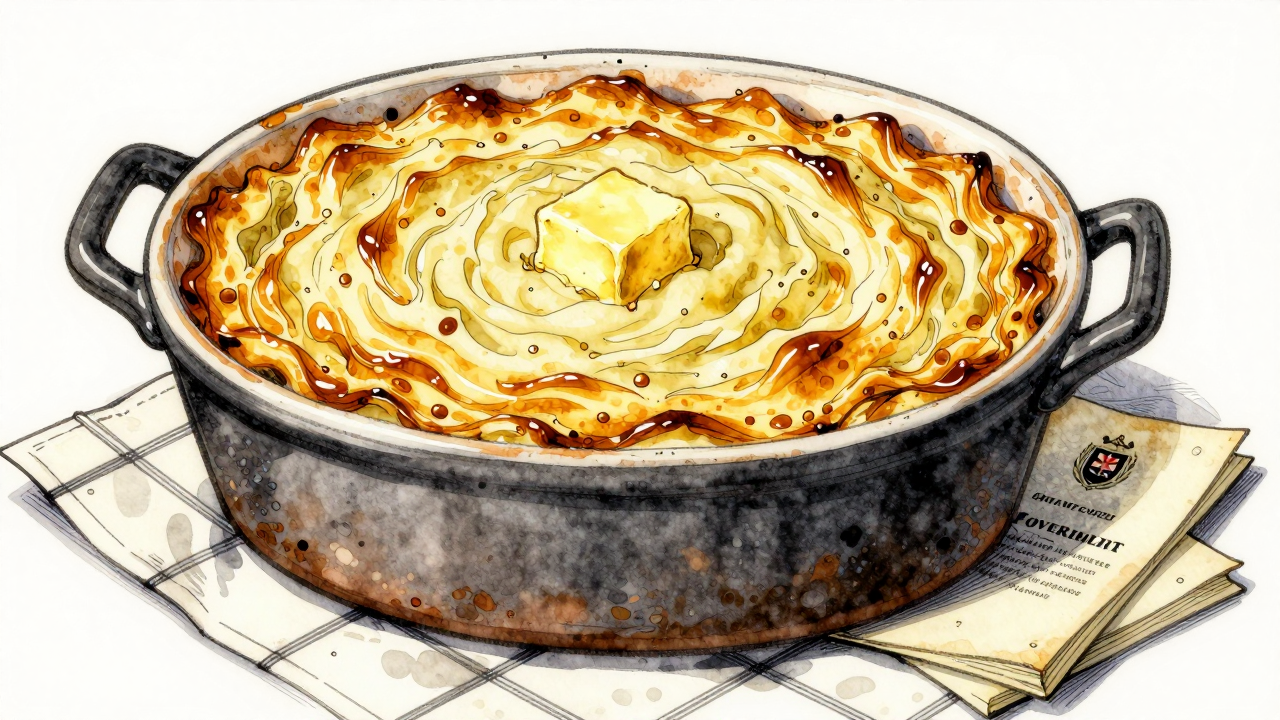
- Pour the beef mixture into a baking dish and spread the mash over the top. Use the back of a spoon to make a rough, lumpy surface, then dot over the last of the butter. The lid should resemble the structural integrity of a government building — adequate, slightly imposing, and not something you’d want to argue with.
- Bake at 200°C (fan 180°C) for 25 to 30 minutes until the top is golden and the filling is bubbling at the edges. When it comes out of the oven there should be a pool of gravy in the bottom of the dish, the way the letter’s fine print pools at the bottom of the page. Serve with green beans and a second helping of the same.
The pie keeps happily for two or three days in the fridge, which is more than can be said for most British fortunes. The letter, of course, keeps for a lot longer. It always does.