There are very few institutions in this country that survive a queue turning the corner, a programme you paid four pounds for, and a row of parents who have collectively decided the popcorn is the main event. The pantomime is one of them. It has been running, more or less uninterrupted, since a man called John Rich started letting Harlequin smash the scenery at Lincoln’s Inn Fields in 1717 — three centuries of the same plot, the same slapstick, and the same audience shouting things at the actors that a bouncer would normally consider a declaration of war.
It is a show built on a small number of unbreakable rules. The lead is played by a young woman in breeches, which is a fact the children in the front row do not question and the adults in the back row have stopped questioning. The dame is played by a man, and everyone pretends this is also not a question. And at some point, without warning or context, the entire audience will open its mouth in unison and shout “he’s on the bicycle!” at an actor who is, at that moment, doing something that has absolutely nothing to do with a bicycle. The show then proceeds as if nothing has happened. This is the most British form of theatre there is, and it is why you eat the pudding on the way out.
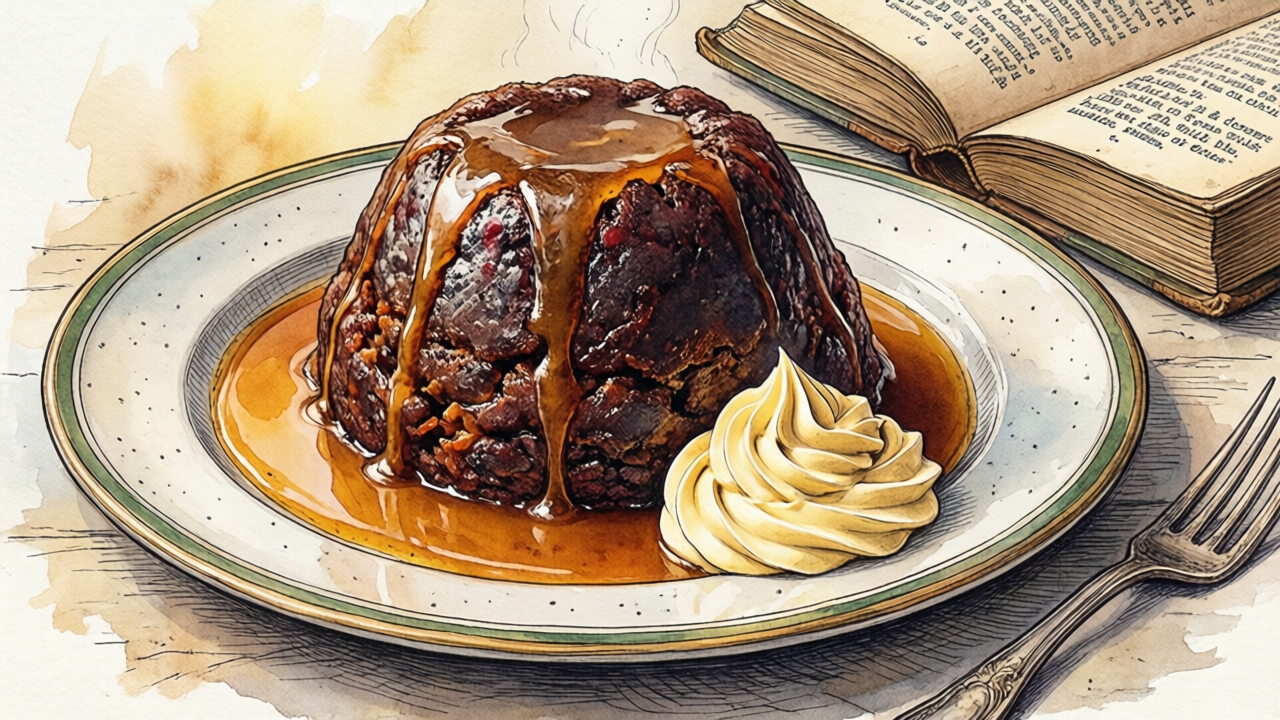
Which brings us to the pudding. The Christmas pudding is the only dish with a long enough waiting period to fit between the matinee and the car park, and the only one whose final act — the flame — is designed to be done in front of an audience that has been waiting for it all evening. It is suet, fruit and patience, steamed for hours, set with the confidence of a dame in a sequined evening dress. Here is one that will carry you from the interval to the exit, no programme required.
Ingredients
- 250g suet, shredded (the frozen kind from the freezer aisle; if you can’t find it, 250g vegetable suet is a fine stand-in)
- 250g sultanas
- 250g raisins
- 100g currants
- 100g dried apricots, finely chopped
- 50g mixed peel
- 50g flaked almonds, toasted
- 150g self-raising flour
- 30g brown sugar
- 1 tsp mixed spice
- ½ tsp ground ginger
- 250ml whole milk
- 2 large eggs
- 60g butter, melted
- 2 tbsp brandy (or a splash of stout if you’re feeling brave)
- 3 tbsp grated lemon zest and juice
- 1 tsp salt
- For the brandy butter: 100g softened butter, 4 tbsp brandy, 2 tbsp icing sugar, a pinch of nutmeg
Method
- Put all the dried fruit in a large bowl and pour the milk over it. Leave it overnight, or at least until the next rehearsal. The fruit will drink the milk and swell into something with actual opinions. This part cannot be rushed — nobody ever won a panto by rushing.
- Mix the flour, sugar, mixed spice, ginger and salt in a second bowl. Stir in the suet until it’s evenly distributed, like the applause is distributed — evenly, and a little bit forced near the end.
- Drain the fruit, reserving the milk. Beat the eggs with the reserved milk, the melted butter, the brandy and the lemon zest and juice, then pour it into the dry mixture. Stir until just combined. Overmixing is the culinary equivalent of doing the Dame’s bit — everyone can tell, and it’s not as funny as you think.
- Line a 1.5-litre pudding basin with buttered greaseproof paper, leaving a long tail of paper up the sides so you can lift the pudding out later. Fill the basin with the mixture, leaving room to rise — it’s going to grow, and it’s going to want space, like the audience after the interval.
- Cover with a second sheet of paper and a disc of foil, then tie the whole thing with string until it looks like a parcel that has been through the post at Christmas. It should look like a parcel that has been through the post at Christmas. That’s the point.
- Steam in a large pan of boiling water, the basin sitting on a trivet or a stack of upturned plates, for 6 to 7 hours. Top up the water as it goes. This is the long part — longer than the interval, longer than the Dame’s second number, longer than the argument about whether the lead is actually a young woman in breeches. Be patient. The pudding is not going anywhere. The bicycle, however, may.
- While it steams, make the brandy butter: beat the softened butter with the icing sugar, a pinch of nutmeg and the brandy until it’s pale and spreadable. It should be the texture of the applause at the end of the act — warm, generous, and slightly too sweet.
- When the pudding is done, untie the string, invert it onto a plate, and peel off the paper. It should come out in one piece, like the lead comes out in one piece at the end, despite the slapstick, the smoke, and the bicycle. If it doesn’t, serve it in pieces. Nobody’s checking.
- Flame the brandy just before serving, if you’re feeling theatrical — the flame is the one part of the pudding that the children actually came for, and they will shout about it for the rest of the evening. If you’re not feeling theatrical, a good knob of the brandy butter on the side will do the job just as well. The custard is non-negotiable. The custard is the audience. You don’t skip the audience.
The pudding keeps for weeks in a cool, dark place — longer, in fact, than most British theatrical traditions. Serve it with the brandy butter and a pot of custard, and eat it with the same competitive determination you’d bring to the “he’s on the bicycle!” moment. It is a dish that knows exactly what it is, and it has not once been embarrassed about it.