There is no more British object than the jam jar on the windowsill. It’s not even particularly useful — you could keep the jam in the fridge, in a lidded tub, in a cupboard, in a drawer, in a bag in the back of the car where it’s been for three years. But the jar, the glass jar, with the lid slightly dented and the label peeling, is the point. And under the lid, in the good old days, there was a paper doily. A doily. A frilly bit of paper laid between the jam and the lid to keep the mould away. It was later shown to be entirely pointless. The British carried on doing it for another fifty years anyway, because the point of the doily was never the mould. The point was that you’d done the thing properly.
The British also make, by one estimate or another, somewhere around 100 million jars of jam a year, most of it from fruit that was grown, picked and boiled within the same county, and most of it in a kitchen where the radio is on and someone is quietly arguing about the amount of sugar. And every one of those jars has a last spoonful. The last spoonful is always the best, and it’s always the one that sticks to the spoon, and it’s always the one that gets taken, by the person who’s been waiting for it, with a particular kind of satisfaction. That’s not a flaw in the jam. That’s the point of the jar.
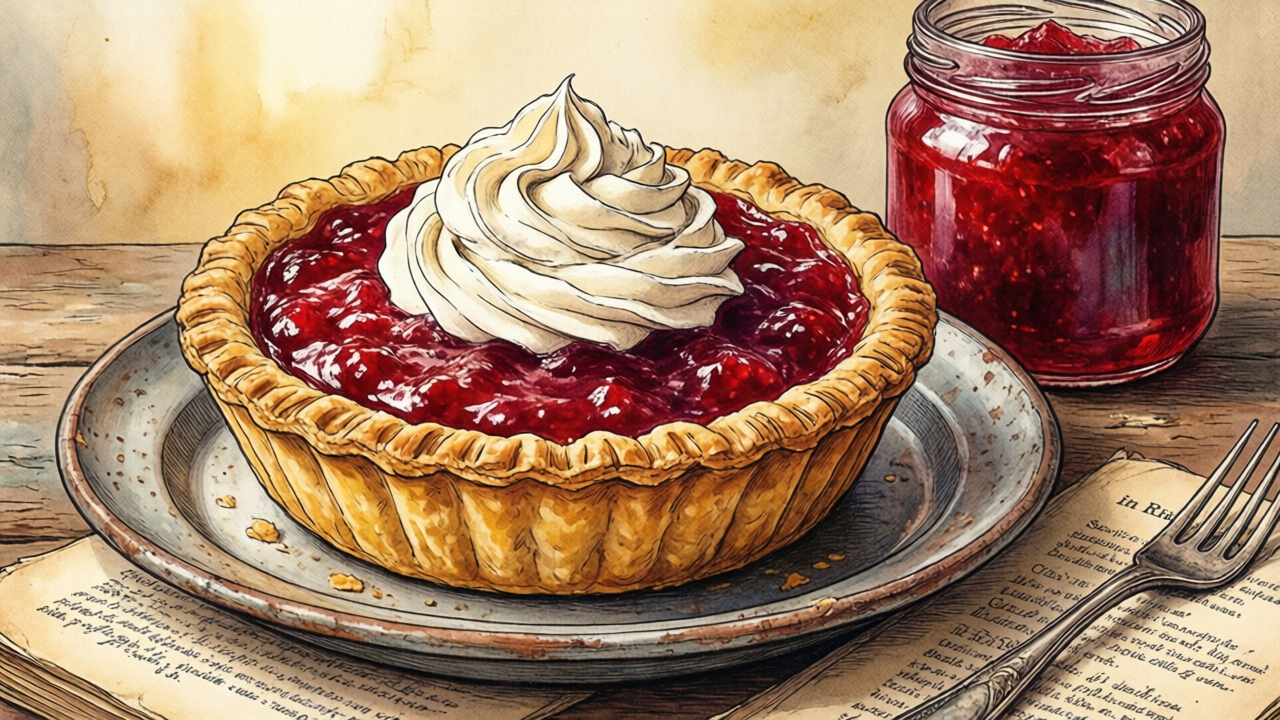
Which is why the jam tart is the most British dessert there is: it’s the jar, turned upside down and baked. All of the last spoonful, concentrated, under a doily of pastry. Here’s a recipe worth trying — the Jam Doily Tart — and in this one, the doily is structural.
Ingredients
- 200g plain flour, plus a little for dusting
- 100g cold butter, cut into cubes
- A pinch of salt
- 1–2 tablespoons of ice-cold water
- 200g good jam — strawberry is the safe bet, rhubarb is the brave one
- 1 egg, beaten, for the wash
- A little caster sugar, for sprinkling
- Crème fraîche or single cream, to serve
Method
- Rub the butter into the flour with your fingertips until the mixture looks like breadcrumbs. This is the “rub it in” step, and it’s the only stage of the recipe where the idiom is actually doing the work. Breadcrumb-size is right; pebble-size is over. The dough should just hold together when you squeeze it — no more, or the doily won’t cut clean.
- Wrap the dough in cling film and chill it for about 20 minutes. This is the stage that cannot be rushed. The dough needs to settle the way a good jar of jam needs a night on the windowsill before it’s worth opening. Rushing it is the pastry equivalent of eating the last spoonful too early.
- Roll out about two-thirds of the dough and line a 20cm tart tin. Press it into the corners, trim the excess, and chill it again while you get the rest out. The base should look like a properly made thing, not a suggestion of a thing.
- Spread the jam in a thick, even layer over the base — about 150g of it. Scrape the jar well. The last spoonful is always the best and the one that sticks, so give it a proper go. You’re not wasting it. You’re earning it.
- Roll out the remaining dough and, with a small round biscuit cutter, cut a series of holes in a scattered pattern across it — that’s your doily. It should look like a paper doily that’s had an opinion about pastry. Lay it over the jam, leaving a little border, and press the edges down so the doily and the base hold hands.
- Brush the doily with the beaten egg and scatter over a little caster sugar. The sugar is for the glaze; the doily is for the principle.
- Bake in a hot oven (200°C / 180°C fan / gas 6) for about 30 minutes, until the doily is golden and the jam underneath is bubbling at the edges. If the doily starts to go dark before the base is ready, drape a piece of foil over it — the doily is load-bearing, and you don’t want it burning before it’s done its job.
- Take it out and let it cool on a wire rack. Once it’s cool, mix the remaining jam with a drop of water until it’s pourable, and drizzle it over the top of the doily. This is the second coat — the doily gets a glaze, the same way a good institution gets a blue plaque.
- Serve in slices, with a spoonful of crème fraîche. The last slice is the best, and it’s the one that sticks to the knife. That’s not a flaw in the tart. That’s the point of the tart.
Serve it with the same quiet satisfaction as the person who’s been waiting for the last spoonful all along. The doily, as ever, does nothing to stop the mould. It does, however, stop you from feeling you’ve done the thing half-properly — which is the only mould that’s ever mattered in a British kitchen.