The crumpet is the only thing in the supermarket that makes you feel slightly guilty for buying it in a tray of four. It sits there, flat and round and holey, in a little paper cradle, and the packaging is doing its best to convince you that you’re about to enter into a relationship with teatime. You’re not. You’re about to put it in a sandwich. The holes are not a defect — they are the entire point — and the reason every crumpet box on the shelf is lying to you about how many you’ll actually eat is that nobody has ever met a crumpet and said “that’ll do.”
The word is older than most of the people reading this. John Wycliffe, translating the Bible in 1382, wrote of a “crompid” — a flat cake — and the modern soft, spongy version didn’t really arrive until the Victorians added yeast and a pinch of baking soda to the batter, which is when the crumpet stopped being a hard griddle pancake and became the thing that is, and has always been, dry as a crumpet. That’s the idiom, and it’s the reason the crumpet is the only breakfast food that can also be an insult. You can’t be dry as a toast. You can’t be dry as a marmite. You can be dry as a crumpet, and nobody has ever managed to make that sound like a compliment.
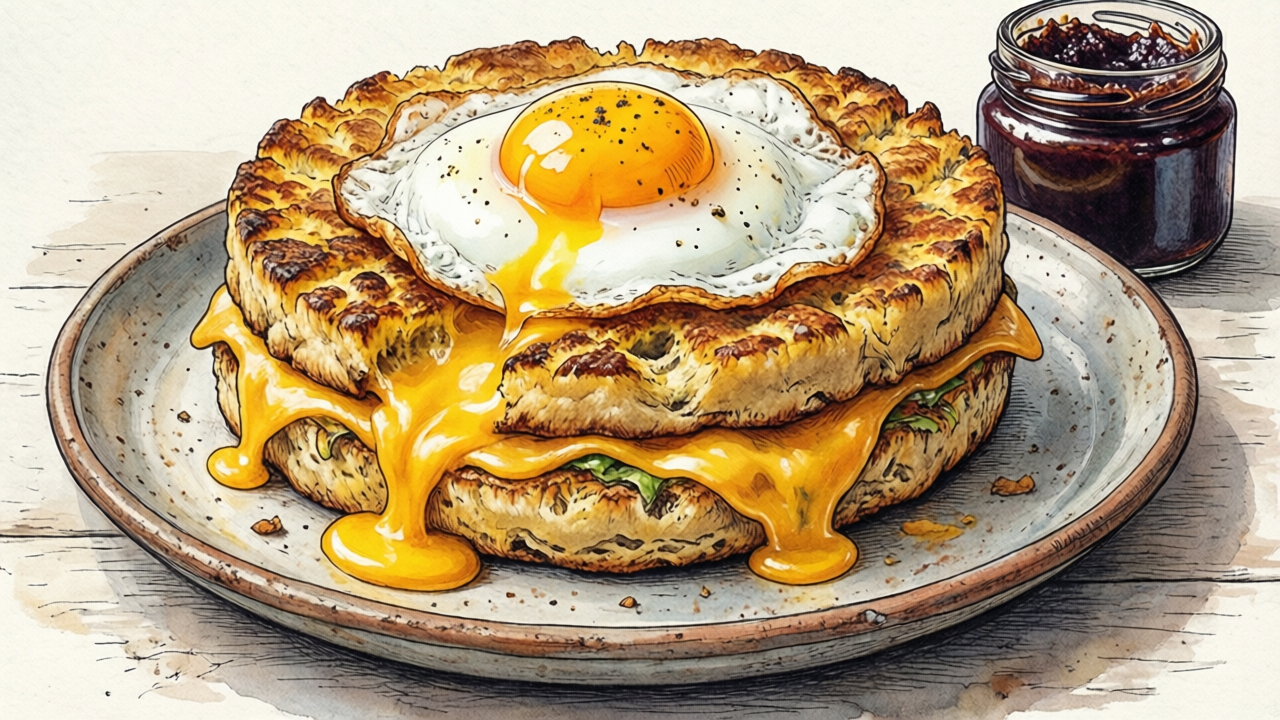
Which is exactly why the crumpet deserves a sandwich. It’s a piece of bread that gave up on being bread and became a hole with opinions, and the right thing to do with a hole with opinions is to fill it with cheese. So: the crumpet croque. A griddled cheese sandwich where the crumpet stands in for the bread, a soft-boiled egg on top, and Marmite on the side where the holes can catch it. It’s the kind of thing a mate would hand you on the back of a pub napkin and say “just do this,” which is the highest recommendation a recipe can get.
Ingredients
- 2 thick crumpets (the supermarket tray ones — the flat round ones, not the “griddled” pretzel thing)
- 2 thin rashers of back bacon (drop these and it’s a croque-monsieur — that’s the vegetarian line)
- 4 slices mature cheddar (or a thick cut, if you’ve got one)
- 1 soft-boiled egg, per sandwich
- A knob of butter
- Marmite (obviously — the only non-negotiable)
- A pinch of black pepper
Method
- Soft-boil the eggs. Three minutes, no more, then straight into cold water. The yolk should be the consistency of the last spoonful of jam in the jar — set enough to hold, loose enough to make a decision. You’re not after a runny mess; you’re after something with the structural integrity of a crumpet, which is to say: it holds, but it’s got holes in its character.
- Butter the griddle and warm it. A knob of butter, spread thin, on a hot griddle. This is the part where you decide whether the crumpet gets toasted on both sides, which is a more important decision than it sounds and the kind of thing that will divide a household.
- Fry the bacon. Lay one rasher per crumpet in the griddle while it heats. The bacon should go the colour of a motorway at rush hour — brown, but not yet giving up.
- Toast the crumpets. Crumpet in the griddle, buttered side down. The holes will start to hiss, and this is the part everyone gets wrong: the holes are not a defect, the holes are working. The butter goes into the holes, the holes catch the butter, the holes are the point. You’ve been told. Don’t argue with the holes.
- Build it. Cheese on the crumpet, bacon on the cheese, top crumpet on top, and then cheese on the outside too, because a croque that doesn’t lose a little cheese to the griddle is a croque that’s been lying to you.
- Griddle, press, flip. A heavy lid or a second pan to press it down, and give it a minute. The cheese is doing the thing — you can feel it through the lid, like a small animal that’s given up. Flip it when the outside looks like it’s seen things.
- Plate, egg, Marmite. Plate it, crack the soft-boiled egg on top, and — this is non-negotiable — a smear of Marmite on the side, where the holes can catch it. The egg is the topping; the Marmite is the opinion.
The whole argument has been the holes all along, and the answer was always going to be: it’s not a hole, it’s a reservoir. It’s the least dry thing a crumpet has ever been, which is a problem, because being dry as a crumpet is the entire brand. Serve it while the cheese is still making a decision, and keep the rest for as long as a crumpet survives in a bread bin — which is to say, only until someone else has the sense to eat it.