There was a sweet shop on the corner of every high street in Britain, and it was the only place where two pence could buy you a bag that made you feel, briefly, like the luckiest person in the parish. Behind the glass counter, rows of glass jars held every shade of boiled sweet that had ever been invented, some with names and most without. A little brass scale sat in the middle of it all, and it weighed out everything: the toffees, the butterscotch, the love hearts, the stuff you were technically not allowed to buy. The bell above the door went ding-dong, and the smell was toffee and butter and the faint suggestion of a place where nobody was planning to say no.
The sweet shop was a post-war institution in the truest sense. Sweet rationing ended on 5 February 1953, after ten years of waiting, and the schoolchildren were first in the queue for what the BBC called “unlimited sweets and chocolate.” By the 1950s, sweets had become a treat that almost every household could afford, and the jars were full again. Then the supermarkets came, and pre-bagged sweets came, and the jars went quiet one at a time. The whole industry now has its own memorial: the Sweets Graveyard, a list of discontinued confections topped by Spangles, the square boiled sweet that Mars made until the early 1980s and which has since acquired what one retro-sweet shop can only describe as a “totemic significance” to anyone born before 1985.
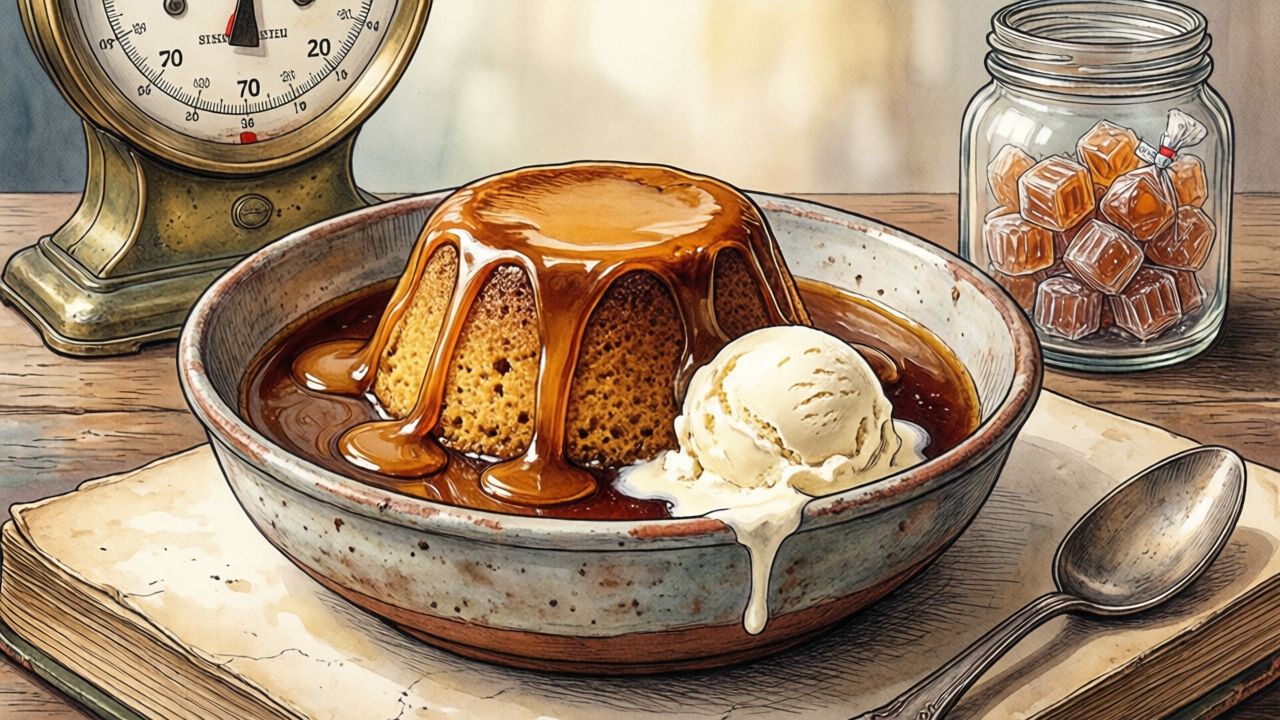
Sticky toffee pudding is what happens when the sweet shop decides to stop weighing things out by the handful and start making a dessert instead. It is, essentially, everything that was in the jars, the toffee, the butter, the sugar, tied into a sponge and drowned in sauce. Nobody will quite agree on where it came from, which is very British: the Gait Inn in Yorkshire claims 1907, the Sharrow Bay Hotel in Cumbria claims the 1960s, the Udny Arms in Aberdeenshire claims 1967, and the Lake District has simply taken it as a symbol, the way nobody will admit to putting brown sauce on their chips. But the pudding itself is the sweet shop’s last order, written down and kept.
Ingredients
- 200g chopped dates (a jar of date paste works too, if your supermarket’s date section has given up)
- 100ml boiling water
- 100g butter, plus a knob for greasing
- 100g caster sugar
- 2 eggs
- 150g self-raising flour
- 1 tsp bicarbonate of soda
- 60ml milk
- For the sauce: 100g butter, 100g soft brown sugar, 100ml double cream
- To serve: vanilla ice cream, or a carton of custard, which is the correct choice
Method
- Put the dates in a bowl, pour over the boiling water and leave for ten minutes. The dates come out of the bag the way sweets come out of the jar, perfectly dry and needing persuading. The water is the sweet shop’s way of saying “have a seat, we’ll be with you shortly.”
- Beat the butter and caster sugar together until pale and fluffy. This is the counter: everything goes through it first, and the little brass scale doesn’t care what it is, it’s 100g either way.
- Beat in the eggs one at a time, then fold in the flour, bicarbonate of soda and milk until you have a smooth batter. The bicarb is the one thing the sweet shop would never have put in a jar, it’s not a sweet, it’s a chemical. It’s the bit of the counter that dealt in lollipops, technically a sweet, functionally a medical procedure.
- Pour the batter into a buttered 900ml loaf tin, or six ramekins if you’re feeling generous with the tins, and bake at 180C (160 fan) for 30 to 35 minutes, until a skewer comes out clean. The sweet shop never did fancy; the fancy part was the paper bag with the top folded over, and that’s a job for the custard.
- While it bakes, make the sauce: melt the butter in a small pan, add the brown sugar and cream, and simmer for three to four minutes until it coats the back of a spoon. It should be the consistency of the last toffee in the jar, the one you had to go round and round the glass for. It is, so far, the only thing on the menu that survived the Sweets Graveyard.
- Turn the pudding out of the tin, it will come off reluctantly, the way the last of the toffees came off the counter, pour the toffee sauce over the top, and serve with the custard or ice cream. The sauce should come off the spoon slowly, with the full weight of the scale behind it.
The pudding keeps for two days in the fridge and the sauce for a week, which is more than can be said for most of the things on the Sweets Graveyard list. The shop on the corner is gone, but the last order is still on the menu. You just have to weigh it out yourself.