Walk into any village church in the last week of October and the first thing you notice is that it smells like a garden that has given up. Cabbages on the second row of pews. A crate of apples that has clearly lost an argument with a squash. Pumpkins the size of small dogs, stacked with the confidence of people who have never once been asked to make room. Somewhere in the back, a vicar is doing his best to look as though he is not being photographed, and the produce display is doing its best to look as though it was chosen with some thought. It was not. It is exactly what was in the allotment on the 28th.
The modern church harvest festival is younger than it looks. In 1843 a vicar called Robert Hawker, at Morwenstow in Cornwall, invited his parishioners to bring in their produce and hold a proper thanksgiving, and the idea caught the way a damp patch catches in a wool coat. A decade later, in 1854, the Revd Dr William Beal at Brooke in Norfolk held his own harvest festival specifically to put a stop to what he called “disgraceful scenes” at the end of the harvest, which is the most British sentence ever written about food and a fair description of almost every harvest supper since.
The old custom, before the hymns and the flowers, was simpler and slightly less polite. At the end of the harvest, the last patch of corn left standing in the field — the Mell, or the Neck — was cut last of all, and cutting it was the signal that the work was done and the eating could begin. It was considered bad luck to be the one who brought the last stand down, so everyone had a reason to be elsewhere when it happened. The reapers would shout “hooky, hooky,” the harvest supper would start, and until quite recently the harvest supper was the biggest meal of the year, and everyone who had worked the harvest was invited, which is a lot of people and a very large amount of food.
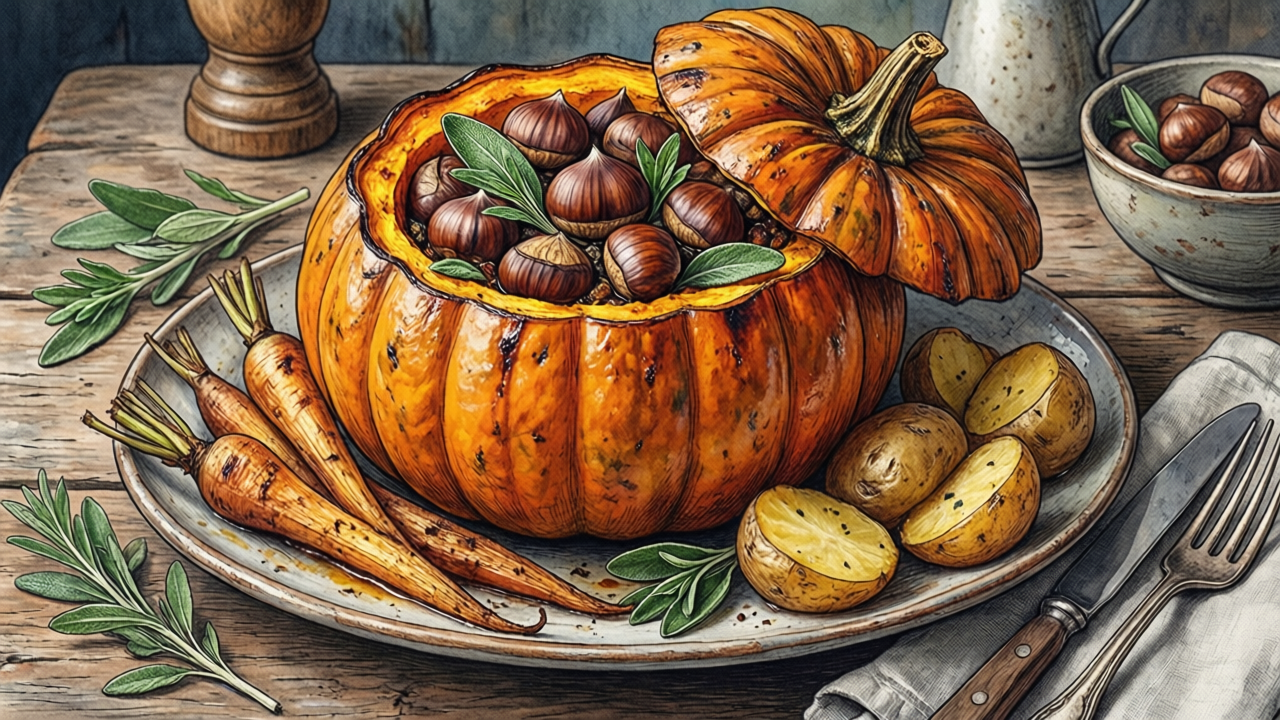
The whole tradition is really about one thing: the moment the last stand goes down and the eating starts. That is the Mell. And this is the dish for that moment — a roast pumpkin, stuffed with chestnut, sage and brown butter, with roast parsnips, roast potatoes and a proper gravy. It is the harvest supper on a plate, and it keeps the one rule the old reapers understood better than anyone: you only cut the last stand once.
Ingredients
- 1 medium pumpkin (butternut squash works fine as the swap)
- 200g chestnuts — fresh ones are in the supermarkets in October; a tin of chestnuts, drained, is the easy swap
- 1 small onion, finely chopped
- A good handful of fresh sage, finely chopped
- 50g butter, for the brown butter
- 2 tbsp plain flour
- 300ml beef stock (vegetable stock for the veggie table)
- A splash of stout
- 600g pork loin, for the proper supper (see below for the veggie table)
- 4–5 parsnips
- 4–5 potatoes, for the roast
- 2 tbsp brown sugar and a few sprigs of thyme, for the parsnips
- Salt, black pepper, a little olive oil
Method
- Heat the oven to 200°C / 180° fan. Halve the pumpkin and scoop out the seeds — save them, they’ll toast up — because the harvest festival is not the place for waste. Score the flesh into chunks but leave it in the skin, which is now doing the work of a roasting tin, a colander and a small act of faith.
- Make the brown butter: melt the butter in a pan over a medium heat and let it foam and go nut-brown, two to three minutes. This is the step the vicar would bless if he were watching. It smells like the church hall the week before the flower show, which is to say: properly good.
- Build the stuffing — chestnuts (tinned and drained, or fresh, roasted in their shells then peeled), the chopped onion, the chopped sage, a spoon of the brown butter, salt and pepper. The chestnuts should be the size of the argument: whole, not crushed. Nobody ever wins by mashing the chestnuts.
- Pack the stuffing into each pumpkin half. Firm, but not like you’re trying to win a competition. This is a thanksgiving, not a contest.
- Roast the pumpkins cut-side down for 30 minutes, so the flesh catches the heat and the skin doesn’t crack. Cut-side down is the rule. Cut-side up and you have a soggy situation and a very confused vicar.
- While they roast, the parsnips: peel, cut into batons, toss with oil, brown sugar and thyme, and roast for 35–40 minutes until the edges go dark. The parsnip is the unsung hero of the harvest, the way the Mell is the unsung hero of the field — both are the last thing you think to look at, and both are the best thing on the plate.
- For the meat table: score the fat on the pork loin, rub it with salt, and roast it alongside the parsnips until a thermometer says 70°C through the middle, then rest it ten minutes. The pork is the “proper supper” element, the bit that says this is a harvest supper and not a salad. The veggie table simply drops the pork and lets the pumpkin do the talking — and the pumpkin, to its credit, can hold the room.
- Make the gravy — this is the Mell, this is the last stand. Pour the pan juices from the parsnip and pork tray into a pan, whisk in the flour, then the stock and the splash of stout, and simmer until it coats the back of a spoon. When it does, the work is done and the eating can begin — that is the whole of the old custom in one pan.
- Flip the pumpkins cut-side up, spoon a little more brown butter over the stuffing, and roast for ten more minutes until the stuffing is set and the flesh gives when you press it. The flesh should give like a stress-tent contestant who has finally heard the verdict — firm enough to hold, soft enough to forgive.
- Serve: the pumpkin halves on the plate, the stuffing mounded on top, the parsnips, the roast potatoes, the pork carved, and the gravy ladled over the lot. The produce display, the Mell, the blessing, the “hooky, hooky” — all of it, on one plate. Eat it before the vicar starts talking about next year’s allotment.
The gravy keeps happily for two or three days in the fridge, which is more than can be said for most harvest suppers — the food lasts, the speech does not. And if you are the one who has to cut the last stand this year, well. Nobody ever remembers the name of the person who brought the Mell down. They just remember the supper.