There is a front room that smells of bacon at 6:45 in the morning. The settee is covered in plastic — not because anyone ever planned to spill anything, but because the settee arrived in 1974 and the household has no intention of letting it develop a personality. There’s a knitted doily under the lamp, a NO SMOKING sign above an ashtray that has demonstrably never been empty, and a laminated card on the table listing fourteen breakfasts, at least three of which are lies. And above the kitchen door, the notice that turns a terraced house into a business: Kitchen Cooked to Order.
The British guesthouse was built by two inventions: the railway, and the radical Victorian idea that a working man might be allowed a week off. On 5 July 1841, Thomas Cook hired a whole train for 485 members of the Leicester Temperance Society, one shilling each, from Leicester to Loughborough — the world’s first package holiday, and dry as the cause that paid for it. By the Industrial Revolution the North had formalised the idea into Wakes Week, when the mills shut for maintenance and entire towns decamped to the sea. The railway from Oldham to Blackpool opened in 1846; in its peak year, 1860, more than 23,000 holidaymakers reached Blackpool on special trains from that one town in a single week. A 1907 agreement guaranteed Lancashire mill workers twelve days’ holiday a year — fifteen by 1915 — and somebody, every morning, had to feed all of them.
That somebody was the landlady. She ran the guesthouse the way a head teacher runs a school trip: firmly, without fuss, and with one non-negotiable rule — you were locked out all day. This wasn’t cruelty, it was house policy. The housekeeping was done by ten, the landlady was not your friend, and you would be readmitted at a time of her choosing. One young man found it galling enough to reorganise the British holiday around: Billy Butlin, locked out of his Barry Island digs as a young man — entirely normal practice at the time — decided a holiday where the door stayed open was worth building, and opened the first Butlin’s camp at Skegness in 1936. The guesthouse fought back with the only weapon it had ever needed: breakfast.
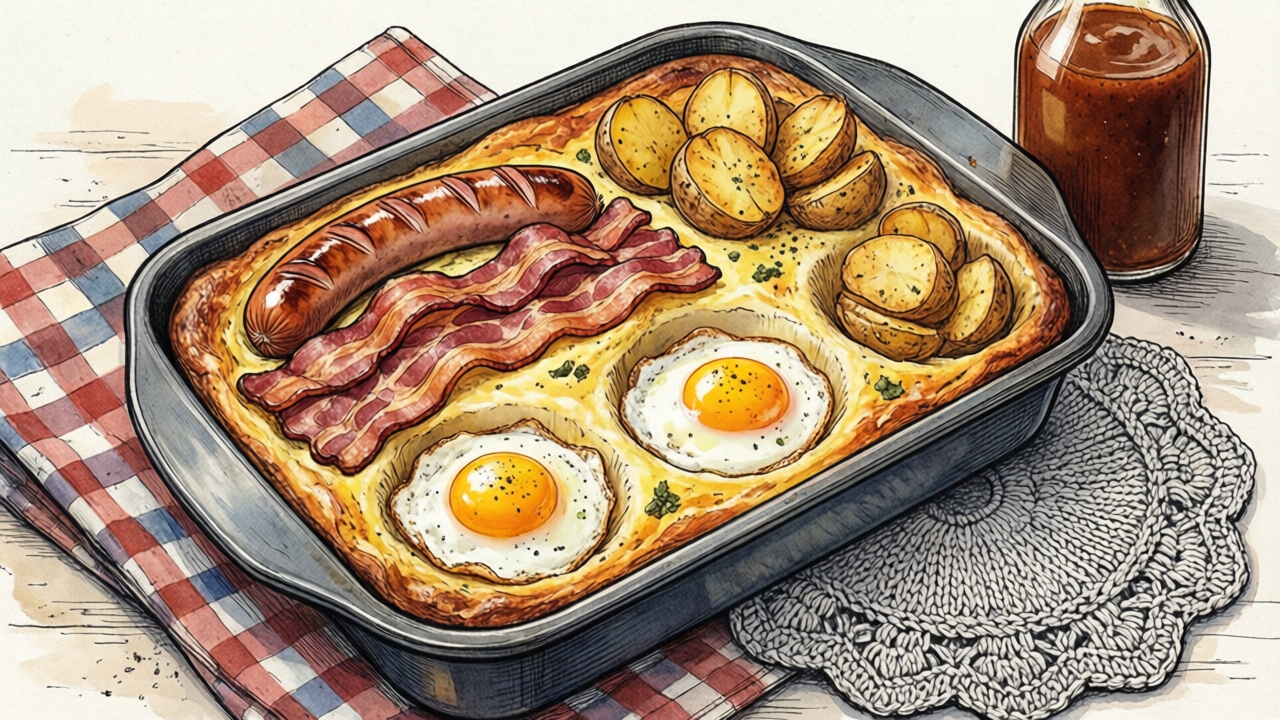
The cooked breakfast was the guesthouse’s answer to everything — served with total commitment and zero negotiation. You didn’t so much order a cooked breakfast as receive it. This recipe is that breakfast, unionised into a single roasting tray: cooked to order, ordered by you, and for once the person doing the locking-up is going to bed early.
Ingredients
- 900g new potatoes
- 8 thick pork sausages (the good ones — the kitchen has standards)
- 6 thick rashers of back bacon
- 2 onions, sliced
- 2 tins (410g each) baked beans
- 1 tsp Marmite (optional, but the kitchen insists)
- 6 large eggs
- 1 tbsp wholegrain mustard
- 2 tbsp sunflower oil
- Brown sauce, to serve
- Parsley, chopped, to finish
- Veggie version: thick vegetarian sausages from the chiller aisle take the place of the pork — see the note at the end
Method
- Heat the oven to 200°C (180°C fan). Boil the potatoes 8–10 minutes, until a knife meets just a little resistance. Drain, tip into a tray and bash them properly — knock every one until the edges go fluffy. B&B potatoes have never been asked their opinion, and it’s the secret of their success.
- Brush the sausages all over with the wholegrain mustard and fry them in the oil over medium heat, 4–5 minutes, until deeply coloured outside and still raw in the middle. Colour now, cooking later: the same philosophy as the front garden of every guesthouse in Britain — presentation first, structure to follow. Add the bacon to the pan for a minute to take on colour, then park everything in a bowl.
- Soften the onions in the same fat, gently, 8–10 minutes — no colour, no drama. This is the housekeeping step: nobody notices when it’s done, everybody notices when it’s skipped.
- Stir the beans and the Marmite through the onions and simmer two minutes. The Marmite is the kitchen’s quiet trick: one teaspoon and the beans taste like they’ve been working the seaside since 1961.
- Tip the potatoes into a large roasting tray, scatter the sausages about, and pour the beans and onions over everything, spooning them through like the games schedule on a camp noticeboard. Lay the bacon rashers over the top in a lattice. The tray should look structural rather than pretty — like a pier, which is to say: adequate, slightly vulgar, and holding.
- Bake 20 minutes, until the bacon has caught and the potatoes are crisp at the edges. This is the gentler part of the morning — kinder than the landlady who locked Billy Butlin out all day, and she was only following house rules.
- Drag the tray out, make six wells in the potatoes with the back of a spoon, and crack an egg into each. This is the cooked-to-order bit, and the only bit where the kitchen negotiates: ten to twelve minutes for a set white and a yolk that wobbles like a deckchair in a sea breeze. Fourteen minutes if you’re one of those people.
- Rest five minutes — the eggs are lava and the landlady will say so — then scatter over parsley and hand round the brown sauce, which the guesthouse never advertises and never runs out of.
Eat from the tray, at the table, with everyone reaching in at once — which is, when you think about it, exactly what a B&B breakfast table is, minus the strangers. Veggie version: thick vegetarian sausages from the chiller aisle take the same colour and the same bake, and everything else — including the landlady’s manner — stays exactly as written. It keeps two days in the fridge and comes back strongly under a hot grill, which is more than can be said for the guesthouses themselves, many of which are now holiday lets with a keybox where the conversation used to be. The cooked breakfast outlived the buildings, and now it lives in your roasting tray. Nobody can lock you out of your own house — that was the landlady’s rule, and it’s the one tradition worth leaving on the beach at Barry Island.