Picture the room. A small office, a clipboard, an examiner who has asked this question four thousand times. “Right then. Charing Cross to Euston. Go.” No map. No phone. No “hold on, let me just put the satnav on”. The candidate talks the route out loud at speed — street after street, the pub on the corner, the traffic lights, the one-way you must not go the wrong way up — and does not stop, because stopping is failed. This is the Knowledge, London’s test for black cab drivers. It was introduced in 1865 and has changed so little since that you suspect the Public Carriage Office simply ran out of ideas and called it tradition.
The numbers are deranged. Twenty-five thousand streets inside a six-mile radius of Charing Cross. Three hundred and twenty pre-set routes — “runs” — in the PCO’s little guide. At least twelve oral examinations, called “appearances”, spread over three or four years of study. You’ll have seen the students, the “knowledge boys”, pottering about central London on mopeds with notebooks, scribbling junctions like tourists sketching the architecture. Pass, and you’re a “butter boy” until you buy your own cab and become a “musher”. As of 2023 there are around 15,100 black cabs left, each one carrying a person who has memorised more of the city than most of its residents have ever seen from a bus.
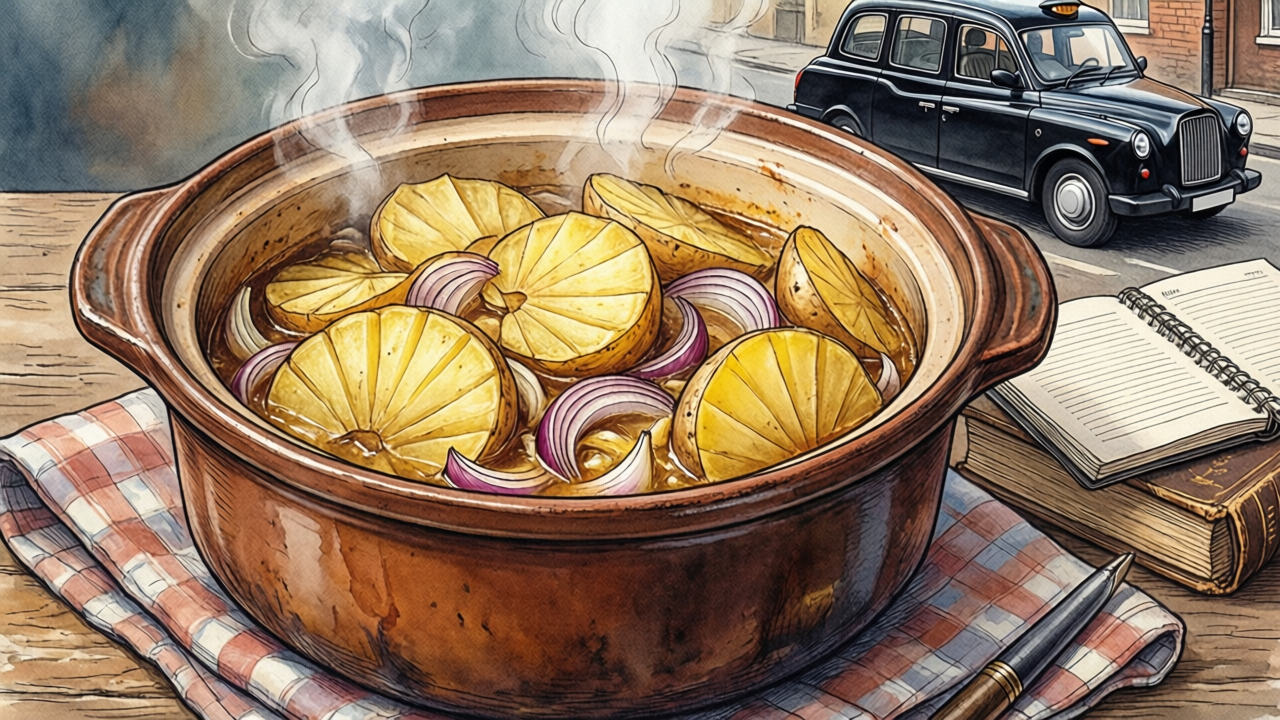
Which brings us, by the only route that makes sense, to the Lancashire hotpot: the one British dish that already has the Knowledge. Every layer knows exactly where it is going — lamb at the bottom, onions in the middle, potatoes fanned across the top — and in three hundred years it has never once been in a hurry. The OED has it being eaten in Liverpool by 1842; Elizabeth Gaskell wrote in 1854 that it was the most prized dish among cotton workers, and you can see why. You build it, you put the lid on, and you leave it alone for hours while everyone else is out at work. It is a stew that drives itself.
Ingredients
- 1kg lamb shoulder, diced into rough 3cm chunks (lamb neck chops, boned and chopped, have more flavour if the butcher will do the chopping)
- 2 large onions, sliced
- 1.2kg King Edward potatoes, peeled and sliced about 5mm — a mandoline helps, an adult with a knife is also fine
- 500–600ml lamb or beef stock; a cube is genuinely fine, this is a mill-town dish, not a coronation
- 50g butter, plus a little extra for the potatoes
- 2 bay leaves
- 1 tablespoon Worcestershire sauce
- Salt and black pepper
- To serve: pickled red cabbage from the jar, or a quick version — half a red cabbage, sliced, simmered in a splash of cider vinegar with a spoonful of sugar
Method
- Melt half the butter in a deep, straight-sided pot and lay in the lamb and onions in alternating layers, seasoning each layer as you go. This is the Charing Cross of the operation: everything else is measured from here. The traditional hotpot pot is tall, round and straight-sided with a tight lid — the dish’s own black cab, built to a standard nobody can quite justify but everybody recognises.
- Fan the potato slices over the top in overlapping rows. Overlap them like the 320 runs in the guide: no gaps, no shortcuts, and no, you cannot rearrange them into something more efficient. The Knowledge is not efficient. That is very much the point.
- Warm the stock with the bay leaves, Worcestershire sauce and remaining butter, then pour it down the side of the pot rather than over the top. Down the side, like a sensible detour round a road closure. The potato tops stay dry so they can colour later — the exam marks presentation as well as substance.
- Lid on, low oven — 150°C — and two hours. This part cannot be rushed and there is no satnav shortcut. The Victorians left hotpots cooking while the entire family was at the mill; you can leave it while you do something else, which is the same thing but with better hours.
- Take the lid off, turn the oven up to 190°C, and give it another 20–30 minutes until the potato top is golden and crisp at the edges. This is the final appearance — the bit where they decide whether you’re a driver or a tourist. The top should be golden; the lamb should give way to a fork that is merely leaning on it.
- Rest it for ten minutes before serving. Nobody ever passed the Knowledge by rushing the last junction, and nobody ever ruined a hotpot by giving it a minute. Probably not even the man from the 1836 Liverpool newspaper, writing about “second-hand Irish hot-pots” with the contempt of a man who had clearly never been offered a seat.
- Serve with the pickled red cabbage — the traditional chaperone — and mash as a plus-one if you like. The cabbage is not decoration. It is the green badge of the plate: the sharp, unfussy bit that proves you know the difference.
Leftovers keep three days in the fridge and reheat gently, by which point you’ve passed and nobody is timing you any more. The end of the road, guv’nor.