Picture the scene: Easter Even, 1936, and a stretch of the Lincolnshire coast that had, until that morning, mostly offered wind for free. Billy Butlin’s new camp at Skegness opened that day — six hundred chalets laid out like a small, optimistic town, with electricity, running water and 250 bathrooms, the lot built in seven months for £100,000 by the same crew who’d just finished Harry Warner’s camp down in Seaton. The ribbon was cut by Amy Johnson of Hull, first woman to fly solo from England to Australia, which remains the most impressive thing to happen in Skegness until the donut van arrived.
Demand was immediate: within the first summer the camp’s capacity had to be raised from 500 to 2,000. But there was a problem. The guests kept to themselves. They looked, to Butlin’s eye, bored. So he asked Norman Bradford — a man engaged as an engineer to build the camp — to spend the evening working the crowd instead. Bradford did icebreakers and jokes, and by the end of the night the place was buzzing. He became the first Redcoat, and Butlin realised he would need an army of people doing exactly what Bradford had done. Ten camps were built between 1936 and 1966. The war requisitioned them — Skegness spent its war years as a naval training base — and they went back to holidays in 1946, at which point a week of family entertainment cost about a week’s wages, and every arriving camper was issued a badge whose purpose nobody has ever satisfactorily explained.
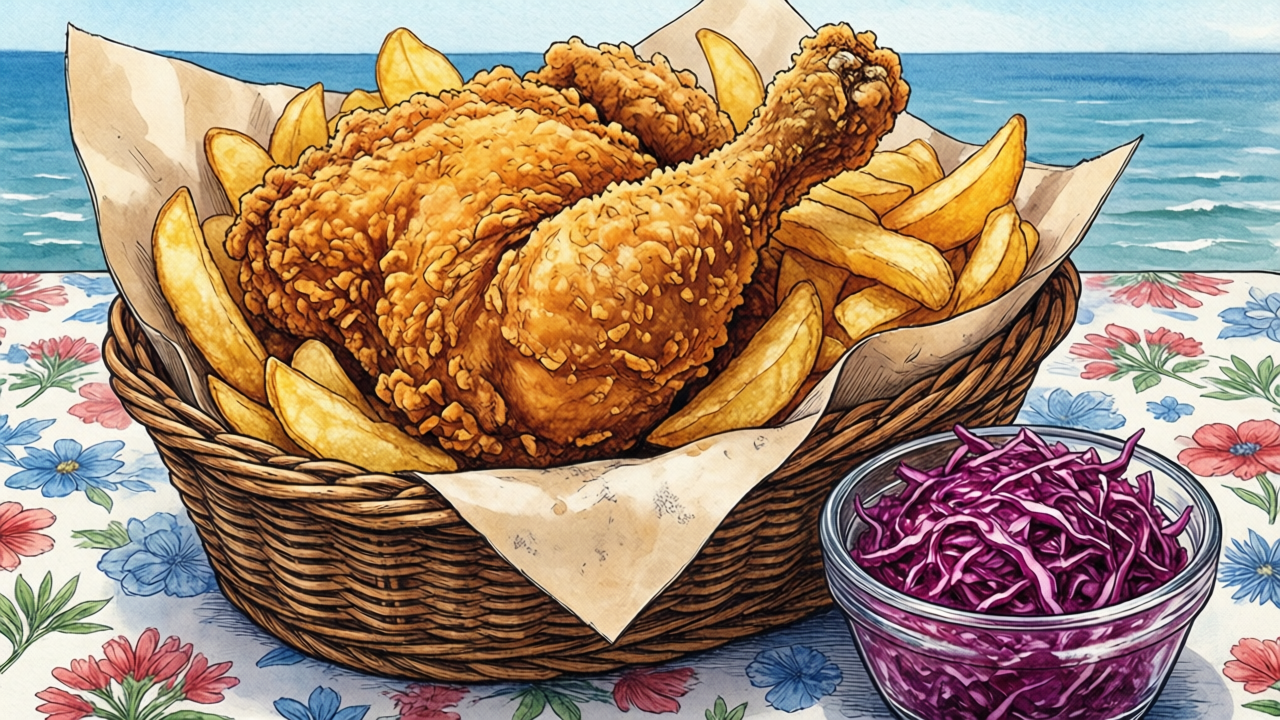
Which brings us, by a route that is entirely logical if you squint, to fried chicken. The camps built entertainment, and entertainment built a room with a stage and a supper counter. By the late 1960s, fried chicken on chips served in a paper-lined chip basket was so ubiquitous in British pubs and supper rooms with evening entertainment that the musicians and compères who worked those rooms had a name for them: the chicken-in-a-basket circuit. The dish was designed like the camp itself — no plate, no knife, one hand free for a pint, the other for a drumstick, both free for the 8pm cabaret. It is the campfire’s edible cousin, and it is worth cooking properly.
Ingredients
- 4 large chicken thighs, boneless and skinless (or 2 breasts, butterflied — thighs are more forgiving, like the 500 that became 2,000)
- 300ml buttermilk (no buttermilk? Thin some natural yoghurt with a splash of milk — nobody will audit you)
- 1 tsp smoked paprika, ½ tsp cayenne, plenty of salt
- Plain flour, for dusting
- 2 eggs, beaten
- 150g golden breadcrumbs (panko if you can find it — more crunch, same job)
- Vegetable oil, for deep frying (a deep pan, filled no more than half full)
- 1.5kg floury potatoes — Maris Piper — cut into proper thick chips
- ½ a red cabbage, shredded; 2 carrots, grated
- 4 tbsp mayonnaise, 1 tbsp English mustard, a splash of malt vinegar, for the slaw
- Brown paper (butcher’s paper, or clean baking paper) to line the basket
- Malt vinegar, to finish
Method
- The night before: whisk the buttermilk with the paprika, cayenne and a good pinch of salt, submerge the chicken, cover, and refrigerate. This is the booking. Nobody who got a chalet in the first summer decided on the morning of — commit in advance and let time do the work.
- Half an hour before cooking, take the chicken out of the fridge and pat it properly dry. Cold, wet chicken going into hot oil is the one genuine campfire mistake: it spits, it hisses, and everyone standing nearby loses confidence in the whole enterprise.
- Set up three stations: seasoned flour, beaten egg, breadcrumbs. Chicken into flour, shake off the excess; into egg; into crumbs, pressed hard. Assembly line, camp-kitchen style — one pair of hands per station. That is how the dinner bell stayed on time.
- Then back through the egg and the crumbs a second time. The double crumb is the Redcoat’s second joke: strictly unnecessary, but it’s the one that gets the biggest reaction.
- Heat the oil in a deep pan to about 180°C — a breadcrumb dropped in should fizz immediately and cheerfully, like the campfire on the last night of the week. Fry in batches, turning once, until deep gold and cooked through: 10–12 minutes for thighs, a little less for breasts. Do not crowd the pan. Six families on one pitch is how everybody ends up cold and miserable.
- Rest the chicken on a wire rack for ten minutes — not on kitchen paper, which steams the underside, and a soggy crumb is a cancelled cabaret. Rest it like a headliner between sets: on a chair, in view, doing absolutely nothing.
- Meanwhile, the chips: boil 4–5 minutes, drain and let the steam do the drying, then fry once at a moderate heat and again, hotter, until they’re the colour of a Butlin’s camp badge (issued on arrival, 1936–1967, purpose never explained). Two fries, no shortcuts — the campfire doesn’t get lit twice either.
- Slaw: shred the cabbage, grate the carrot, dress with the mayonnaise, mustard and a splash of malt vinegar. Five minutes, no rehearsal — the only part of the evening that runs first time.
- Line a basket with the brown paper (a clean bowl works fine; the basket is doing theatre, not engineering). Chips first, a ramekin of slaw to one side, chicken laid on top, and a splash of malt vinegar over the chips. The vinegar goes on the chips, not the chicken. That is not a suggestion; it is camp law.
No meat? Thick slices of king oyster mushroom — the thick ones you’d mistake for scallops — take the same buttermilk soak and the same double crumb, with a shorter fry. They’ll pass for chicken in a dim supper room, which is the entire history of the dish.
Leftovers keep a day in the fridge and should be revived in the oven, never the microwave — the microwave gives you the campfire’s heat and none of its crunch. But eat it fresh if you can. The basket empties, the cabaret ends, the Redcoat is already planning tomorrow’s treasure hunt, and lights out, as ever, is ten.