There is a room at the top of most English church towers that nobody warns you about. It’s smaller than you’d imagine — a painted circle on the floor, eight ropes coming down through holes in the ceiling, and a woollen grip halfway up each rope called the sally, which is four feet long and exactly as comfortable as it sounds. Eight people stand around the circle in what is generously called a band, and for half an hour before the service they pull ropes in a sequence that never repeats itself. That last part is the whole point. It’s called truth, and its opposite has one job in the language: when a row gets rung twice, the ringing is false. Not “sloppy”. False. A word usually reserved for alibis.
The hobby has taken this slightly further than strictly necessary. Full-circle bell swinging was invented in England in the early 17th century, and by 1668 Richard Duckworth and Fabian Stedman had published Tintinnalogia, a book whose subtitle promised “plain and easie Rules for Ringing all sorts of Plain Changes”, which is the kind of promise a book can make and unmake in the same breath. Because eight bells have 40,320 possible orders. Ringing every one of them without repeats is called an extent, it takes over twenty-two hours non-stop, and it is essentially never done — the hobby’s equivalent of the marathon nobody enters on a Tuesday. So instead they ring peals: 5,040 changes, no repeats, roughly three hours on your feet in a cold room. There’s a board at St Peter and St Paul in Chatteris, Cambridgeshire, recording a peal from 1910 — 5,040 changes, two hours and forty-nine minutes. The church thought that worth putting on a wall forever. Most of us can’t keep a group chat on topic that long.
The connection to tonight’s dinner is structural. Onion rings and change ringing are both ring-based, both collapse the moment one member of the band starts thinking of themselves as a soloist, and both go false the instant you crowd them. What follows is a recipe with a method, and in this house we follow the method.
Ingredients
- 3 large onions, peeled and cut into 2 cm slices (the biggest ones in the produce aisle; small onions are a different change)
- 150 g plain flour, plus 1 tsp baking powder
- 200 g fine cornmeal — golden, from the baking aisle; plain flour doubled is a fine swap, cornmeal is just the louder option
- 1 tsp smoked paprika
- 1 tsp mild curry powder — the chip-shop kind, not the fiery kind
- 1 can (330 ml) very cold lager, or the same volume of very cold sparkling water if you’d like these to be a dry accomplishment
- Oil for deep frying — sunflower or vegetable, whatever’s on the shelf in quantity
- Sea salt and plenty of black pepper
- For the dip: 3 tbsp mayonnaise, 1 tbsp wholegrain mustard, a shaken-in pinch of curry powder
This is, start to finish, a vegetarian operation. Nobody had to be consulted about it.
Method
- Break the onion slices into rings and pull out the core pieces — keep the small complete ones, they’re useful practice. Every ring wants to be 2 cm thick: any thinner and it isn’t a ring, it’s an onion crisp, and that’s a separate institution with its own politics.
- Soak the rings in cold water for fifteen minutes, then drain and pat properly dry. This takes the raw edge off and keeps the layers supple — the band warming up before the real thing.
- Set out three stations: the seasoned flour (flour, baking powder, paprika, curry powder, salt, pepper); the batter (half the flour mixture whisked with the cold lager to a sloppy, pancake-batter consistency, then left to sit ten minutes); and the cornmeal on a flat plate. Flour, batter, cornmeal. The three places every ring must pass through: lead, dodge, settle.
- Heat about 5 cm of oil in a heavy pot to 180°C. No thermometer? A cube of bread should turn gold in around forty seconds. If it colours faster than that, the oil has gone off the change — too hot, and the batter sets before the onion has softened, which everyone will taste and nobody will be able to name.
- Roll each ring in the seasoned flour, shake off the excess, dip it through the batter, then press it into the cornmeal. Do not skip the flour — batter slides straight off wet onion like a ringer skipping his practice slot. This is the method. Nobody ever rang a peal by inventing a method mid-ringing, and nobody ever built a cornmeal crust by improvising at station two.
- Fry in small batches — four or five rings in the oil at a time, two to three a side, until deep gold. This is the step that separates amateurs from towers. A crowded pan is what the hobby calls false: the temperature crashes, the rings merge into a single sad garland, and everyone watching can tell before the person responsible does.
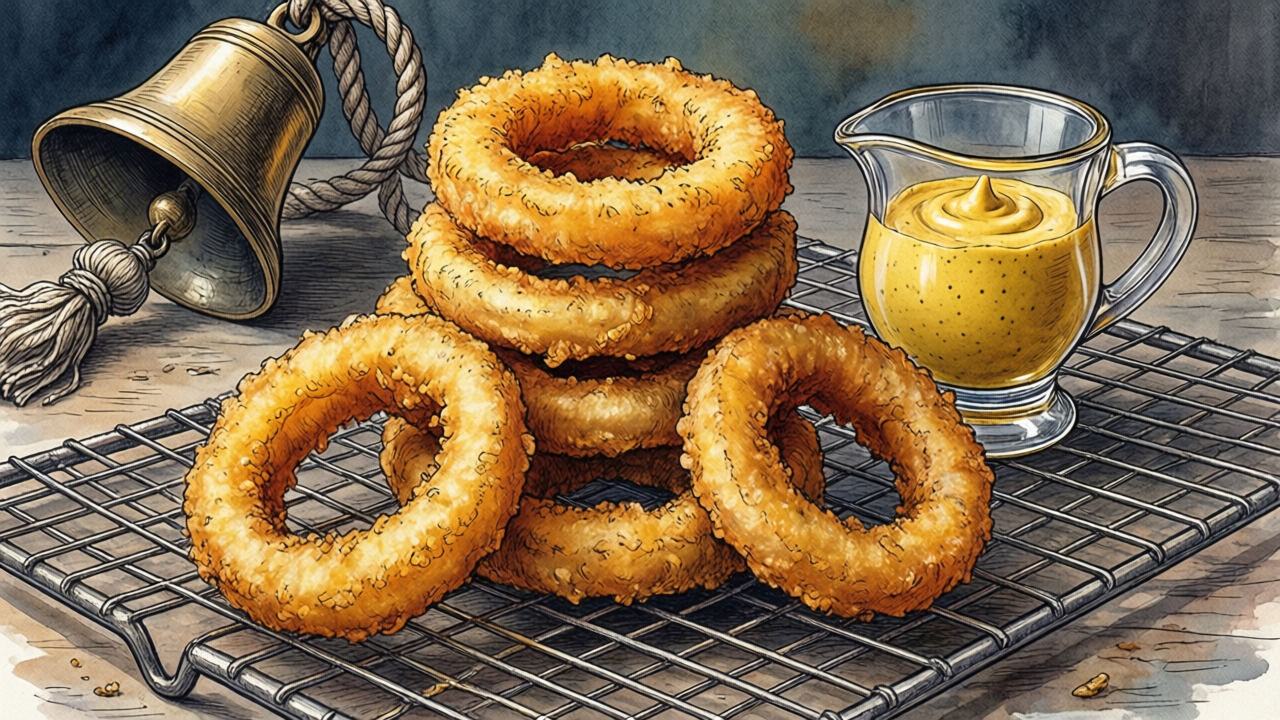
- Lift out onto a wire rack and salt immediately, while the batter is still tacky enough to hold it. Not kitchen paper — paper is where crunch goes into hiding. Keep finished batches warm on a rack in a low oven, which is where the second half of the band waits politely for its turn.
- Stir the dip together and put it in the middle of the table. Stack the rings three high if you want the table to see what a sally looks like from below.
They cannot be saved. Onion rings do not reheat into anything you’d invite back; eat them within the time it takes the batch to cool, which is mercifully close to the length of a normal tower performance anyway. If anyone at the table asks how many rings you’ve rung, give them the only number the hobby respects: 5,040, in two hours and forty-nine minutes, on a board in Cambridgeshire since 1910. The rings will be gone before anyone can check whether it’s true. That’s allowed. Only the ringing has to be.