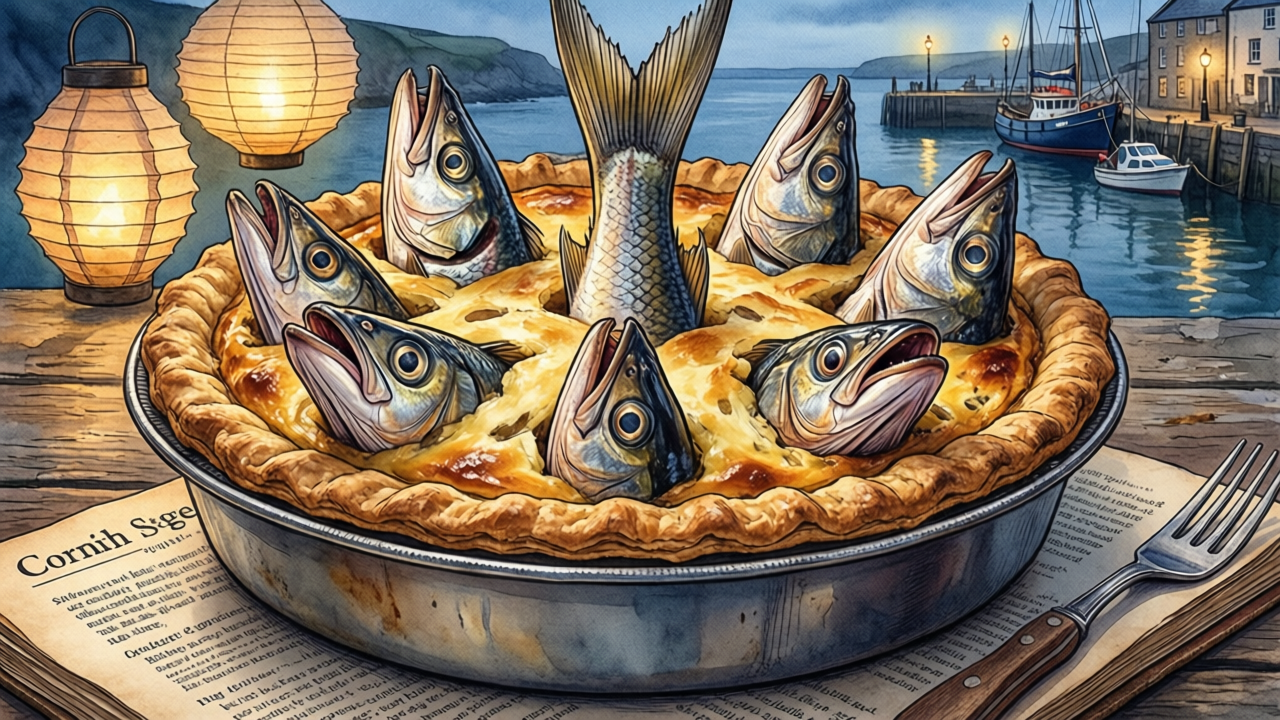
On the evening of 23 December, in a Cornish harbour roughly the size of a shopping trolley, the hand-made lanterns come out. Mousehole does things by halves about as often as it does them by whole: the illuminations have lit the entire harbour since 1963, one of the light displays is a giant pie sitting under six stars, and the villagers process a colossal stargazy pie on a table down to the Ship Inn — the village’s only pub — while the company toasts the name of a man nobody has ever managed to prove existed.
The man is Tom Bawcock, and the story goes like this: one winter in the sixteenth century the storms pinned every boat in the harbour and the village, which survived on fish the way other villages survived on stubbornness, was headed for a hungry Christmas. Bawcock rowed out on 23 December into weather that had already cancelled everybody else’s plans, and came back with enough fish to feed the entire place — seven kinds, all baked into one enormous pie. The fish heads poke up through the pastry, in the legend, to prove there were fish inside. Which is, when you think about it, the most Cornish answer to a credibility problem ever recorded: not an argument. Evidence, still attached.
The joke being that Bawcock himself is the bit nobody can attach. The folklorist Robert Morton Nance wrote up the feast in the journal Old Cornwall in 1927, describing a custom as it stood before 1900, and suspected the name was really the French Beau Coc — a handsome rooster, which would be a magnificent reason for a fisherman’s festival. A rumour says the whole occasion was invented by the landlord of the Ship Inn in the 1950s. The pie outdates the landlord, though printed accounts barely outrun the myth: William Sandys’ 1846 dialect collection lists it as pilchards and leeks, and as far back as 1820 a newspaper printed by the crew of a Royal Navy Arctic expedition was already writing, through the ice and the homesickness, of a pilchard who “peeps through the crust, the moon and stars to see”. Frozen naval officers, missing a Cornish fish pie. British nostalgia has no lower temperature limit.
The heads do have a practical job: they act as little drainpipes, letting the oil run back into the pie as it bakes, which is how a pie built from fish, potatoes and leeks alone stays moist. But the folk answer is better, and the Devil vouches for it. In Robert Hunt’s collection of Cornish legends, the Devil crossed the Tamar to Torpoint, noticed that the Cornish would put nearly anything in a pie, and went back to Devon at once — before they got the urge to make a devil one. So this is a pie designed to defeat doubt, and this recipe comes with its proof of contents on display like Bawcock’s — best believed in the dark, by lantern light, by people who want to.
Ingredients
- 4 whole mackerel, cleaned with the heads left on (the fish counter will do this if you ask nicely and catch their eye; large sardines are the traditional swap — plain fillets work too, they simply cost the pie its stare)
- 600g new potatoes, boiled and sliced
- 2 leeks, trimmed, thickly sliced, softened in butter (an onion if the leeks are being difficult)
- 4 eggs, boiled, cooled, halved
- A little butter, plus 3–4 knobs for between the layers
- 1 bay leaf, plenty of black pepper, salt with a heavy hand’s restraint — the fish bring their own opinions
- A splash of milk
- Pastry: 375g plain flour, 185g cold butter chopped, 1 egg and a splash of cold water. Puff pastry is permitted — the lid is a display piece — but if you use it, admit nothing to Bawcock
- 1 beaten egg, to glaze
Method
- Boil the eggs first, cool them, halve them. Everything else in this pie is negotiable; the eggs go in at the bottom, uninsured, like the village’s winter savings.
- Rub, bind and rest the pastry for half an hour at least. Pastry rests the way a fisherman does after a storm — no shortcuts, the resting is the point.
- Soften the leeks gently in butter until properly yielding. This part cannot be rushed. Nobody ever outran a gale in a rowing boat, and the leek knows it.
- Build the pie in a deep dish: potatoes on the bottom, softened leeks over, egg halves tucked between, bay leaf, black pepper, the butter knobs distributed between every layer. Press it down like the catch going into the one pie — potato for bulk, leek for quiet competence, egg for morale.
- Prepare the fish: cut the mackerel along one side leaving the head attached to the fillet — a job the fish counter will take off your hands for the price of “please”. Lay the flesh into the pie and angle each head upright, where the lid slits will go. Not decoration. Affidavit. Proof of fish inside, mounted like a headline act.
- Fit the lid, crimp the edge hard, slit the top, brush with the egg and milk. The crimping should resemble the structural integrity of a harbour wall — adequate but not inspiring. The heads stay outside the pastry, upright, like witnesses waiting to be called.
- Bake at 200C for 40–45 minutes, until the lid is properly gold and the heads have a visibly roasted opinion about it. If the pie looks dry, a splash of milk through the slits. Watch it through the oven door exactly once, the way the village watched the harbour: not because watching helps, but because waiting without watching is not the Cornish way.
- Rest ten minutes, then carry it to the table on something steady — a procession if there is one, a lantern if there is dark, a tray at minimum. Cut between the heads, never through the lid itself: the lid is evidence, and the slice should come down through the middle where the uninsured eggs are.
Vegetarian version: trade the mackerel for 500g thickly sliced mushrooms and a drained tin of butter beans, bound in a few spoonfuls of white sauce with a handful of capers, and poke four parsnip fingers through the lid where the heads go. The pie is contractually obliged to have something pointing at the sky; heads are tradition, but the sky has no view on species.
Eat hot, on the night everyone is pretending not to be watching you eat it. It keeps a day or two in the fridge — rather longer, unfortunately, than Tom Bawcock’s own credibility has kept, and about the right amount of certainty for a dish whose entire design is proof you can inspect but never quite finish. Take the five-star review from the one food critic who refused to stay for pudding: the Devil inspected a Cornish pie, concluded they would bake anything, and left the county. Heads, as always, were proof.