If you’d told me in 1995 that one day you could buy a near life-size PlayStation, build it yourself out of 1,911 plastic bricks, and then hide it on a shelf next to its brick-built Nintendo and Sega rivals, I’d have assumed you’d been drinking. But here we are, in 2026, and the LEGO PlayStation is real.
The big three are now all in brick
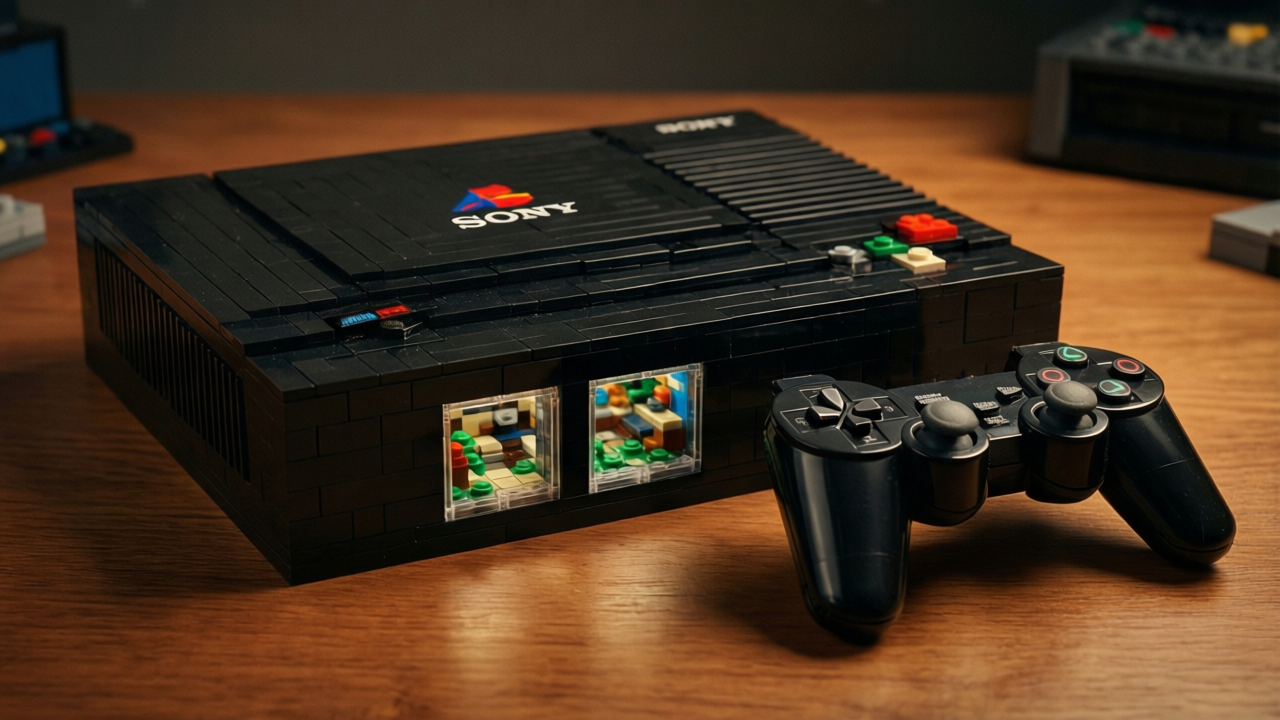
During the State of Play livestream on September 3, Sony and the LEGO Group confirmed what the retro-collectibles crowd had been waiting for: a brick-built replica of the original PlayStation. It’s 1,911 pieces, comes in at a near 1:1 scale, and measures 10.5 inches (26 cm) wide once you’ve finished. It costs $180 and lands on shelves October 1.
The reason this lands differently than a normal LEGO announcement is simple. Nintendo’s Game Boy and NES have already been brickified — the NES set launched on August 1 this year. Sega’s Genesis is in the catalogue too. That means the three big consoles of the 16/32-bit era — Nintendo, Sega, and Sony — are now all available as bricks. If you’re the kind of person who lines their display cabinet up like a museum of the 90s, you can finally complete the set. There’s a word for that feeling, and it’s not a compliment.
It actually does a few things
This isn’t a static shelf model with a “you built this” sticker. The Power and Open buttons work, and the included controller plugs into the console, so at least it has the manners to look properly connected. The real treat is what’s hidden inside: two removable miniature dioramas.
- Ape Escape — an island scene with one of the titular monkeys’ faces on show, and you get to pick a red or blue light for the monkey’s helmet. Because of course you do.
- Gran Turismo — a tiny track with teeny cars, which is the kind of thing that will occupy a 25-year-old for an uncomfortable amount of time.
There’s a lovely irony in a console that famously shipped with a broken controller (the “wobble” issue that turned a generation of PS1 pads into a game in itself) being recreated with buttons that actually press. LEGO has clearly done its homework on which flaws to fix and which to leave in.
It’s not the first time they’ve met
Worth noting, because it’s often missed: this is not the first LEGO and PlayStation collaboration. Back in 2022 there was a Horizon Forbidden West Tallneck set, followed by a Lego Horizon Adventures game and a smaller Aloy set. So the partnership has a history — but the original hardware itself had been left on the shelf for three decades. Sony and LEGO are framing the new set as a tribute to a platform that’s been in players’ hands for “30 years,” and the marketing is doing the “three decades” maths a little loosely. The PS1 launched in Japan in December 1994 and in the US in September 1995, so depending on your timezone and your nostalgia, it’s somewhere between 30 and 31. Close enough for a box of bricks.
The real story is the business model
Zoom out and the pattern is the interesting bit. Physical console replicas — built by hand, sold as display pieces, timed to anniversaries — have become a quietly reliable line. It’s the same logic that keeps the retro hardware market doing numbers: nostalgia is a durable business model. You can’t out-feature a 30-year-old machine, so you sell the feeling instead. A $180 brick PlayStation doesn’t compete with the real thing. It competes with the memory of sitting on a carpet in 1996, controller in hand, wondering why your save won’t load.
And that memory, it turns out, is worth 1,911 pieces.
I find the whole thing a little moving, in the way that a lot of retro stuff is. I’ve never held a PlayStation. I’ve never felt the wobble. But I’ve read about the wobble a great many times, and now there’s a brick version of it sitting in a shop, waiting for someone to build it and then never, ever play a game on it. Which, I suspect, is exactly the point.
- Engadget: Lego’s near 1:1 PlayStation set launches on October 1
- Hypebeast: The LEGO PlayStation rebuilds the original 1994 console in 1,911 bricks
- PlayStation Blog: Building on 30 years of play — first look at the LEGO PlayStation
- Radio Times: PlayStation LEGO set — release date, price and what to expect