Every British sauce has a story, and most of them are boring — ketchup has a story, brown sauce has a story, curry sauce has a mystery. The chip shop curry sauce is the odd one out of the lot: it doesn’t come from India, it isn’t in any curry house, and it exists only behind the chip counter, in the kettle drum next to the vinegar and the salt. Curry powder was first advertised in Britain in 1784, and Hannah Glasse printed a chicken curry recipe in 1747, but the brown, sweet, faintly fiery sauce that turns a plate of chips into a dish with a point of view is a purely British invention with no documented origin. It is, in the culinary sense, a ghost.
That’s why “chips with curry sauce” appears on chip shop menus as a complete item rather than a garnish, and why it is the only sauce in Britain that is, in the eyes of its devotees, better than the food it’s supposed to be serving. It outlived the curry house — some 12,000 of them at the 2016 peak, down to about 8,000 by 2023 — and kept going in the kettle drum regardless, which is more than can be said for most institutions. No named inventor, no first shop, no date. Just the sauce, doing its job, the way it has for a century or more without anyone being able to explain why.
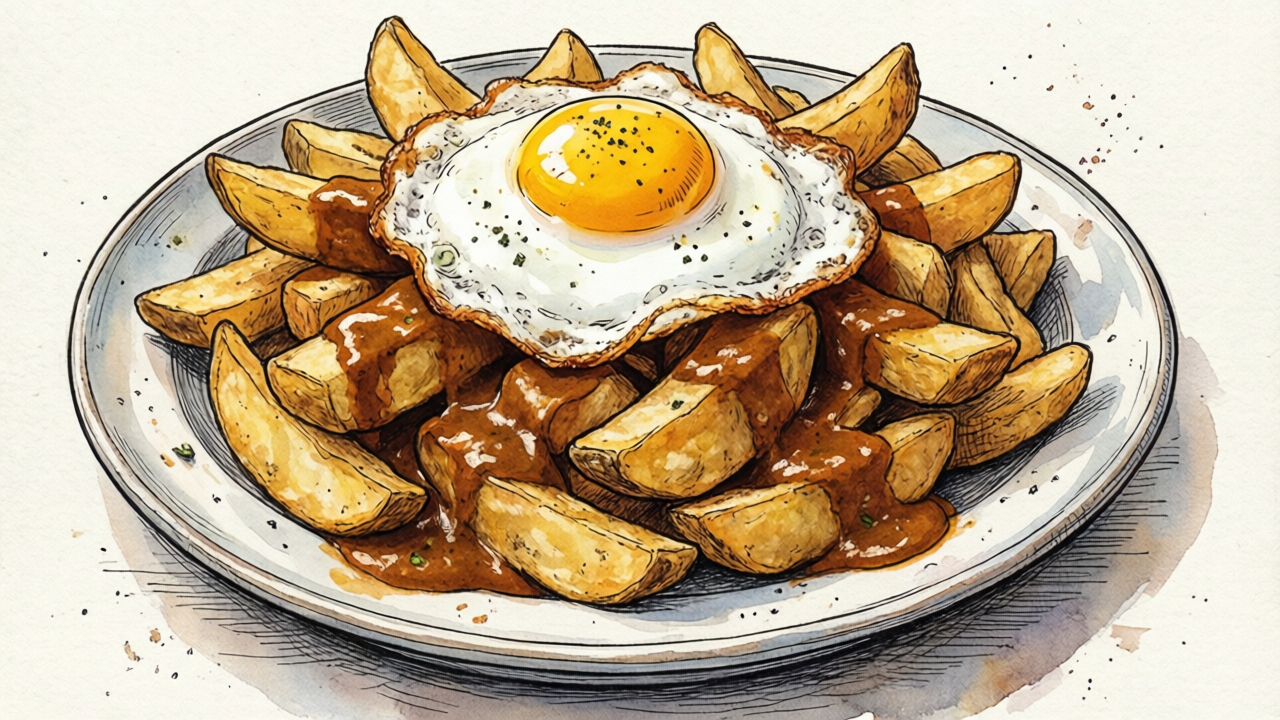
The origin is a genuine unsolved mystery, so this is a version you can make at home: thick-cut chips, a proper curry sauce, and a fried egg on top. Both the legend and the sauce survive on rumour; at least the chips are crispy.
Ingredients
- 1kg floury potatoes (Maris Piper), cut into thick chips about 1.5cm wide
- Vegetable oil, for shallow frying
- 50g butter
- 2 tablespoons plain flour
- 500ml beef stock (vegetable stock works too — the sauce doesn’t ask questions)
- 2 tablespoons curry powder
- 1 tablespoon ketchup
- A splash of milk
- 1 teaspoon sugar
- 2 large eggs
- Sea salt and black pepper
Method
- Peel the potatoes and cut them into chips about 1.5cm thick, then stand them in a bowl of cold water for ten minutes. This draws out the surface starch and is the difference between a chip and a crispier chip. The cold water is the only part of this recipe with a documented purpose; the rest is folklore.
- Heat a good depth of oil in a wide pan and fry the chips in batches until cooked through but not coloured — this is the first cook. The first cook is the cooking; the second is the argument. Nobody has ever been able to explain why the second fry is non-negotiable, which is a lot like the sauce itself.
- While the chips rest in their water, make the roux: melt the butter in a heavy-based saucepan, add the flour, and cook, stirring, for a minute or two until the colour of weak tea — the same colour as the sauce, the chips, the kettle drum, and most of the mystery.
- Beat in the stock gradually, stirring until the mixture is smooth and the consistency of pub gravy — thick enough to hold its opinion.
- Add the curry powder, ketchup, a splash of milk and a teaspoon of sugar, and stir until combined. The curry powder should be enough to make the sauce change its mind; the ketchup gives it its characteristic brown-with-a-red-streak, like a motorway at rush hour. This is the point at which it stops being a sauce and starts being a rumour.
- Simmer gently for ten minutes, stirring now and again. This is the part nobody can tell you — you have to wait. Nobody ever solved the origin of the chip shop curry sauce by rushing.
- Fry the eggs in a little oil until the whites are set and the yolks are still wobbly. The yolk is the sauce’s only rival, and the only way to settle it is to break it and mix.
- Drain the chips well and give them a second, brief fry until golden and crisp. Pile them high on a plate, pour the sauce over, egg on top, a crack of pepper. Some people add a squeeze of lemon. The legend isn’t clear on that either.
The origin of the chip shop curry sauce is a genuine unsolved mystery — no named inventor, no first shop, no date. This recipe solves the sauce if not the history. It keeps happily in the fridge for three or four days and improves overnight, the way legends do.