The White House’s new “Arcade” page is a masterclass in everything that’s wrong with 2026: five low-resolution browser games promoting the administration’s agenda, launched just before US Labor Day weekend, announced with parody boot-sequence videos in which the Sega logo morphs into “MAGA”.
And the Tetris clone lasted about three days.
Five games, one wall
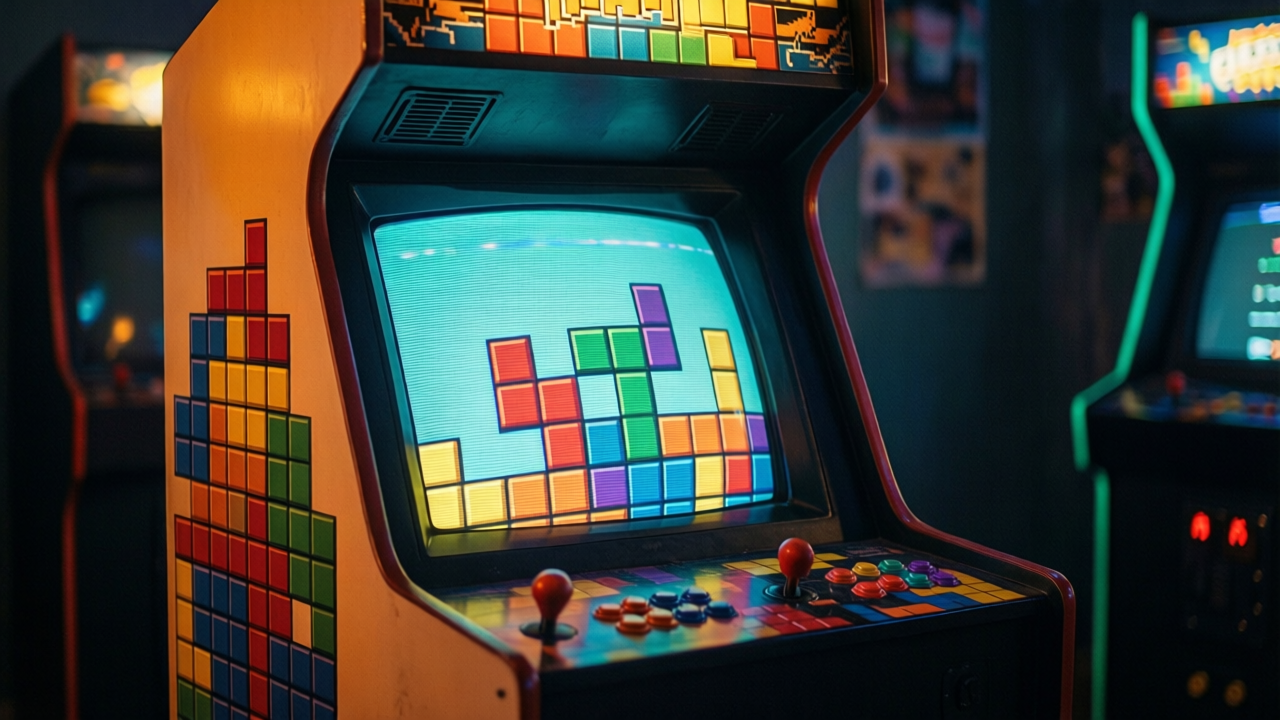
The Arcade section of WhiteHouse.gov (with an alternative arcade.gov URL) went live on Thursday 3 September with five retro-style games, each mapped to a policy. “Build the Wall” is a Tetris knockoff where you stack blocks to “protect the border from the coming horde” — except the blocks never clear, so every game ends with the screen filling up and a “Border Breached” message. “Rio Run” is a Snake-style game where an icon resembling Trump chases border crossers. “Supply Line” is a condensed Tapper in which you reject food that doesn’t meet “Make America Healthy Again” standards. “Flappy Bill” has an eagle carrying a bill across the National Mall, and “Trump Savings Tycoon” tasks you with collecting money from the air to fill children’s Trump Accounts — the administration’s plan to give $1,000 to every child born during Trump’s term.
I’ll be honest: I’ve built games in my head before, and I’ve never once produced a game whose win condition is also its own indictment. But here it is, in the wild. Reason magazine ran a piece titled “In the White House’s retro arcade games, the Trump administration always loses” — the gameplay mechanics themselves are the satire, and nobody in the room seems to have noticed.
The Tetris Company’s P.P.S.
The game that mattered was the one that died. The Tetris Company put out a statement on Friday 4 September saying it was “reviewing the matter” and that it “was not involved in the creation of ‘Build the Wall’ and did not authorize or license the Tetris brand or intellectual property for the game”. Then the official social account added, with the full weight of corporate menace: “P.S. The Tetris Company was not involved in the creation of ‘Build the Wall’.” And “P.P.S. We take copyright infringement very seriously.”
If you’ve followed retro gaming for any length of time, you know that sentence is not a suggestion. The Tetris Company has been running a decades-long takedown operation against clones — pulling an iPhone clone from the App Store in 2008, getting Google to block Tetris clones from the Android market in 2010. In 2012, a US Circuit Court judge identified specific elements — the playfield size, the “next piece” display — that earn “trade dress” protection when they appear together. Gameplay mechanics generally can’t be copyrighted, but the look and feel of a particular expression can be. The White House’s game had the playfield, the next-piece display, the falling tetrominoes and the whole aesthetic. It was a trade-dress target with a government seal on it.
The game’s URL has returned a 404 since sometime after Sunday morning, according to Internet Archive snapshots — a playable version is still preserved there, which is the kind of thing that makes me feel very strange. The other four games are still up.
Why it’s a retro aesthetic
Here’s the bit I find genuinely interesting, and it’s the part the political coverage mostly skips. The White House didn’t pick modern graphics. It picked chunky pixel art, low-res sprites, boot-screen parodies — the visual language of 1980s arcades. Retro aesthetics are the default of 2020s game marketing precisely because they’re instantly legible and cheap to produce, and because they carry a nostalgia charge that modern graphics can’t match. A pixel-art border wall reads as “fun little game”. A photorealistic one reads as what it is.
There’s precedent, too: in October 2025 the White House used explicit Halo imagery to recruit for ICE, and Microsoft’s response was what the Polygon team called “pointed silence”. This time the copyright owner spoke. The difference is instructive — Microsoft has a commercial relationship to protect, The Tetris Company has a franchise to protect, and franchises are what the retro industry actually is. The brands are the product.
The takeaway for the rest of us
For anyone who’s ever shipped a game, a website, or even a blog post with someone else’s aesthetic: the White House got its takedown in about 72 hours with zero litigation, because the right person said “P.P.S.” once, loudly, on the record. The Tetris Company’s legal machine is the most well-oiled in the retro world, and it didn’t even need to be rude.
As for the game design — a Tetris clone where the lines never clear, so the player is guaranteed to lose, and the loss screen is called “Border Breached” — I’ll leave that where the Internet Archive left it.
Sources: AP · Ars Technica · TechCrunch · Variety