There is a field somewhere in the Midlands on a Saturday afternoon where the grandstand is a row of straw bales and the commentary is a man with a megaphone who has clearly been told to “keep it moving”. The cars are second-hand family saloons with the interiors ripped out, the wings bolted on with whatever the scrapyard had, and the number 37 on the door because the number 37 is what’s left in the paint tin. They race each other into a wall. Deliberately. The winner is frequently the car that still has all four wheels at the end, which is a philosophy of competition you will not find at Ascot.
Banger racing — racing derelict cars on purpose, contact not merely tolerated but written into the rulebook — is a British invention, and it properly took off in the 1960s. The first stock car meeting at Wimbledon greyhound stadium was on 29 September 1962, and the place became the sport’s flagship venue for a decade; the Unlimited Banger World Final raced there until 2008, when the London low emission zone made it too expensive to bring the transporters. The spiritual patron of the whole affair is the Ford Popular: built 1953 to 1962, the cheapest new car in Britain at launch, 155,340 made, 30 horsepower, one vacuum wiper, no heater, and a dashboard that was literally a flat steel panel. Not so much a car as a roof with an apology attached. The sport runs on the economy of the second-hand. Nobody at a banger meeting has ever paid full price for anything, and they are furious about anyone who has.
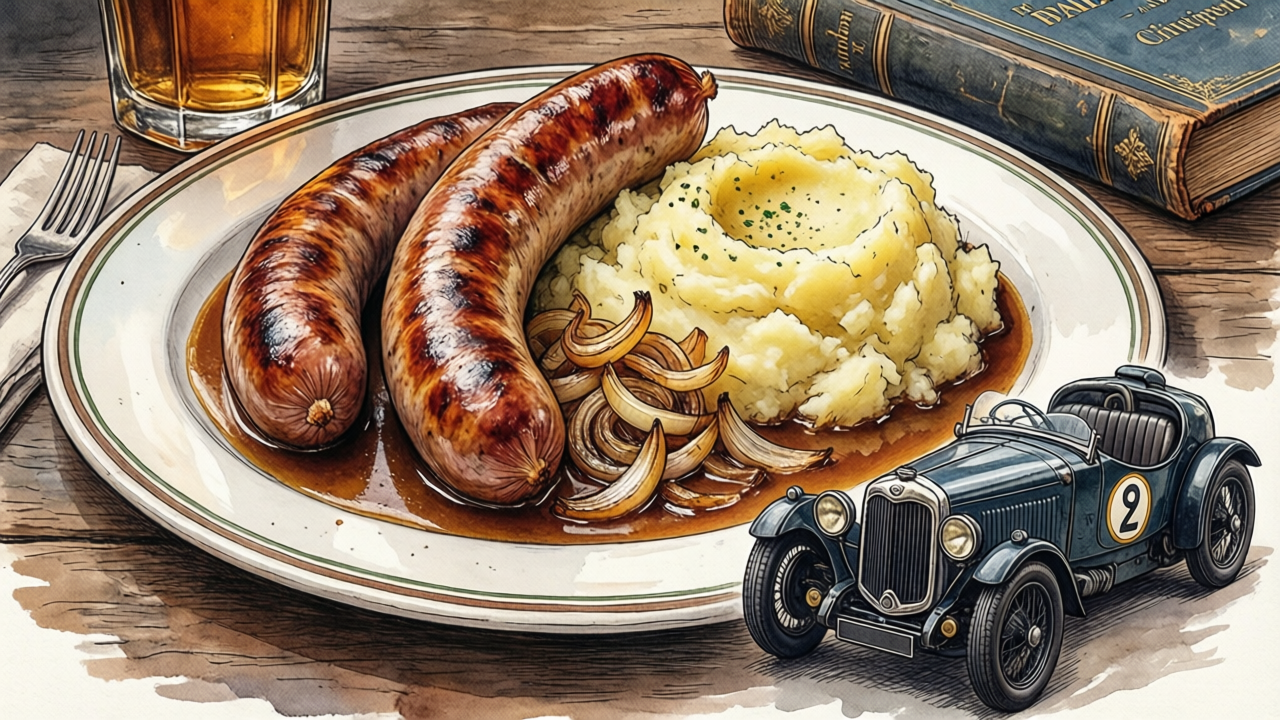
Which brings us, via a route that will surprise exactly nobody who has read this far, to bangers and mash. Sausages, mash, onions, gravy: a dish built entirely from the cheap parts, assembled with no pretence, served in a pub so dark the menu is a rumour. Both the sport and the supper reward the people who don’t chase their losses. Both are at their best slightly past the point of respectability. And both are, deep down, about the wing.
Ingredients
- 8 thick pork sausages (the proper kind from the butcher counter or the good pack in the chiller — about 100g each if you’re weighing)
- 1.5kg Maris Piper potatoes, peeled
- 100g butter, plus another knob for the mash
- 3 large onions, sliced into rings
- 2 tbsp sunflower oil
- 2 tbsp plain flour
- 1 tbsp Marmite
- 1 tsp English mustard powder
- 600ml beef stock (a proper stock cube is fine; this is bangers and mash, not the Grand National)
- 1 splash of stout or extra stock, for the finish
- Milk, for the mash
- Salt, black pepper
Method
- Put the potatoes in cold salted water and bring them to the boil. They have the longest race on the card; everything else starts later. This is the number 37 of the menu — it’s been running since before you arrived.
- While they go, melt the butter in a wide pan and put the onions in on medium-low. They should go slowly, soft and golden, over twenty minutes or so — like a race secretary explaining the class rules, nobody ever got anywhere by rushing the onions.
- Take the onions out and put them somewhere warm. In the same pan — do not wash it, that pan is now property of the meeting — brown the sausages on all sides over medium heat. You want colour, not a char: the sausages should look like they’ve been in a respectable incident, not a total write-off.
- Drain the potatoes and let them go steam-dry in the pan for a minute. Mash them with the knob of butter and a splash of hot milk. Season hard. The mash should be smooth enough to lose a spoon in, which is the same standard the marshals apply to a car’s bodywork: no flaps, no loose parts.
- Back to the sausage pan: stir the flour and mustard powder into the fat and cook for a minute, until it smells like a biscuit that’s gone slightly off. This is the roux. It is the wing. Nobody notices it until it comes off.
- Take the pan off the heat and stir in the Marmite — it’ll clump, then dissolve, like the commentary getting emotional about a first-lap pile-up. Add the beef stock a ladle at a time, stirring, back on a gentle heat. It should thicken to something that coats a spoon with conviction. A splash of stout at the end if it’s being thin or mean.
- Put the sausages back in the gravy, on the lowest heat, for ten minutes to finish through. Gentler than the heat, more patient than the queue at the gate. They should be cooked through but never split — a split sausage is a car that lost its wing on the final lap.
- Return the onions to the gravy for the last two minutes, so they rejoin the race with their dignity mostly intact.
- Build the plate like the results board: mash as the base, sausages on top, onions arranged over, gravy poured with a steady hand and absolutely no showmanship. Gravy is a public service here, not a special effect.
Veggie variant, because the scrapyard was never exclusive: thick vegetarian sausages from the chiller aisle take the same colour and the same gentle finish, and vegetable stock does the gravy’s job with the Marmite doing the shouting. Everything else — the slow onions, the load-bearing roux, the smooth mash — is unchanged.
The gravy keeps for three or four days in the fridge, which is a longer and more dignified second life than most of the cars get. The sausages don’t keep at all, but then they were never meant to. Best eaten with the same philosophy as the meeting itself: don’t chase the losses, keep your wing on, and leave while there’s still something left to drive home.