Every British village has one. It sits back from the road behind a car park that is never quite full and never quite empty, and it is called something earnest: the Memorial Hall, the Village Institute, the Community Centre. Inside: linoleum with a pattern designed to hide spilt tea, a stage the width of two dining tables with painted curtains that smell of 1977, badminton nets left hanging because nobody can be bothered to take them down, and a noticeboard held together with blu-tack and optimism — a lost cat from August, a coffee morning from June, a raffle for the roof appeal that has been the same roof appeal for eleven years.
The hall itself is usually the village’s most sincere building. Estimates put the number of village halls in the UK at over 10,000, and most of them went up in the decade after the First World War — 1919 to 1929 — as memorial buildings, driven by the newly formed National Council of Social Service. The war dead are on a board by the door. The committee that keeps the place running is, by tradition, the same committee that has been arguing about the boiler since at least 2009.
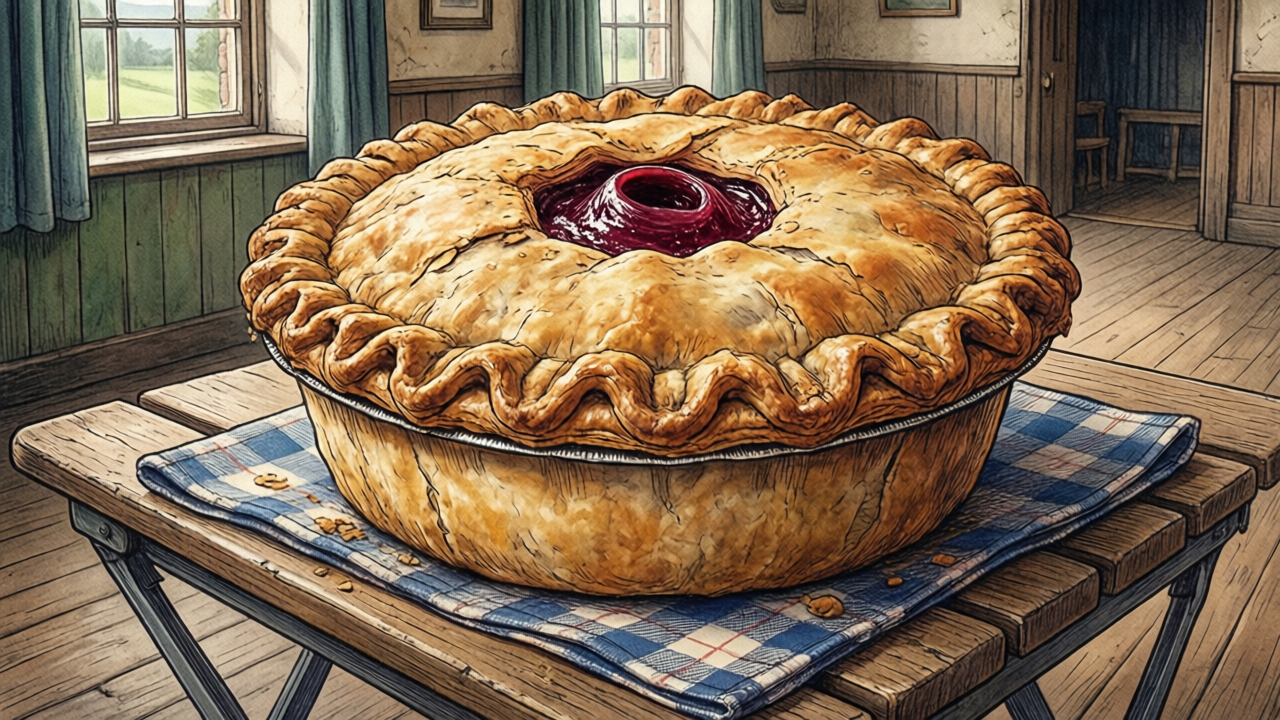
Which brings us to the food. A village hall can survive a funding crisis, a leaking roof and a decade of the same raffle, but it cannot survive a function without a pie. So here it is: a proper pork pie with a jelly poured in through the hole in the top — the only item on any village agenda ever approved unanimously.
Ingredients
- For the pastry (a hot water crust — this is structural work): 300g plain flour, 100g lard, 100g butter, 150ml whole milk, 1 tsp salt
- For the filling: 400g pork shoulder, diced as small as your patience allows; 200g pork belly or streaky bacon, diced; 1 large onion, finely chopped; 2 tsp dried sage; 1 tsp mace (or half a grated nutmeg — it’s the same argument the committee has about the tea urn); 1 tsp black pepper; 1 generous tsp salt
- For the jelly: 300ml good chicken or vegetable stock and 1 gelatine leaf (or 1 tsp powdered gelatine), sprinkled in warm — the supermarket gelatine is fine; the committee has accepted it
- 1 egg, beaten, for the glaze
Method
- Item 1: the pastry. Put the lard, butter, milk and salt in a pan and bring it to the boil. Pour it into the flour and stir with a knife until it comes together as a soft, hot dough. This is not a delicate pastry; it is a hot water crust, and it behaves like the hall itself — utilitarian, slightly lumpy, and stronger than it looks.
- Item 2: the motion. Set a third of the dough aside for the lid. Press the rest into a 15–18cm loose-based tart tin, or free-raise it on a baking tray like the Victorians did and like the hall’s 1923 foundation stone would approve of. The wall should be about 5mm thick and should resemble the structural integrity of a motorway bridge — adequate, not inspiring.
- Item 3: the amendment. Mix the pork shoulder, belly, onion, sage, mace, salt and pepper in a bowl. Pack it into the case in handfuls, pressing hard at every layer — air pockets are the equivalent of an unresolved point of order, and they will come back to haunt everyone. Pile the filling slightly domed; it settles as it cooks, like attendance at the second meeting.
- Item 4: the vote. Roll the reserved dough into a lid, fit it on, and pinch the edges shut with a knife edge and your thumb — a decorative crimp, which is the pastry equivalent of minuting the meeting. Cut a thumb-sized hole in the centre. This hole is not a flaw; it is the funnel, and it is the whole point.
- Item 5: the long session. Glaze with beaten egg. Bake at 200°C for 30 minutes, then drop to 160°C for another 90 minutes, tenting with foil if the crust colours too fast. This part cannot be rushed. Nobody has ever rushed a village committee, and the pie is no exception — the pastry needs the slow hour to go properly crisp, because a soft bottom is the one scandal the hall cannot survive.
- Item 6: the refreshments. Warm the stock and stir in the gelatine until dissolved. Leave the pie to cool completely — a full hour at least, longer if you enjoy suspense — then pour the jelly through the hole in the top until it fills the gaps the meat shrank away from. It goes in reluctant and cloudy and comes out as the glue that holds the whole enterprise together.
- Item 7: any other business. Refrigerate overnight, or until someone asks when it will be ready. Serve cold, cut in wedges, with a pickle and the particular silence of people who said they weren’t hungry.
Vegetarian variant: swap the pork for 500g of chopped mushrooms, a drained tin of butter beans and 100g chopped chestnuts, seasoned identically, and use vegetable stock for the jelly. The jelly is non-negotiable — it’s load-bearing.
The pie keeps, well wrapped in the fridge, for about a week — longer than the roof appeal, longer than the argument about the boiler, and with rather less minutes taken. It travels well too: put it in a car, drive it to the hall, and it will be gone before the tea urn is on. That is the whole point of the building.