Every DIY store in the country has a trolley with a wobbly front wheel. It’s not a defect; it’s a tradition. You find it in the car park, you accept it the way you accept the free coffee by the entrance — slightly bitter, slightly lukewarm, slightly too good to refuse — and then you push it along the aisles for two hours, past the paint, past the tiles, past the man who has been measuring the same skirting board for forty minutes, and you emerge to discover you’ve bought one bag of screws and a sense of personal failure. It’s a ritual as British as the queue itself, and it produces more abandoned trolleys in the corner of the car park than any other institution in the country.
The format goes back to March 1969, when two men called Richard Block and David Quayle opened Block & Quayle in a disused cinema in Portswood, Southampton — a former cinema, which is the most British possible starting point for a place that will eventually sell you 4,000 different kinds of handle. The name was shortened to B&Q within living memory, and the format has since grown to more than 300 stores across the UK and Ireland. Somewhere in there, the sausage roll found its spiritual home: two flat components, a few fixings, and a general agreement that the results may vary.
Which is exactly what a sausage roll is. It’s the flat-pack of the kitchen — the instructions are on the back of the pastry sleeve, the Allen key is a fork, and the end result is somehow more satisfying than the thing you actually went in there to build. Here’s the recipe.
Ingredients
- 6 good-quality pork sausages (about 450g) — keep it British: pork and sage if you can find it. For a veggie version, use 450g of vegetarian mince or a pack of ready-made vegetarian sausage mince from the chilled aisle; everything else stays the same.
- 2 sheets of frozen puff pastry (the supermarket box, the one with the wavy edges — no need to spend more)
- 1 egg, beaten, for the glaze
- 1 tablespoon of wholegrain mustard, for the glaze
- A small handful of mustard seeds, for the top
- A splash of Worcestershire sauce
- Pinch of salt
- Brown sauce, for dipping (the bottle, the obvious one)
Method
- Preheat the oven to 200°C (180 fan). It takes a while to get up to temperature, like the car park on a Saturday — but it does eventually, and the people who leave early are the ones who end up at the other store.
- While that warms up, squeeze the sausage meat out of the skins into a bowl. This is the bit where you should have used a bigger bowl. Nobody measures sausage mince; everyone learns about it the hard way, like a DIYer who bought the wrong drill bit.
- Season the mince with the Worcestershire sauce and a pinch of salt, and mix it through. Worcestershire sauce is the filler sealant of British cooking: it goes everywhere, nobody quite knows what it’s doing, and the house looks better for it.
- Roll out the pastry to about 5mm thick — the thickness of a decent piece of MDF, which is to say, adequate but not inspiring. If it sticks to the counter, dust with a little flour. If it sticks to you, that’s a different problem, and we’re not equipped to help with that.
- Spread the sausage mince along the centre of the pastry, leaving a 2cm border all the way around. It’s the same border as the gap between your shelf and the wall that you will never, ever be able to fill with anything.
- Brush the border with the beaten egg, then fold the pastry over and press the edges down with a fork. The crimp is your fixings — you don’t need many, but if you skip it, the whole thing falls apart like a flat-pack shelf without the Allen key.
- Slit the top down the middle, an inch or so, so the steam can get out. Steam trapped in a sausage roll is like a customer trapped at the till queue: the pressure builds quietly, and eventually somebody gets out.
- Brush the top with the remaining egg mixed with the wholegrain mustard, and scatter over the mustard seeds. The mustard seeds are the free sample by the entrance: small, free, and very hard to say no to.
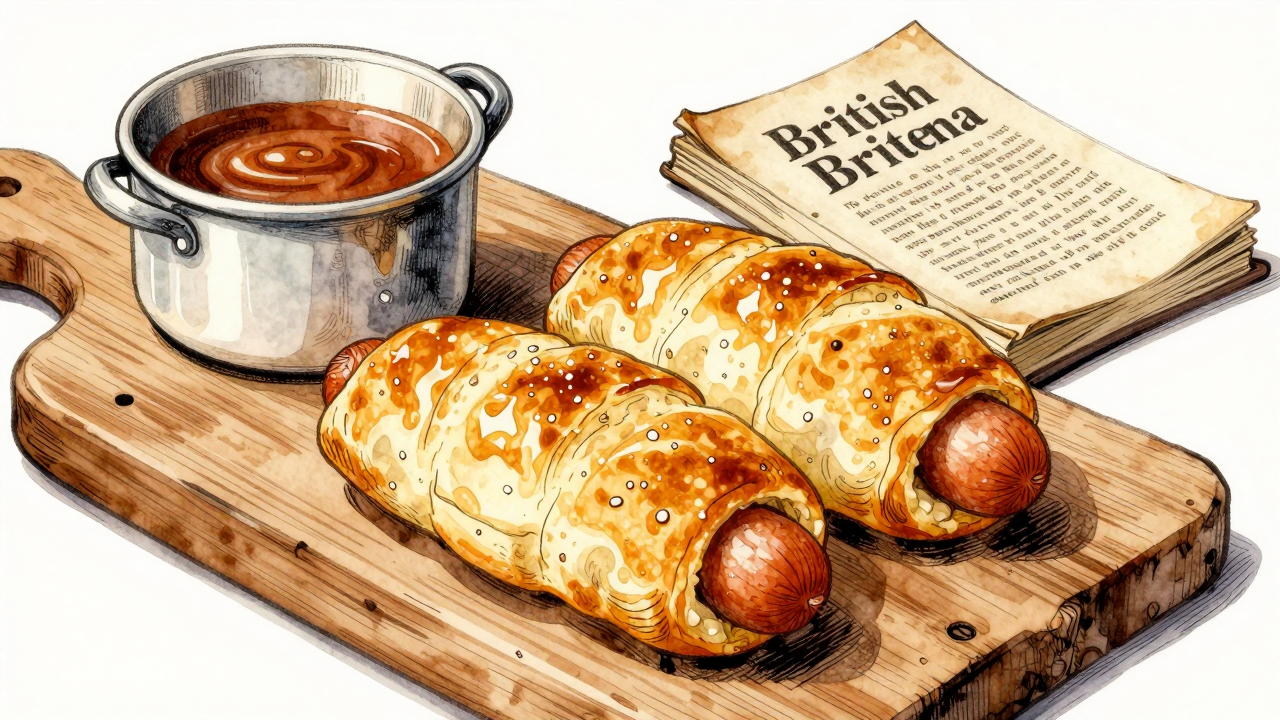
- Bake for 20 to 25 minutes, until properly golden and puffed. They should come out of the oven looking like they’ve just arrived at the store — slightly over-eager, a bit puffed up, and holding it all together with nothing but confidence.
- Rest for a couple of minutes, then serve with a pot of brown sauce on the side. The brown sauce does the work that the mustard seeds only suggested, and it’s a pairing as reliable as the trolley with the wobbly wheel — you never choose it, it just chooses you.
They keep for a day in a tin, eat fine cold, and are better than the thing you actually went to the store to build, which is the whole point. The wobbly wheel can wobble on.