There is a particular note that fluorescent light makes, a half-tone below B, and you will only ever have heard it in a laundrette. The machines go round and round at a speed that suggests they are thinking about it, a folding table holds someone’s jumper out like a crime scene, and there is a queue — three people deep, all of them holding a 25p coin ready in their hand like it’s a church collection. At their peak in the early 1980s there were 12,500 of them across the country, each one a small democracy of damp wool.
There are roughly 3,000 left now. Ninety-seven per cent of British homes have their own machines, which means the laundrette’s actual product was never clean clothes — it was forty minutes of standing around and talking to people you’d never otherwise talk to. The mid-1980s Levi’s advert understood this perfectly: a handsome young man walks in, and suddenly the laundrette is a place where things happen, which is precisely why your nan would never have gone.
Shepherd’s pie works the same way. You load the machine, you feed it the coins, you wait forty minutes, and what comes out is warmer and somehow better than what went in. It is the only dish with a built-in social hour, which is why it belongs in this series and not in a proper restaurant.
Ingredients
- 500g beef mince (about 20% fat — the sort that browns instead of sulking)
- 1 onion, 1 carrot and 1 stick of celery, all finely chopped
- 30g butter, plus a little more for the mash
- 1 tbsp tomato purée
- 1 tsp Marmite — the laundrette’s way of adding a bit of character to a basic wash
- 1–2 tbsp Worcestershire sauce
- 300ml beef stock
- 100ml milk
- 500g floury potatoes, such as Maris Piper
- A knob of butter and a splash of milk for the mash
- Nutmeg, salt and black pepper
- Four 25p coins, optional but traditional, for the ritual
Method
- Load the drum. Tip the mince into a large heavy-based pan over a medium-high heat and break it up until it’s properly browned. This is the wash cycle — the longest part, and the only part where you’re allowed to stand there and do absolutely nothing.
- While it does its rounds, chop the onion, carrot and celery fine. These are the coins for the machine: individually useless, collectively the reason the whole thing works.
- Tip the vegetables into the pan with a knob of butter and cook for 8–10 minutes, until the onion is the colour of a well-loved towel. Don’t rush it. The machine doesn’t, and neither do you.
- Stir in the tomato purée, the Marmite and the Worcestershire sauce and cook for two minutes, until the pan smells like it has somewhere to be.
- Pour in the beef stock and the milk and simmer gently for 15 minutes, until the filling has thickened to the consistency of a conversation that’s going well. If it dries out, add a splash more stock — the laundrettes always had a tap for that.
- Meanwhile, make the mash. Boil the potatoes in salted water until they collapse, drain them properly, then mash with the butter, a splash of milk, a pinch of nutmeg and salt. It should have the consistency of a fresh towel from the dryer — soft, but with a structure.
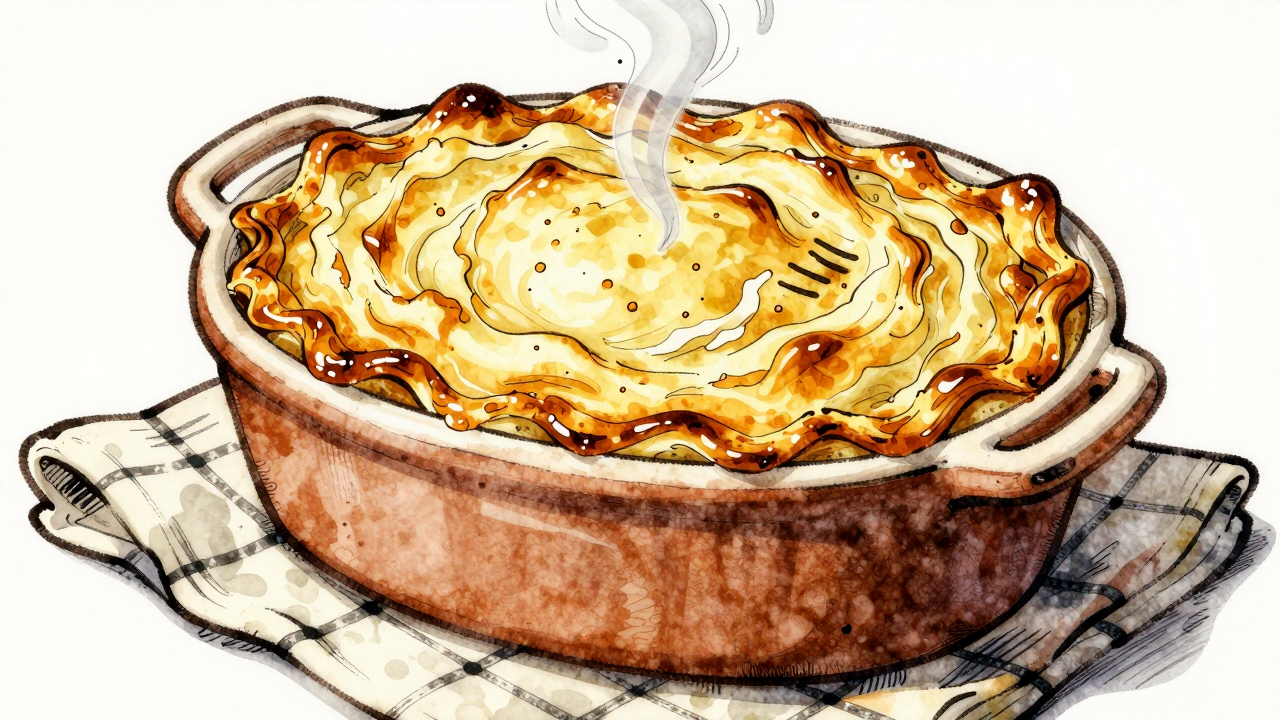
- Spoon the filling into a 1.5-litre ovenproof dish and spread it level. Top with the mash, spreading it right to the edges and raking it with a fork so the peaks and troughs look like a bed you made once and never again. No one gets a thinner corner of crust than anyone else. That’s how the laundrettes treated the broken machine, and you’re better than that.
- Brush the top with a little milk and bake at 200°C (180 fan), gas mark 6, for 25–30 minutes, until the mash is golden and the edges are bubbling. The oven is your machine now, the mash is the load, and the coins have already been eaten.
- Take it out and let it rest for five minutes. This part cannot be rushed. Nobody ever got their change back by rushing.
Serve with something green, because the laundrette always had a window and the pie deserves the same. For a vegetarian version, swap the mince for 200g of finely chopped mushrooms and a 400g tin of drained white beans, use vegetable stock instead, and everything else stays exactly as it is — the mash, the Marmite, the forty-minute wait, all of it.
The pie keeps happily for three or four days in the fridge, which is more than can be said for most laundrettes, and considerably longer than the queue for them.