The Sunday roast is the only meeting in Britain where nobody checks their phone, nobody apologises for being late, and everyone clears the table without being asked. It’s the family’s annual general meeting, held every week, with the quorum provided by the gravy boat and the minutes taken in gravy. The house goes quiet at one o’clock, the smell does the calling, and the whole arrangement has been running for longer than most marriages. It doesn’t need an agenda. The agenda is the roast.
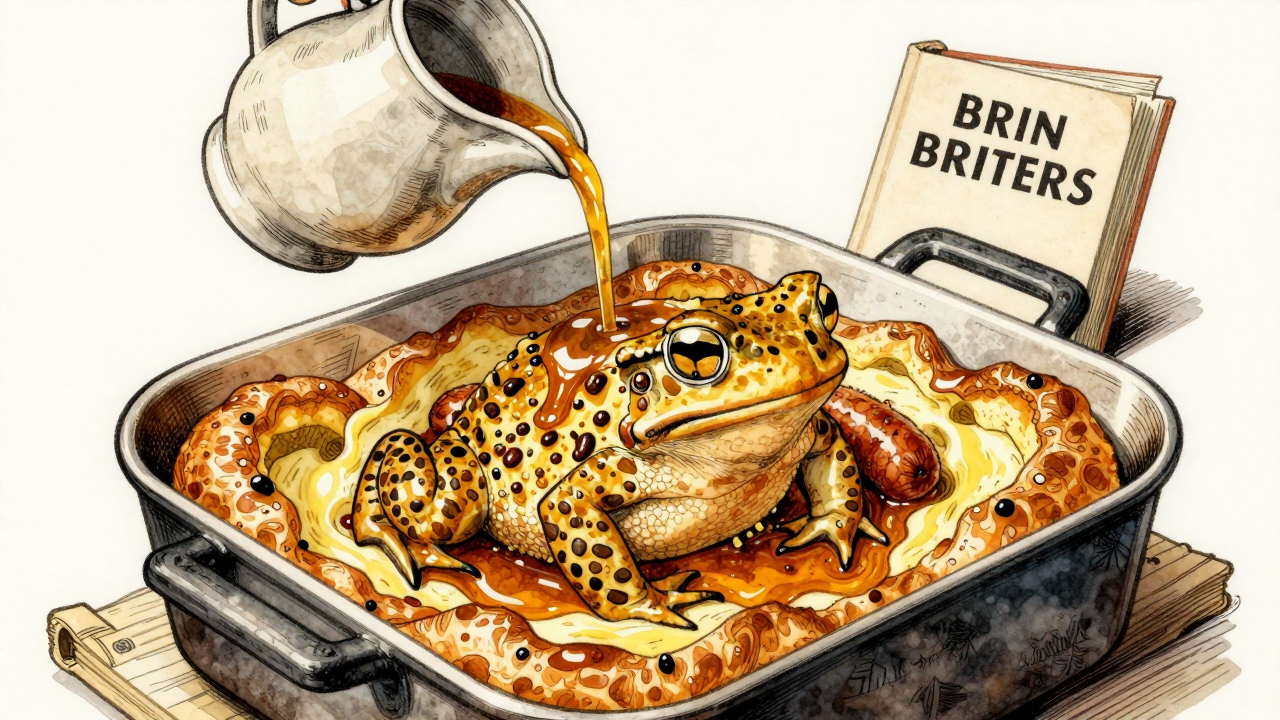
Toad in the hole is the roast’s scrappier cousin — the one who turns up in a tracksuit and still gets the gravy. The dish has been around a while: Hannah Glasse’s The Art of Cookery Made Plain and Easy (1747) included a recipe for “Pigeon in a Hole”, and the name “toad in the hole” first appeared in print in 1787. It was invented in poor households as a way to stretch cheap meat with cheap batter, which makes it the most British dish ever created: a plan that a nation looked at a hot oven and a bag of sausages and decided was enough. It’s enough. It’s a lot more than enough. It’s the dish that wins the AGM by a single vote.
So this episode is a toad in the hole, dressed up for the roast — proper Yorkshire batter, sausages with a bit of character, and a gravy with a small spoonful of Marmite in it, because the gravy is the quorum and the quorum has opinions. Serve it with roast potatoes and whatever vegetables are still pretending to be fresh, and you have the whole institution on one plate.
Ingredients
- 6–8 good sausages (pork, or a pork-and-beef mix; vegetarian sausages from the chiller aisle work fine — see note below)
- 2 tbsp vegetable oil
- 100g plain flour
- 2 large eggs
- 300ml whole milk
- Pinch of salt
- For the gravy: 2 tbsp beef dripping (or vegetable oil), 2 tbsp plain flour, 300ml beef stock (or vegetable stock), 1 tsp Marmite (optional, strongly recommended), splash of Worcestershire sauce
- To serve: roast potatoes, green beans or whatever veg is in the fridge, and a small pot of brown sauce for the veg, because the carvery set the precedent
Method
- Preheat the oven to 220°C (200°C fan). This is the part that needs planning, like the roast itself — the heat has to be in the room before the family arrives, and it cannot be rushed. The oven is the committee room and the committee meets at one o’clock.
- Tip the oil into a large roasting tin and lay the sausages in it. Roast for 15 minutes, turning once, until they’re golden and the tin has collected a layer of fat. That fat is the founding document of the meal. Everything important downstream is written in it.
- While that’s going, make the batter: whisk the flour, eggs, milk and salt in a jug until it’s smooth, with no lumps thicker than a small argument. Then leave it to rest for at least 15 minutes. Resting batter is like a referee before a cup final — it doesn’t have to do anything, it just has to be calm.
- Remove the sausages and pour off most of the fat, leaving 3–4 tablespoons in the tin. Put the tin back in the oven for 5–10 minutes until it’s properly hot. You want the tin hot enough that the batter hits it and hisses — hot enough to make the neighbours’ dogs slightly concerned.
- Pour the batter straight into the tin around the sausages, then nestle the sausages back into the middle of it. Roast for 25–30 minutes, until the batter is well risen and deeply browned. Do not open the oven. This is not a request. The oven is a boardroom and the batter is mid-speech.
- While that’s in the oven, make the gravy. Melt the dripping in a small pan, add the flour and cook for a minute, then pour in the stock a little at a time, whisking until it’s smooth. Simmer for a few minutes until it coats the back of a spoon, then stir in the Marmite and the Worcestershire. The gravy is the quorum — without it, no decision at the table is valid.
- Serve a wedge of toad on a plate with roast potatoes and the vegetables, and pour the gravy over everything with the confidence of someone who has been to this meeting before. The vegetables are the part nobody reads, but they are in the minutes.
Veggie variant: use good-quality vegetarian sausages (chiller aisle, the ones that actually hold their shape), vegetable oil in the tin, and vegetable stock for the gravy. The Marmite stays. The quorum is non-negotiable.
The toad keeps for a day or two in the fridge, the potatoes for three, and the peace of the household for as long as the gravy lasts — which is to say: until someone suggests washing up.