Every British housewife in 1943 had a small green book on the kitchen shelf: Make the Most of Your Garden Crops, issued by the Ministry of Food, which was the department responsible for the fact that meat was a rumour and potatoes were a personality. Its star recipe was a pie named after the Minister of Food himself, Lord Woolton — a man who had, in his previous life, sold radios, and who would go on to write a memoir called Woolton in the Wilderness, because a man who has rationed a nation for four years is never short of things to say.
The original was the Savoy Hotel’s, cooked by the head chef, François Latry, and it reached the nation through a government pamphlet, which is the furthest a dinner can get from a restaurant menu. The filling was whatever the garden had produced that week — swede, carrot, potato, onion, a little butter, and the general idea that you were being patriotic. That is a recipe category the British still run on: the dish is whatever the garden had, and the justification is that someone else’s garden had less.
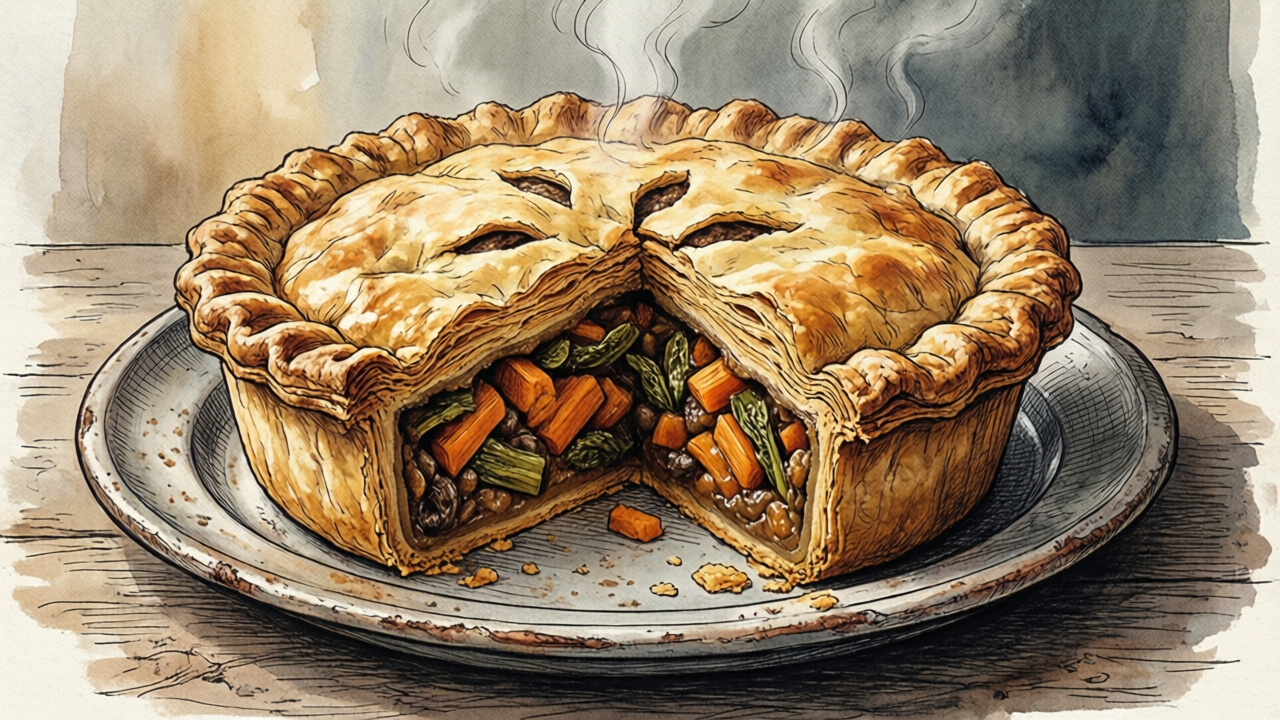
This is the Woolton pie, with the garden replaced by the frozen veg aisle and the ration book replaced by the loyalty card. The pastry is a basic shortcrust, the filling is a slow-cooked ragout of swede, carrot, potato and onion, and the whole thing is assembled with the quiet confidence of a woman who has already checked the queue for butter is moving.
Ingredients
- 225g plain flour
- 110g cold butter, cubed
- a good knob of ice-cold water
- 200g swede (turnip in Scotland, which is how you’ll know the driver)
- 2 medium carrots
- 2 medium potatoes
- 1 large onion
- 1 tbsp butter for the filling
- 1 tbsp flour
- 150ml milk
- a knob of dried thyme, and salt and pepper
- 1 egg, beaten, for the top
Veggie variant: the whole thing is already vegetarian — it’s a war pie, it never needed permission. For a vegan version, swap the butter for olive oil, the milk for oat drink, and the egg wash for a splash of milk, and nobody at the table has to be told anything.
Method
- Make the pastry: rub the butter into the flour until it resembles breadcrumbs, then add a knob of ice-cold water and bring it together. It should hold together the way a 1943 committee held together — barely, and with a great deal of muttering. Wrap it and put it in the fridge.
- Peel and cut the swede, carrot and potato into smallish chunks — small enough that they’ll cook through, because there was no second helpings budget in 1943, and there isn’t one here. Chop the onion.
- Heat the butter in a big pan, add the onion and fry until it’s gone soft and a little gold. This is the step that cannot be rushed. Nobody ever won the war by rushing the onion, and you will not win dinner either.
- Add the vegetables and a splash of water, cover, and let them go soft and sweet for about ten minutes. If the pan starts to look like it’s having a bad day, add a splash more water. The vegetables should end up the colour of a garden that has given up but not quit.
- Stir in the flour and cook for a minute, then pour in the milk and the thyme and let it thicken into a proper thick, lumpy, unapologetic sauce. It should resemble a Sunday lunch that has been through a war — which is to say: adequate, and deeply reassuring.
- Roll out the pastry and line a 20cm pie dish, leaving a good overlap at the top. The edges should look like a flag that’s been hoisted in a gale and is doing its best.
- Spoon in the filling, brush the egg over the top, and bring the pastry over it. Crimp the edges with your thumb and forefinger, or a fork if you’re feeling like the Ministry of Food. Cut a couple of small slits in the top for the steam, which is the pie’s way of filing a complaint.
- Bake at 200°C (180 fan) for about 40 minutes, until the top is a proper gold and the filling is bubbling through the slits. The kitchen will smell like a victory garden that has finally been harvested, and that is the correct smell.
- Leave it to stand for ten minutes before serving, because a pie that has settled is a pie that has made its mind up. Serve with peas — tinned if you’re being honest — and a glass of something that was also rationed at some point, because everything was.
The pie keeps for three or four days in the fridge, which is more than can be said for most British policies. And if anyone asks why it’s called that: Lord Woolton was a decent enough man, and the pie is named after him, and you’d best not say otherwise at the table.