There’s a moment, just after the till opens, when the queue forms. Not a line — a queue. The British are the only people on earth who call a line a “queue” (the word comes from the French, and the French from the Latin for “tail,” which is about as British a thing as you can get: a line of people, all of them quietly pretending they’re not annoyed). The Americans call it a “line” and think we’re being absurd about it. We call it “queuing” and think they’re missing the point. Both of us are right, and neither of us will be the first to say so.
Stand in a queue in Britain and you’ll find it has a geography. It turns the corner. It doubles back. It has a front (the till), a back (where you joined) and a middle where everyone has decided, without consulting anyone, that it is not their fault they are late. The unspoken rules are strict and universal: join the back, don’t push in, and if you must push in, say “sorry” as if it’s your fault rather than yours. The queue-jumper is the only figure in British life that everyone, without exception, agrees on.
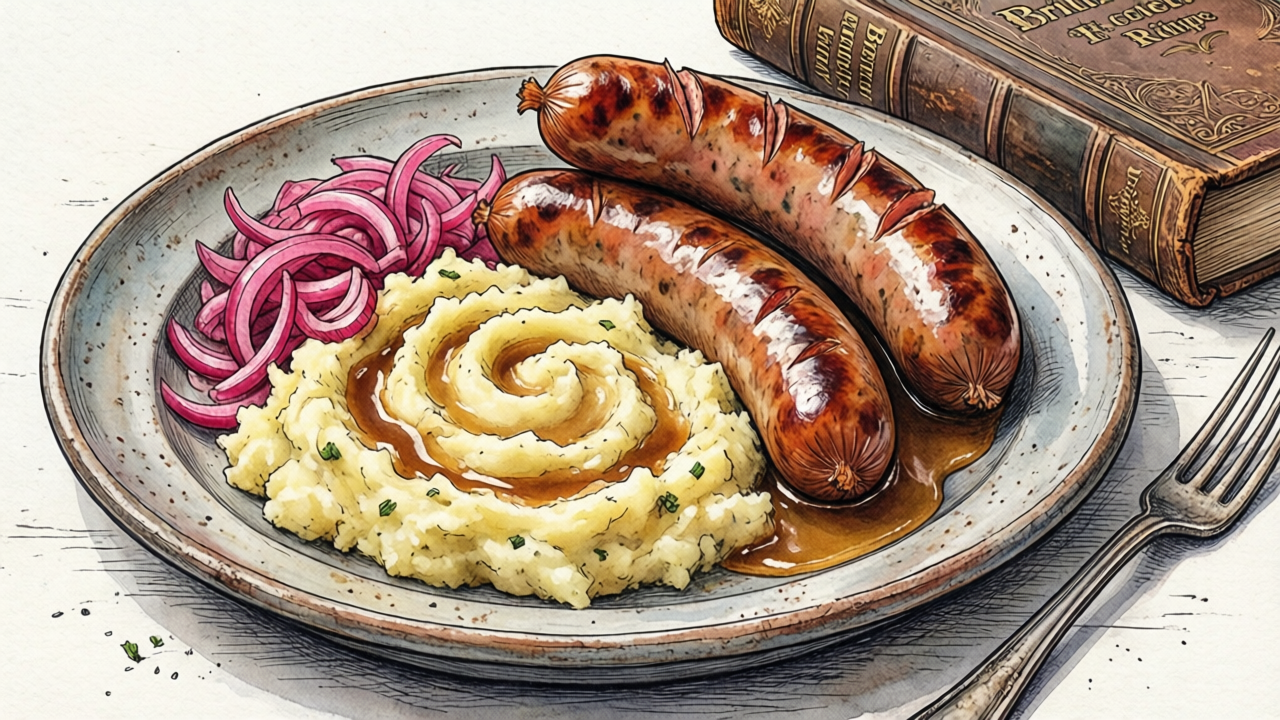
Sausages and mash is the only British dish that actually behaves like a queue — lined up in a row, served in turn, no pushing in. It’s the food you make after a forty-minute wait at the till, when you’ve decided that at least one thing in your evening is going to be in the right order.
Ingredients
- 6 pork sausages — the thick, proper kind from the chiller, not the thin cocktail ones
- 1kg floury potatoes (Maris Piper or Desira)
- 1 large onion, chopped
- 60g butter, plus a knob for the mash
- 2 tbsp plain flour
- 500ml beef stock (a carton or two cubes will do)
- A splash of stout, about 60ml — swap for a splash of dark beer, or just extra stock
- Salt and black pepper
- A splash of milk, for the mash
- A handful of pickled onions, from a jar — for the back of the queue
- A few sprigs of parsley, if you’re feeling generous
Method
- Put the potatoes in a large pan of cold, well-salted water and bring to the boil. A queue needs a foundation, and the foundation here is the potatoes. They’ll take about ten minutes from the boil. Don’t rush this — nobody ever won a queue by rushing, and the potatoes aren’t going anywhere.
- While the potatoes cook, get a frying pan over a medium heat with a knob of butter and a little oil. Line the sausages up in a row — no pushing in, no gaps. If one starts to get ahead of the others, give it a gentle nudge back to its place. They’ll take about fifteen minutes, turned now and then, until they’re an even, honest brown all the way around. Like a queue where everyone’s had a fair go.
- While the sausages do their time, make the gravy. Melt the butter in a saucepan, add the chopped onion, and cook it down gently until it’s soft and sweet — that’s about eight minutes, and it’s the one part of the queue you can’t fast-forward. Stir in the flour and cook for a minute, then pour in the stock and the splash of stout, bring to a simmer, and let it thicken. The stout is the only slightly odd thing here, but it’s the kind of odd you’d find on the back of a pub napkin, not in a lab.
- Drain the potatoes and beat them with the butter, a splash of milk, salt and pepper until they’re completely smooth. A queue is a queue — no gaps, no lumps, no one standing in the middle doing their own thing. A ricer works best. A fork and a grudge will do.
- To plate, form the mash in a neat row down the middle of the plate — that’s the pavement. Line the sausages up on top, one behind the other, in the order they came out of the pan. Spoon the gravy over and around them, in turn, no pushing in. Scatter the pickled onions at the back of the queue, where they belong, and a few sprigs of parsley on top. Serve it hot, in the order you plated it, and don’t let anyone cut in.
For the vegetarian version, swap the pork for the thick sausages from the chiller aisle and the beef stock for vegetable stock. The stout stays — it’s the only part of the dish that’s got a point of view.
The gravy keeps happily for a day or two in the fridge, which is about as long as most queues hold before someone tries to cut in. Serve it in turn, and nobody will push in. And if anyone does, the only correct response is to look at them the way you’d look at a queue-jumper: with the full, unshared disappointment of the entire queue.