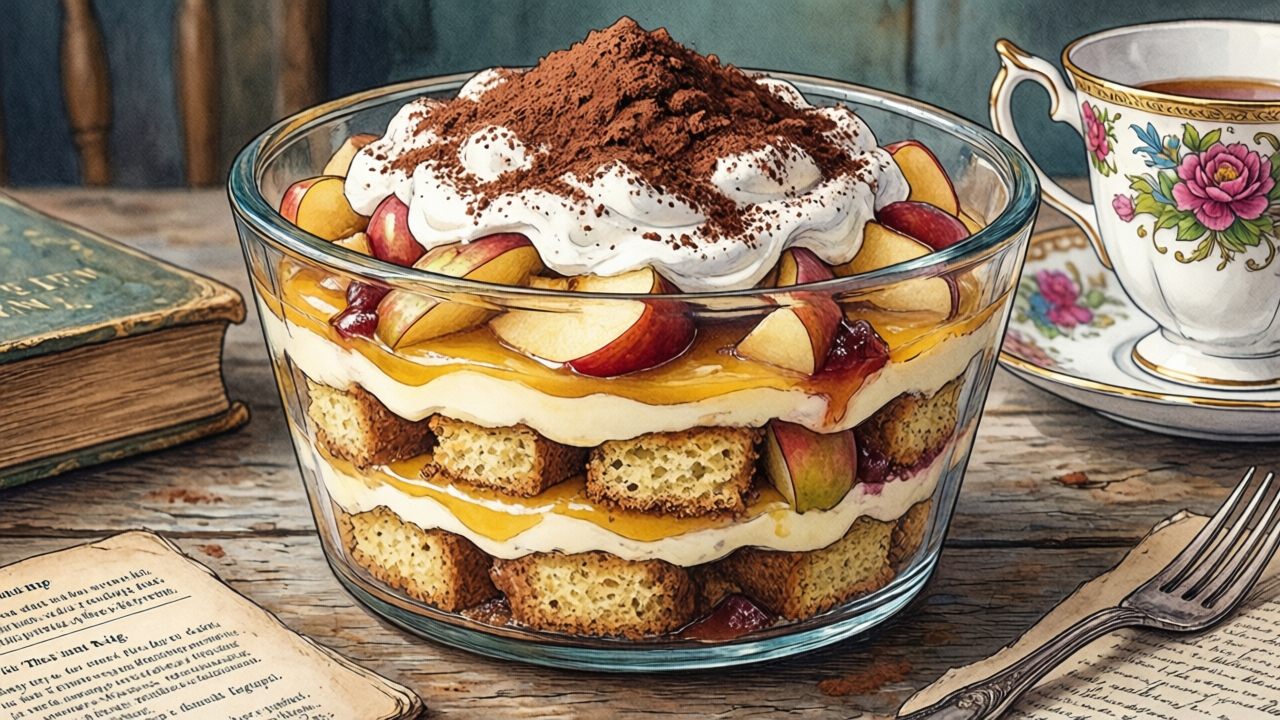
There is one object in British dining culture where everyone in the room agrees on something and nobody says it: the trifle in the glass bowl at the centre of the table. You can see through it. You can see the layers — the sponge, the fruit, the custard, the cream — stacked like a geology lesson that went off the rails. Everyone can see it. Nobody touches it first. The trifle is the only dish where the polite standoff is the main course.
The name is a joke that has been running for four hundred years. A trifle, in the original sense, was a trivial, worthless thing — and the first trifle was a humble thick cream flavoured with sugar, ginger and rosewater, recorded in Thomas Dawson’s 1585 cookbook The Good Huswifes Jewell. The English had a word for “nothing worth mentioning”, and the English did what the English do: they made a dessert out of it, then presented it in a silver bowl, which is the opposite of nothing worth mentioning.
It took a while to become the layered showpiece we know. Hannah Glasse put a recognisably modern trifle in The Art of Cookery Made Plain and Easy (1751) — biscuits soaked in wine, layered with custard, topped with a froth of syllabub — and followed it up in 1760 with a “grand trifle” that used calves’-foot jelly, which is the kind of thing only the eighteenth century would do casually. By the time Isabella Beeton included a trifle in her 1861 Book of Household Management, it had become a proper institution, and by 1891 Garrett’s eight-volume Encyclopaedia of Practical Cookery carried thirteen recipes, including, yes, a veal trifle and a lobster trifle. Britain looked at a dessert called “a trivial matter” and said: we can do better, but also veal.
A dish named after an insult is exactly the kind of thing Britain would do. The trifle is the culinary equivalent of a British apology: it means nothing, it means everything, and it is the only thing on the table worth fighting over — politely.
Ingredients
- 200g sponge fingers (ladyfingers), or a 200g pack of plain sponge cake, torn into rough pieces
- 150ml stout (or sherry, if the family insists on tradition — it works)
- 4 large Bramley apples, peeled, cored and thinly sliced
- 60g butter, 60g caster sugar, a generous pinch of cinnamon
- 500ml full-fat milk
- 3 egg yolks + 1 whole egg
- 60g cornflour
- 40g caster sugar
- 1 tsp vanilla extract (or a little vanilla bean paste)
- 300ml double cream
- 100g digestive biscuits, crumbled
- 2 tbsp cocoa powder
- A pinch of salt
Method
- Stew the apples. Melt the butter in a wide pan, add the sugar and cinnamon, then the apples. Cook over a medium heat for about 15 minutes, until soft but still holding their shape. They should be just a trifle wobbly — soft enough to give way to a spoon, firm enough to stand up for themselves. (Two tins of peaches work if you want the easy option, but it is apple season, and the apples will do the job better.)
- Make the custard while the apples cool. Whisk the yolks, the whole egg, the cornflour and the sugar in a heatproof bowl. Heat the milk until it is just below the boil, then pour it over the egg mixture, whisking steadily. Return everything to a low heat and stir like you mean it. The custard is the only thing in this recipe that notices when you stop. Cook until it coats the back of a spoon — thick enough to hold a layer, thin enough to pour. That is a narrow window. Stir through the vanilla, cover the surface with cling film so it does not skin over like a disappointed relative, and set aside.
- Whip the cream to soft peaks. Just a trifle before it goes stiff — the cream is the one ingredient that will absolutely not wait for you, and it will let you know.
- Build the trifle in a glass dish. A trifle in an opaque bowl is a trifle you cannot see, which is a contradiction, like a British apology. Start with a layer of sponge and pour over most of the stout. Let it soak for a minute — the sponge should drink it like a man who has been standing in the rain. Add a layer of the stewed apples, then half the custard. Repeat: sponge, a splash of stout, the rest of the apples, the rest of the custard.
- Top with the whipped cream, smoothing it over with the back of a spoon. Mix the crumbled biscuits with the cocoa and scatter them across the top. It should look like a trifle that has had a cup of tea and decided to be a bit more serious.
- Chill for at least two hours. This part cannot be rushed. The trifle is the only dish where the waiting is the point, like a queue, except the reward is better and nobody has to pretend they are not annoyed.
- Serve with a big spoon. The first person to reach it is the one with the least to lose.
The trifle is vegetarian by design — the stout is the closest it gets to a sin. For a vegan version, swap the cream for coconut cream, use a dairy-free custard, and a vegan sponge from the chiller aisle; the apples, cinnamon and biscuits all hold up. It is not just a trifle. It is a full commitment — the kind of pudding that, once it is on the table, settles the argument about who has had enough, and the answer is never anyone.