WC2026 Host City Spotlight: Mexico City, Mexico
Mexico City is the kind of place that makes you reconsider everything you thought you knew about cities. It’s built on the ruins of an Aztec capital, which itself was built on an island in a lake that the Spanish drained because “what’s the worst that could happen?” (Answer: the entire city now sinks at 50cm per year. You’re welcome, urban planning textbooks.)
With a metropolitan population of around 21.6 million, it’s the second-largest city in the Western Hemisphere. That’s more people than live in Canada. All of Canada. Try not to think about that too hard.
A City That Ate Its Neighbours
Mexico City — or CDMX, as the locals call it (because apparently acronyms are a universal love language) — is a megacity born of conquest, colonialism, and some very aggressive urban sprawl. The original settlement, Tenochtitlán, was founded by the Aztecs in 1325 on Lake Texcoco. Hernán Cortés arrived in 1519, was briefly impressed, then promptly knocked the whole thing down and built a Spanish colonial city on top.
Fast forward to the 20th century and the city exploded — literally and figuratively. A 1985 earthquake measuring 8.1 on the Richter scale killed between 5,000 and 10,000 people (nobody’s quite sure — the government wasn’t particularly transparent about it). The problem? Remember that drained lake? The city sits on soft lakebed mud, which amplifies seismic waves like a bowl of jelly on a speaker. The geology of Mexico City is basically nature’s way of saying “I told you so.”
Today, the city is a dizzying mix of colonial architecture, brutalist government buildings, and some of the best street food on the planet. The neighbourhood of Coyoacán — where Frida Kahlo lived and painted and apparently never stopped looking betrayed by Diego Rivera — is still one of the most charming places to wander, with its tree-lined streets, colourful houses, and the Jardín Centenario where you can eat a taco while pretending you’re in a postcard.
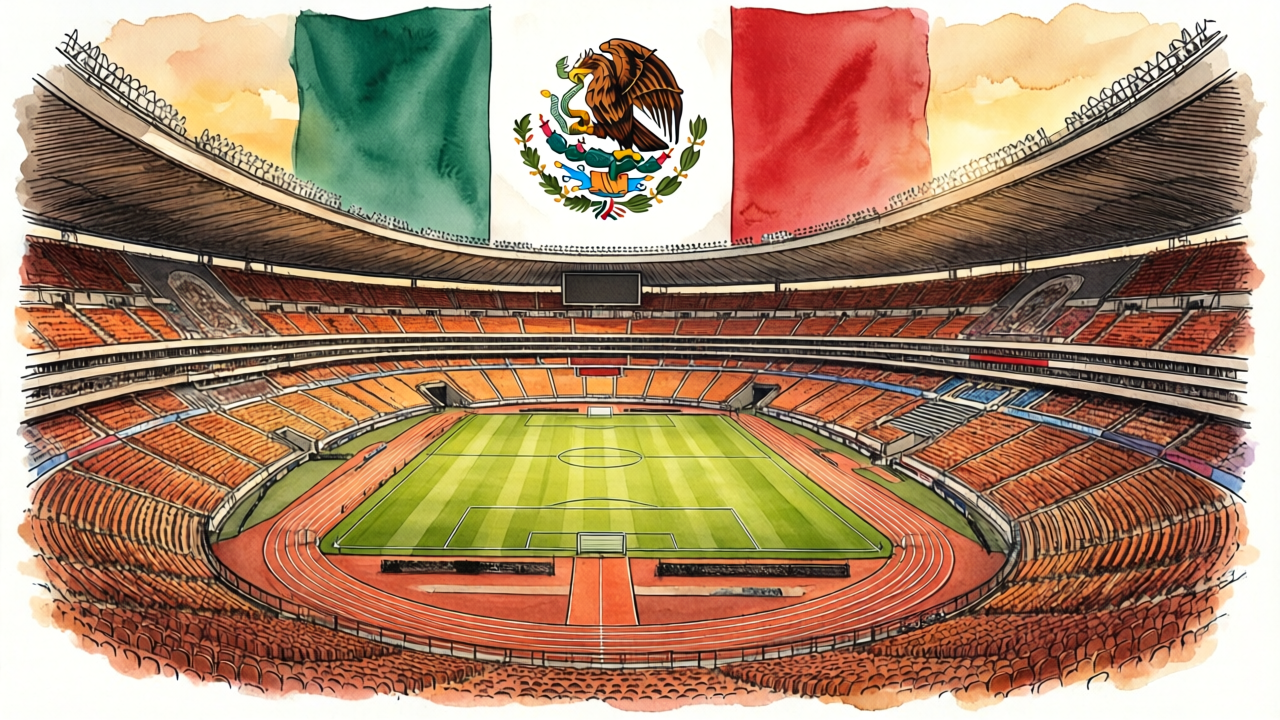
The Stadium: Estadio Azteca (Now “Mexico City Stadium” Because FIFA)
The Estadio Azteca is the only stadium in the world to have hosted two World Cup finals — 1970 (Germany beat Argentina 1-0 in extra time, with a certain young Pelé watching his Brazil side finish third) and 1986 (when Argentina, led by a certain Buenos Aires-born forward with an eye for goal, beat West Germany 3-2).
For 2026, FIFA has rebranded it “Mexico City Stadium” as part of their sponsorship-neutral naming policy, which is like renaming Wembley “London Stadium” and being surprised when nobody cares. The locals still call it Azteca, and they probably always will. The stadium has been refurbished for 2026 with a maximum capacity of around 87,000, and — in a decision that has apparently caused no controversy whatsoever — it will host the tournament’s opening match on Thursday 11 June: Mexico versus South Africa.
The stadium sits at 2,200 metres (7,300 feet) above sea level, which gives Mexican teams a genuine tactical advantage that has nothing to do with skill. Thin air means less oxygen, which means visiting players fatigue faster. In 1970, Brazil — who would go on to win the tournament — spent three weeks acclimatising at altitude before the final. For 2026, teams playing in Mexico City have already described the altitude as a “very potent setting.” That’s sports journalism code for “we’re going to be gasping for air while the Mexicans are just having a nice jog.”
Chilaquiles: Mexico City’s Actual National Dish (The Tacos Are a Red Herring)
Yes, tacos are famous. But the dish that defines a CDMX morning — the one that separates locals from tourists — is chilaquiles. They’re essentially tortilla chips simmered in salsa until they achieve that perfect balance between crispy and softened, then smothered in sour cream, cheese, onion, and usually a fried or scrambled egg.
They’re the Mexican equivalent of using leftover toast to make crumpets. Except infinitely better. The debate between chilaquiles rojos (red salsa, made with ancho or guajillo chiles) and chilaquiles verdes (green salsa, made with tomatillos and jalapeños) is as fierce as any football rivalry. Both are correct. Neither side needs to convince the other.
Here’s a recipe you can actually make at home — chilaquiles rojos, the red variety, which is the classic:
Chilaquiles Rojos
Ingredients:
– 8 corn tortillas, cut into wedges (sixth-sized)
– 4 dried guajillo chiles, stems and seeds removed
– 2 dried ancho chiles, stems and seeds removed
– 2 ripe Roma tomatoes, halved
– 1 white onion, quartered
– 3 garlic cloves
– 1 jalapeño (seeds out if you value your sinuses)
– 200ml chicken or vegetable stock
– Salt to taste
– 200g Oaxacan cheese (or any Mexican melting cheese), crumbled
– 4 eggs
– Fresh cilantro, chopped
– Sour cream or Mexican crema
– Radishes, sliced (for garnish — Mexico City takes garnishes very seriously)
– Vegetable oil for frying
Method:
-
Make the salsa: Soak the guajillo and ancho chiles in hot water for 15 minutes until soft. Drain. Meanwhile, roast the tomatoes, onion, garlic, and jalapeño under a hot grill or in a dry pan until charred at the edges. Blend everything — chiles, roasted veg, and stock — until smooth. Strain if you want it silky; leave it chunky if you’re feeling rustic.
-
Fry the tortillas: Heat a good glug of oil in a large pan over medium-high heat. Fry the tortilla wedges in batches until golden and crisp — about 2 minutes per side. Drain on kitchen paper. They should be proper chips, not sad crackers.
-
Simmer: Pour the salsa into a large, wide pan (a griddle or chargeur if you’re fancy). Bring to a gentle simmer. Add the fried tortilla wedges and toss everything together, letting the salsa coat each piece. Cook for 3-4 minutes — the tortillas should soften slightly but still have a bit of bite. If they go fully mushy, you’ve made soup. Keep going.
-
Fry the eggs: While the chilaquiles are simmering, fry your eggs however you prefer. In Mexico City, they tend to go for scrambled eggs mixed into the chilaquiles (which is a valid approach, even if it looks slightly chaotic).
-
Plate: Spoon the chilaquiles onto a warm plate. Top with crumbled cheese, a fried or scrambled egg, a generous dollop of crema, chopped cilantro, sliced radishes, and diced white onion. The cheese should be starting to melt. The crema should be doing nothing — it’s supposed to be cold. That’s the point.
-
Eat immediately while standing up, ideally with a glass of orange juice and zero regrets.
Why It Matters for the World Cup
Mexico City is hosting five matches at the Azteca across the tournament, including that opening fixture. The altitude, the atmosphere, and the history combine to make it arguably the most electric venue on the 2026 schedule. When 87,000 people in a single stadium chant “¡Méééxico!” at 7,300 feet, something about the physics of sound changes. Or maybe it’s just the thin air making everyone more emotional.
The city is also the cultural heart of a country that takes football almost as seriously as it takes lunch breaks — which is to say, with passion, volume, and an unreasonable number of ingredients. If you’re watching the tournament from a sofa somewhere in the English Midlands, you’re missing the proper experience. The proper experience involves a chilaquiles stand, a view of the Azteca from a nearby hill, and the realisation that you’ve come 5,000 miles to eat tortilla chips in salsa while 87,000 people scream at a ball.
Worth every penny. And every flight of stairs. Especially every flight of stairs — don’t forget, you’re at altitude.
Sources: FIFA.com, StadiumDB.com, AP News, The Athletic, Fox Sports