”
The Hand of God, the Falklands, and a Pie That Shouldn’t Work (But Does)
England and Argentina in a World Cup semi-final. If you’ve ever wanted a football match that feels like a plot device written by someone who really enjoys tension, this is it. Three Lions vs. La Albiceleste. Tuchel vs. Scaloni. A rivalry that went from “mildly competitive” to “geopolitical incident” after 1982 and has never looked back.
They’ve met four times in World Cup knockout matches: Argentina won two, England two. The 1986 quarter-final needs no introduction. The 1998 round of 16 will live in infamy forever – Beckham was sent off for a foul on Simeone, England lost on penalties with 10 men, and “Beckham-bashing” became a British national pastime for the next decade. But 2002 brought the sweetest revenge: England won 1-0 in Group C with Beckham converting a penalty against the very team that destroyed him four years earlier. Diego Simeone, watching helplessly from the Argentina bench, couldn’t have written that ending himself.
On paper, both teams are in fine form. England have been entertaining, clinical when they need to be, and looking like a side built for a tournament. Argentina are the defending champions, the team that won in 2022, and they bring the same blend of swagger and suffering that has defined South American football for generations. Whatever happens Wednesday night at Mercedes-Benz Stadium in Atlanta, it’s going to be a proper one.
So let’s talk about what both countries do best when they’re not arguing about offside calls: food.
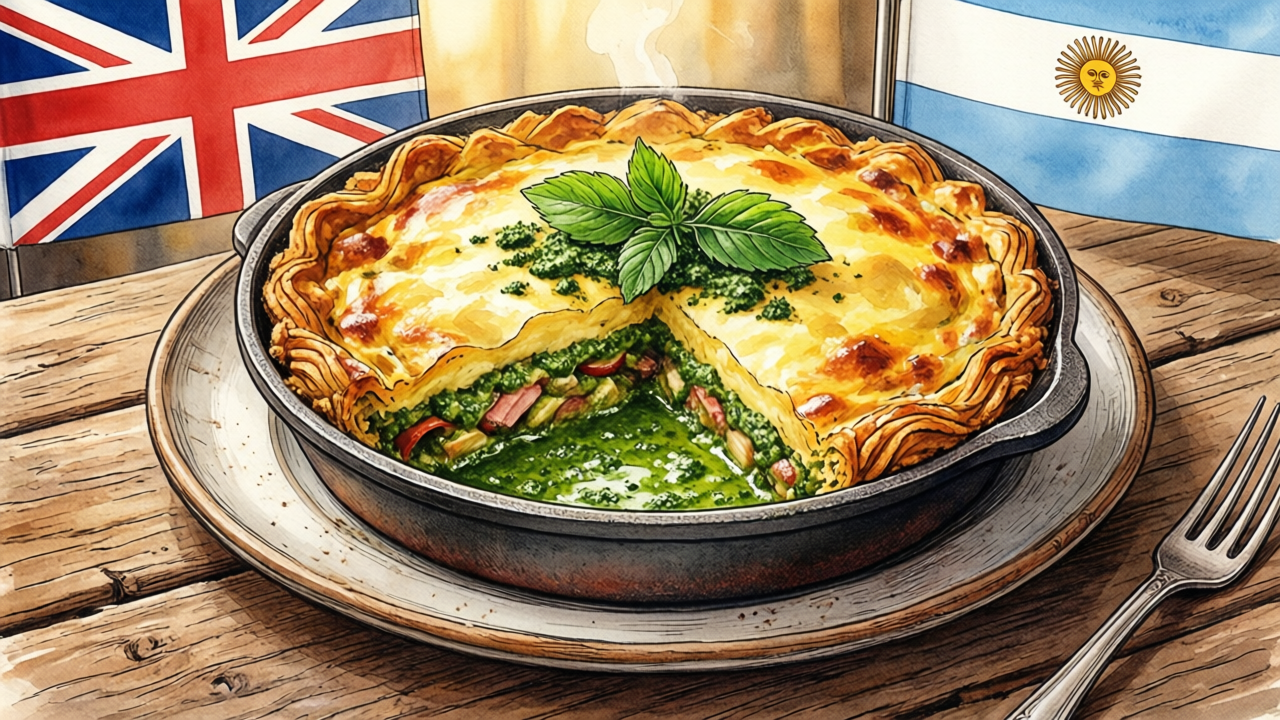
The Concept: Cottage Pie, Pampas-Style
England gave the world Shepherd’s Pie – or Cottage Pie, depending on whether it’s lamb or beef. Argentina gave the world asado, chimichurri, and an attitude to grilled meat that should be taught in schools. The fusion is almost embarrassingly obvious: take the British comfort food architecture (minced meat, gravy, mash on top) and inject it with the flavours that make an Argentine BBQ sing.
This is cottage pie with a chimichurri-infused beef filling, roasted peppers from the Pampas, olives and raisins for that classic Argentine sweetness, all under a crown of garlic mashed potatoes. It’s the dish you’d make if England and Argentina were forced to share a kitchen \u2014 and it’s better than both countries’ national dishes separately.
Seriously. Both nations should send their culinary delegations to taste this before the match and see if it helps.
Ingredients
The Filling
- 500g beef mince (higher fat content, around 20% \u2014 this isn’t a diet food)
- 1 large onion, finely chopped
- 2 garlic cloves, minced
- 1 red pepper, roasted and sliced into strips
- 2 tbsp olive oil
- 2 tbsp chimichurri sauce (store-bought is fine, or make your own: parsley, oregano, garlic, red wine vinegar, olive oil, chilli flakes)
- 1 tbsp tomato puree
- 200ml beef stock
- 1 tbsp Worcestershire sauce
- 1 tsp smoked paprika
- 50g black olives, roughly chopped
- 30g raisins or sultanas
- 1 tbsp flour (for thickening)
- Salt and pepper to taste
The Mash
- 900g floury potatoes (Maris Piper or King Edward), peeled and cubed
- 50g butter
- 50ml full-fat milk
- 1 garlic clove, crushed (yes, garlic in the mash \u2014 the Argentine influence)
- 2 tbsp grated Parmesan (because why not)
- Pinch of nutmeg
The Chimichurri Drizzle (to serve)
- Extra chimichurri sauce – you’ll want it on the table, in the pie, and possibly on your shoes
Method
- Preheat your oven to 200C (180C fan/gas mark 6). Get a pie dish or ovenproof baking dish warmed up – nothing fancy, just something that fits in the oven and can go from hob to oven.
- Start the filling. Heat the olive oil in a large frying pan or casserole dish over medium-high heat. Add the beef mince and break it up with a wooden spoon. Cook until properly browned – we’re not looking for grey, we’re looking for caramelised edges. This takes 6-8 minutes. Don’t rush it.
- Add the aromatics. Once the beef is browned, add the chopped onion, garlic, and smoked paprika. Cook for 3-4 minutes until the onion starts to soften. Add the tomato puree and stir for a minute to cook out the raw taste.
- Build the flavour. Sprinkle the flour over the mixture and stir for a minute. Pour in the beef stock and Worcestershire sauce, then stir in the chimichurri. This is where the fusion happens – the chimichurri brings parsley, oregano, garlic, and chilli heat to a gravy that’s essentially British pub food. Add the chopped roasted pepper strips, olives, and raisins. Simmer for 10-15 minutes until the sauce thickens to a rich, spoon-coating consistency. Season with salt and pepper.
- Make the mash. While the filling simmers, boil the potatoes in salted water until tender (12-15 minutes). Drain thoroughly – really dry them out by leaving them in the warm pan for a minute. Mash with butter, milk, the crushed garlic, Parmesan, and nutmeg until smooth and creamy. The garlic and Parmesan are the Argentine influence on what would otherwise be a textbook British mash.
- Assemble. Spoon the beef filling into your pie dish, spreading it evenly. Top with the mash, spreading it into a thick, even layer. Use a fork to create ridges on top – they’ll crisp up and golden in the oven. Drizzle a little extra chimichurri over the top of the mash for colour and flavour.
- Bake. Put the pie in the oven for 20-25 minutes until the topping is golden and the filling is bubbling around the edges. If the top is browning too fast, cover loosely with foil for the last 10 minutes.
- Serve. Let it rest for 5 minutes (the filling will be lava-hot and needs to set slightly). Serve with a side salad of rocket and tomato, or just a big glass of red wine and a prayer that your team doesn’t go to penalties.
Why This Works
Both British and Argentine cooking are built on a simple principle: take something humble and make it unforgettable. Shepherd’s Pie was born from necessity – a way to use up leftover roast meat. Asado is the centrepiece of every Argentine social gathering, where the grill is a religion and the chimichurri is the prayer.
The chimichurri brings brightness (parsley, vinegar, garlic) to the deep, rich gravy of the pie. The olives and raisins add that sweet-savoury dimension that’s standard in Argentine cooking but rare in British fare. The roasted pepper strips are a nod to the peppers you’d find on any asado grill, bringing a smoky sweetness that complements the caramelised beef.
It’s not a compromise dish. It’s the kind of thing you’d make if both countries sat down in a kitchen and agreed that, for once, they’d stop arguing about football and start sharing food instead.
Which, given the history, is about as unlikely as England winning penalties in a World Cup.
“