WC2026 Host City Spotlight: Vancouver, Canada
If you’ve never been to Vancouver, you probably think it rains 23 hours a day. The other hour is spent looking for an umbrella you lost during the previous 23 hours. It’s a reputation that’s earned, but also rather overstated — Vancouver is only the ninth rainiest city in Canada. Places like Prince Rupert and Port Alberni would like a word.
What Vancouver is, though, is one of the few cities on earth where you can watch mountains rise from the ocean while standing on a sidewalk. It’s the kind of place that makes you question why you ever paid £2,400 a month for a London flat the size of a large cupboard. Vancouver housing is expensive too, admittedly, but at least you get a view that doesn’t consist of the back of another building.
The City
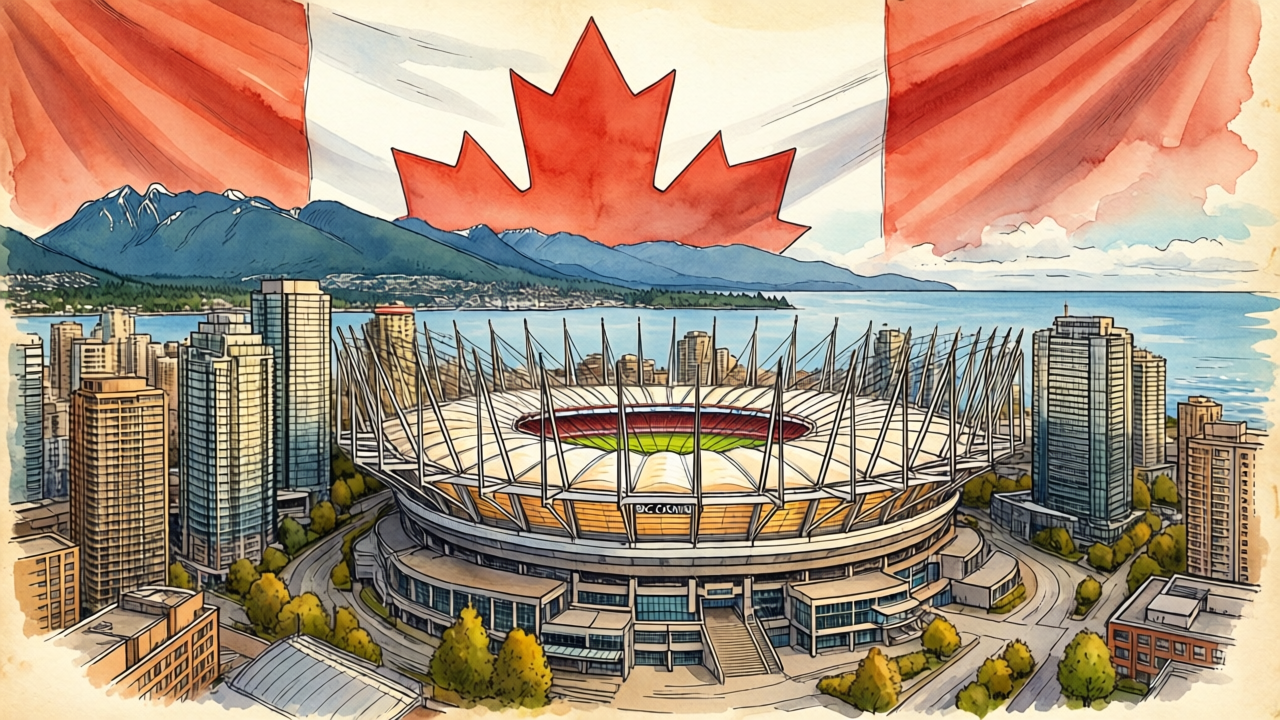
Vancouver sits on the west coast of British Columbia, squeezed between the Pacific Ocean and the Coast Mountains. Population: roughly 662,000 in the city proper, 2.6 million in the metro area. About 40% of the population were born outside Canada, making it one of the most internationally diverse cities in North America. You can get authentic dim sum, sushi, dosa, and poutine all within a 15-minute walk in the right neighbourhood.
The neighbourhoods each have their own personality. Gastown has those famously unnecessary steam clocks that hiss at regular intervals (because nothing says “quaint” like industrial noise pollution). Granville Island is a floating market where you can buy artisanal cheese and pretend you’re in Europe. Commercial Drive — aka “Little Italy” — is where the rollerbladers live. Vancouver has more rollerbladers per capita than any city on earth. Nobody quite knows why.
The weather? October to April is a damp grey blanket. May to September is sunshine and people doing things outside. The World Cup matches in July will be played in what is essentially Canadian summer, which is to say: pleasant. Possibly warm. The meteorologists will disagree among themselves, but the forecast for late June/early July is historically around 20-25°C. You’ll need a t-shirt. Possibly a rain jacket. Vancouver is Vancouver.
The Stadium: BC Place
BC Place has been through more reinventions than a reality TV contestant. It opened in 1983 as the world’s largest air-supported domed stadium — essentially a giant inflated balloon the size of three football pitches. If the pumps stopped, the roof would deflate. The city once held an emergency “re-inflate the stadium” event during a power outage because the game had to go on.
In 2010, they tore the pneumatic roof off and replaced it with a cable-supported retractable fabric roof — the largest of its kind in the world. 36 outer panels, each about 220 feet long and covering roughly 10,000 square feet of fabric. The steel structure weighs around 18,000 tons — roughly the same as two Eiffel Towers stacked on top of each other. The retractable portion slides on rails and can open or close in about 15 minutes.
Capacity is 54,500 for football. BC Place will host seven World Cup 2026 matches, including a Round of 16 knockout on July 7 and two Canadian national team group stage fixtures. It’s also one of only a handful of World Cup venues located in a city centre, meaning fans won’t need to trek across a desert or through a snowstorm to get to the game. Instead they’ll need to find parking, which in downtown Vancouver is its own form of suffering.
The Recipe: Nanaimo Bars
Every host city needs a recipe, and Vancouver’s answer comes from a smaller city about four hours east on the coast: Nanaimo. The Nanaimo bar is Canada’s most famous no-bake dessert, and it’s the sort of thing that appears at every school fundraiser, church hall, and office Christmas party from coast to coast.
Three layers. No oven required. Approximately zero culinary skill needed. It is the culinary equivalent of a Canadian: polite, layered, and vaguely apologetic about being delicious.
Ingredients:
Base layer:
– 1 cup graham cracker crumbs (or digestive biscuits — we’re British, we understand)
– ½ cup shredded coconut
– ¼ cup cocoa powder
– ½ cup butter, melted
– ¼ cup golden syrup or light corn syrup
Custard layer:
– ½ cup butter, softened
– 2 tablespoons custard powder (or vanilla pudding mix in a pinch)
– 1 cup powdered sugar
– 1 teaspoon vanilla extract
Chocolate topping:
– ¾ cup dark chocolate, melted
– 1 tablespoon butter
Method:
-
Mix all base layer ingredients in a bowl until it looks like damp sand. Press firmly into a lined 8×8 inch tin. The key word is firmly — press until your arm questions your life choices. Chill for 15 minutes.
-
Beat the custard layer butter until creamy, then gradually add the powdered sugar, custard powder, and vanilla. Spread evenly over the chilled base. Don’t overthink this — it’s supposed to look like something a primary school class made. That’s the aesthetic.
-
Pour the melted chocolate and butter mixture over the custard layer. Spread it to the edges. The trick is to do this quickly before the chocolate sets, which is easier said than done in a cold kitchen.
-
Chill for at least one hour until firm. Cut into 12-16 squares. Serve with the kind of modest pride that says “oh this? it’s nothing really” while simultaneously making everyone ask for the recipe.
Serving note: Nanaimo bars are best slightly chilled. They are also best eaten in quantities that would concern your doctor. The World Cup is a reasonable excuse for both conditions.