Belgium and Iran have never met in a competitive match before today. You’d think two nations with such rich footballing traditions would have crossed paths by now — but apparently the draw gods save the best clashes for a 48-team tournament.
Both teams arrive at SoFi Stadium in Inglewood having drawn their opening matches: Belgium held 1-1 by Egypt, while Iran produced a dramatic 2-2 thriller with New Zealand. Group G is the most evenly balanced group at this tournament — all four teams level on one point, and this match is effectively a two-horse race for top spot.
The Belgian side brings their usual midfield intelligence and structural discipline. Iran brings something harder to quantify: a team that scores freely and concedes freely, playing with a kind of reckless enthusiasm that makes them dangerous in any match. The last time Iran reached a World Cup knockout stage (2018), they lost to Croatia 0-1. Belgium’s last exit came at the group stage in 2022 — knocked out by Morocco and Canada in a tournament that went spectacularly wrong for the “Red Devils.”
Neither team can afford another draw. SoFi Stadium gets its first Group G decider.
The Fusion Concept
Belgian and Persian cuisines share more in common than you’d expect from countries separated by 5,000 miles. Both cultures take beer incredibly seriously — Iran’s pre-Islamic brewing heritage is legendary, while Belgium has roughly 1,500 beers and a national identity built around them. Both cuisines elevate humble ingredients through slow, patient cooking. And both have a deeply ingrained pub/bar culture where food exists in service of socialising.
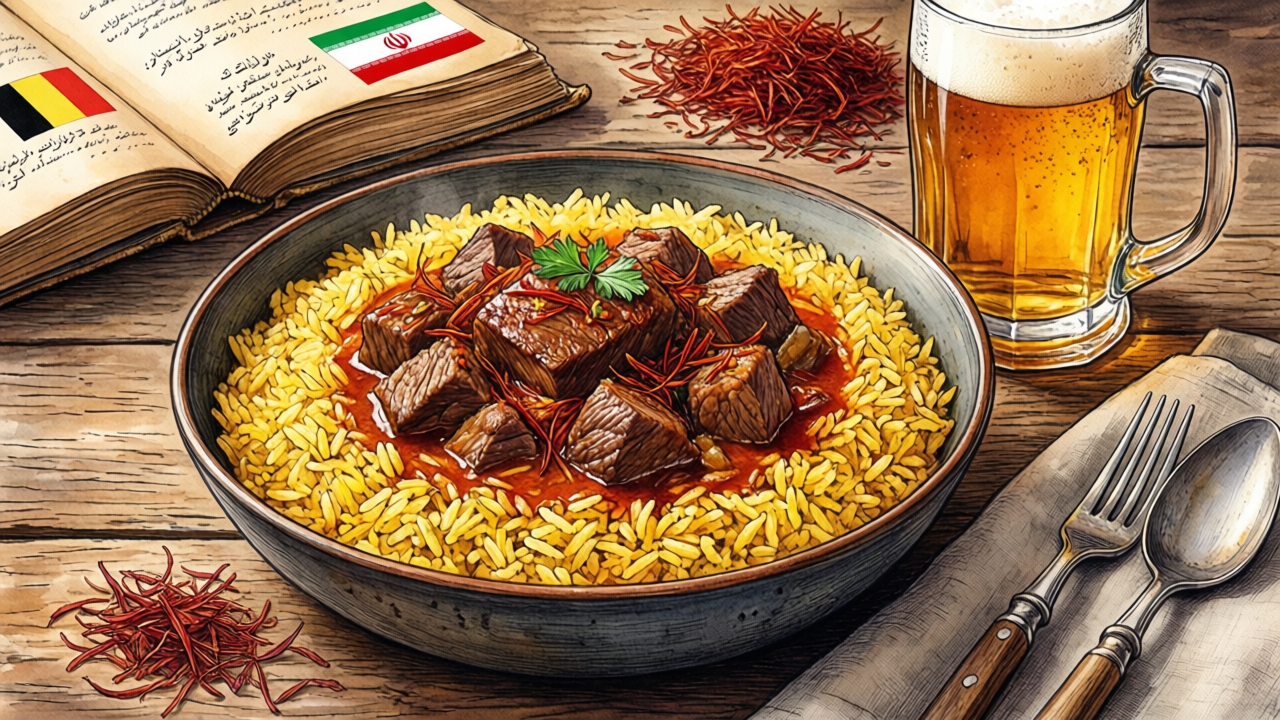
The fusion dish: Saffron Carbonnade with Tahdig. It takes the Belgian carbonnade flamande — the iconic beer-braised beef stew with caramelised onions — and runs it through a Persian filter: saffron in the braising liquid, pomegranate molasses for sweetness, sumac for brightness, and instead of the usual frites on the side, a bed of tahdig, the legendary crispy Persian rice bottom that every household argues over.
It sounds like a collision. It works like a conversation.
Ingredients
For the saffron carbonnade:
- 1 kg beef chuck, cut into 4cm cubes
- 2 large onions, thinly sliced
- 3 cloves garlic, minced
- 1 tbsp olive oil
- 2 tbsp butter
- 2 tbsp plain flour
- 600ml dark Belgian ale (Stout or Dubbel — Chimay Blue or Leffe Brun)
- 2 tbsp pomegranate molasses
- 1 tsp saffron threads, crushed into 3 tbsp hot water
- 200ml beef stock
- 2 bay leaves
- 1 tbsp Dijon mustard
- Salt and black pepper
- 1 tsp ground cumin
- Handful of fresh flat-leaf parsley, chopped
For the tahdig:
- 300g basmati rice
- 3 potatoes, peeled and thinly sliced
- 3 tbsp saffron threads, infused in 4 tbsp hot water
- 4 tbsp vegetable oil
- 2 tbsp melted butter
- Salt for the cooking water
To serve:
- Sumac, for sprinkling
- Plain Greek yoghurt with a squeeze of lemon
- Pomegranate seeds, if you want to feel fancy
Method
The tahdig (start this first — it needs time):
- Soak the basmati rice in cold water for at least 30 minutes. This removes excess starch and gives you properly separate grains.
- Drain and rinse. Bring a large pot of generously salted water to the boil — it should taste like the sea.
- Parboil the rice for exactly 4 minutes. It should still be very firm in the centre. Drain and rinse under cold water.
- In a heavy-based 20cm saucepan, heat the vegetable oil. Layer the potato slices on the bottom, overlapping slightly — this is your crispy base.
- Mix the parboiled rice with half the saffron water. Layer the rice over the potatoes.
- Make 3-4 holes in the rice with the handle of a wooden spoon so steam can escape. Cover tightly with foil, then the lid.
- Cook on medium-high for 5 minutes, then reduce to the lowest possible heat for 40 minutes. Do not open the lid.
- Turn off the heat and leave for 10 more minutes. Then invert onto a plate — the golden potato crust should release in one piece. If it doesn’t, you were impatient.
The saffron carbonnade:
- Season the beef generously with salt and pepper. Heat the olive oil in a large casserole dish or Dutch oven over medium-high heat.
- Brown the beef in batches — don’t crowd the pan. You want a proper sear, not steaming. Set aside.
- In the same pan, add the butter and onions. Cook on medium heat for 15-20 minutes until deeply caramelised. This is the backbone of the dish — don’t rush it.
- Add the garlic, flour, cumin, and mustard. Stir for 2 minutes to cook out the raw flour.
- Return the beef to the pan. Pour in the Belgian ale, scraping up any fond from the bottom. Add the beef stock, pomegranate molasses, saffron water, and bay leaves.
- Bring to a simmer, then cover and transfer to a 150°C oven (or keep on the lowest hob setting) for 2.5-3 hours until the beef is falling-apart tender.
- In the last 15 minutes, remove the bay leaves. Taste and adjust — you should get a balance of malty richness, saffron warmth, pomegranate sweetness, and sumac brightness.
- Finish with chopped parsley.
To serve:
- Crumble the tahdig into generous portions. Spoon the saffron carbonnade alongside or over the top.
- Drizzle with a little of the sauce from the pan, scatter with sumac, and serve with yoghurt on the side.
- Drink something Belgian. This is non-negotiable.
The magic of this dish is in the contrast: the deep, malty richness of the Belgian stew against the bright, floral notes of saffron and sumac. The tahdig adds the textural punch that frites would provide, but with the kind of golden crunch that makes Iranians emotional. It’s a dish that says “I respect both cultures equally” — which is exactly the sort of thing you want going into a World Cup match where either side can win.
Kick-off at SoFi Stadium, Inglewood: 02:00 UTC on June 22. Group G, Matchday 2.