The World Cup kicks off in proper fashion on Friday with Canada hosting Bosnia and Herzegovina at BMO Field in Toronto. It’s the first World Cup match on Canadian soil, and it’s also the sort of clash where the food cultures are just as interesting as the football tactics.
Canada: host nation, first game on home turf, Jesse Marsch on the touchline, Alphonso Davies leading the line — the whole country is buzzing. Bosnia: back after a twelve-year absence, managed by former captain Sergej Barbarez, with Sead Kolasinac as their talisman at Atalanta. Two very different footballing philosophies about to collide on a Friday evening in Toronto.
And two very different food traditions that, it turns out, actually go together remarkably well. Here’s the thing: Toronto already has one of the best Bosnian restaurants in North America (Mraković on Bloor — if you’re there, go). So the fusion of these two cuisines isn’t just theoretical. It’s already happening, one plate of ćevapi at a time.
The Matchup
Canada — Manager Jesse Marsch (who many outside the MLS bubble barely know, despite his work at RB Leipzig and Bayer Leverkusen) has built a team around pace and directness. Alphonso Davies on the left flank is arguably the most exciting player either side will field. The Wales-born Bayern Munich star scored Canada’s first ever World Cup goal in Qatar 2022, and the whole tournament is built around getting him the ball as quickly as possible.
Bosnia and Herzegovina — Sergej Barbarez, a national icon who captained the team to their only previous World Cup appearance in 2014, returns as manager for what could be his last tournament. The squad is younger this time — Kerim Alajbegović, Amar Dedović, and Esmir Bajraktarević bring fresh energy to a team that plays with technical Balkan flair. Sead Kolasinac at Atalanta is their experienced head.
The tactical contrast is fascinating. Canada wants to run at you. Bosnia wants to pick you apart. If Davies gets space, Canada should win. If Bosnia can slow the game into a midfield chess match, they’re dangerous. It’s the sort of tactical puzzle that makes World Cup group stages worth watching.
The Fusion Concept
Canadian cuisine is, let’s be honest, built around comfort food. Poutine — the triumvirate of fries, cheese curds, and gravy — is the national dish whether you like it or not. Bosnia’s answer is ćevapi: small grilled sausages of minced beef and veal, served with lepinja flatbread, raw onion, kajmak (a creamy fermented milk product), and ajvar (roasted red pepper relish). Both are hearty, both are street food, both are the kind of food you eat with your hands and don’t bother explaining to people who’ve never had it.
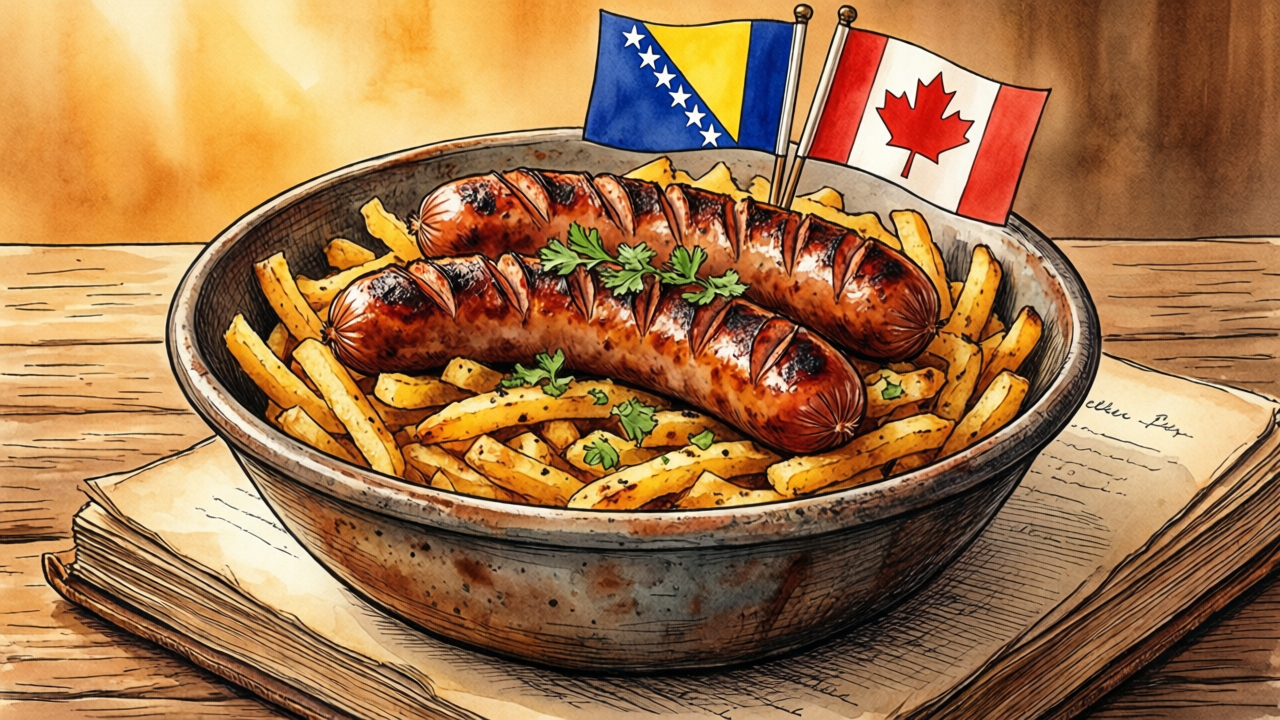
The fusion is simple: take a proper poutine base, swap the standard gravy for a spiced kajmak-ajvar sauce, and crown it with grilled ćevapi. The smoky sweetness of ajvar complements the squeaky cheese curds in a way that probably shouldn’t work but absolutely does. It’s comfort food from two different continents that decided to be friends.
Ćevapi Poutine
Serves 2-4. Prep 20 mins, cook 35 mins.
For the Ćevapi
- 500g minced beef (best cut you can find — neck or shoulder)
- 200g minced lamb (traditional Bosnian mix; all beef works if you prefer)
- 3 cloves garlic, finely grated
- 1 tsp salt
- ½ tsp black pepper
- ½ tsp baking soda (this is the Bosnian secret — it gives them that characteristic light texture)
- 2 tbsp olive oil
For the Kajmak-Ajvar Gravy
- 200ml beef stock
- 100ml double cream
- 3 tbsp ajvar (roasted red pepper relish — buy it or make it from roasted peppers, garlic, and a pinch of sugar)
- 2 tbsp kajmak (or substitute with clotted cream — it won’t be the same, but it’ll do)
- 1 tsp paprika (smoked if you have it)
- Salt and pepper to taste
For the Poutine Base
- 700g potatoes, cut into thick batonnet fries
- 400g cheese curds (this is non-negotiate — if you can’t find cheese curds, you’re not making poutine, you’re making a vaguely Canadian gratin)
- Vegetable oil for frying
- Flaky sea salt
Sides
- Freshly chopped red onion (Bosnian style — raw, generous, on the side)
- Lepinja or warm pita bread for dipping
- Extra ajvar for the enthusiastic
Method
Step 1: The Ćevapi
Mix the minced beef and lamb with the grated garlic, salt, pepper, and baking soda. Work it well by hand for at least 3 minutes — the texture should be sticky, almost paste-like. This isn’t a suggestion; properly mixed ćevapi hold together on the grill, and poorly mixed ones disintegrate. Shape into small sausages, about 5cm long and 2cm thick. You should get around 20. Refrigerate for at least 30 minutes while you sort the rest.
Step 2: The Fries
The double-fry method. Heat oil to 160°C and cook the potatoes for 5 minutes until softened but not coloured. Remove, drain, and cool. Crank the oil to 180°C and fry again for 3-4 minutes until golden and crispy. Drain on paper towels and season with flaky salt.
Step 3: The Gravy
Heat the beef stock in a saucepan. Stir in the cream, ajvar, kajmak, and paprika. Simmer for 5-7 minutes until it thickens to a gravy consistency. The colour should be a warm amber-red — if it looks too orange, add more stock. If it’s too pale, add more ajvar. Taste and adjust seasoning.
Step 4: Grill the Ćevapi
Hot grill or ridged pan. Cook the ćevapi for 3-4 minutes per side until charred on the outside, pink but cooked through inside. Don’t overcook — they should still be juicy. The baking soda means they puff up slightly, giving a nice contrast of crispy exterior and tender interior.
Step 5: Assemble
Pile the hot fries into bowls. Scatter the cheese curds over the top — they should just start to soften from the heat. Pour the kajmak-ajvar gravy over everything. Slice the ćevapi in half diagonally and arrange on top. Scatter chopped red onion generously. Serve immediately with warm lepinja on the side for proper gravy-sopping.
Why This Works
The genius of this fusion is that both cuisines are already built on the same emotional foundation: food that tastes like someone looked after you. Poutine is the dish your Quebec grandmother would make on a cold February night. Ćevapi is the dish your Bosnian neighbour grills on a Sunday afternoon and insists you stay for rakija afterwards. They’re different languages expressing the same sentence.
The ajvar bridges the gap beautifully. That smoky-sweet roasted pepper flavour is the sort of umami bomb that cheese curds were clearly designed to meet. And the kajmak in the gravy adds a creamy richness that makes the whole thing taste a bit more expensive than a bag of chips with sauce on it — which, let’s be fair, is exactly what poutine is trying to be.
Canada might not win Friday’s match. Bosnia might. It’s the group stage, and anything can happen. But the food? The food’s a winner either way.