WC2026 Kitchen: France vs Spain — Cassoulet Paella with Rouille Aioli
Tomorrow the World Cup reaches its first semi-final, and it couldn’t be more fitting: France and Spain, the two most decorated nations in the tournament’s history, collide at AT&T Stadium in Dallas. France have two World Cup titles (1998, 2018). Spain have one (2010). But both have four European Championship crowns between them, and both have been playing football like they’re cooking their national dishes — France with technique, Spain with flair.
The head-to-head record tells its own story: 38 meetings, Spain with 18 wins to France’s 13. Their last encounter? A 5-4 thriller. You can tell neither side knows how to make a quiet game.
So let’s get to the food. Both France and Spain have a dish that defines their culinary identity: cassoulet, the slow-baked bean-and-meat casserole from the south of France, and paella, the saffron-laced rice dish from Valencia. Both are one-pot affairs, both are traditionally made for gatherings, and both are fiercely defended by their regions as the “proper” way to cook them.
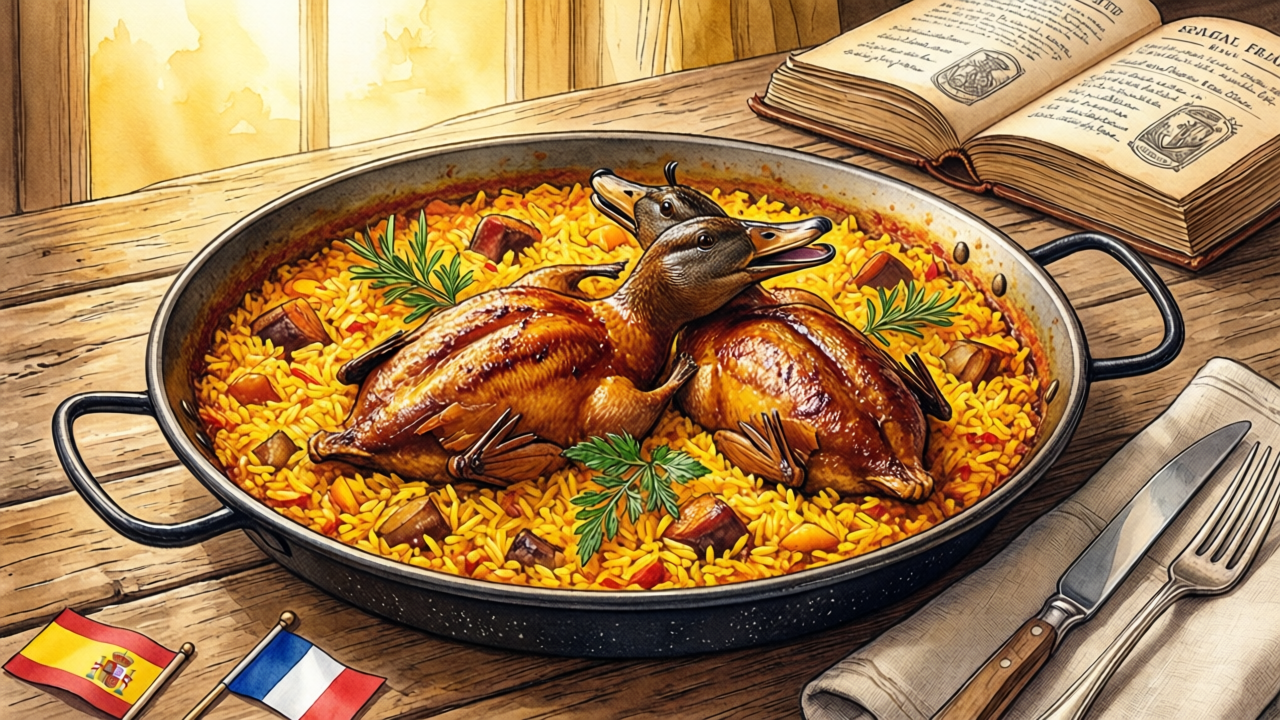
This fusion — Cassoulet Paella — takes the saffron rice architecture from Spain and loads it with the hearty, slow-cooked ingredients of a French cassoulet: duck confit, sausage, white beans, and a rouille aioli that bridges the two cuisines. It’s the football equivalent of a penalty shootout: technically precise, emotionally charged, and absolutely delicious.
The Concept
Cassoulet is the ultimate French comfort food — layers of haricots blancs (white beans), duck confit, Toulouse sausage, and pork, all baked under a breadcrumb crust until bubbling and golden. Paella is Spain’s answer to communal dining — rice cooked flat in a wide pan with saffron, chorizo, chicken, and whatever the market offered.
The DNA is identical: protein, starch, slow heat, serve to the crowd. The execution is where the neighbours differ. Our fusion takes the best of both — the saffron rice base from Valencia, the duck and bean richness from Toulouse, and an aioli-rouille drizzle that would have both chefs weeping with joy.
Ingredients
For the saffron rice base:
– 300g bomba rice (or arborio as a substitute)
– 600ml chicken stock, warm
– 1 generous pinch saffron threads (soaked in 2 tbsp warm water)
– 1 large onion, finely diced
– 4 garlic cloves, minced
– 1 red pepper, diced
– 200ml dry white wine
– 2 tbsp olive oil
For the cassoulet fillings:
– 2 duck legs (confit if you can get it, otherwise sous-vide for 2 hours at 75°C)
– 200g Toulouse sausage or chorizo (the bridge between both cuisines)
– 1 can (400g) haricots blancs / cannellini beans, drained
– 200g lardons or pancetta, diced
– 1 sprig thyme
– 1 bay leaf
For the rouille aioli:
– 2 garlic cloves
– 1 egg yolk
– 1 tbsp Dijon mustard
– 200ml olive oil
– 1 tsp paprika (smoked for the Spanish influence)
– 1 tbsp tomato purée (the rouille element)
– Salt and black pepper to taste
For the crust (the French touch):
– 50g breadcrumbs
– 1 tbsp melted butter
– 1 tsp dried herbs de Provence
Method
1. Cook the duck legs. If you’ve got confit duck, simply render the legs in a hot oven at 200°C for 20 minutes until the skin crackles. No confit? Sous-vide at 75°C for 2 hours, then sear skin-side down in a dry pan until golden. Set aside and shred the meat from the bone.
2. Brown the lardons and sausage. In a large, wide pan (ideally a paella pan, but any wide shallow wok will do), cook the diced lardons until crispy. Remove. Slice the sausage into coins and brown them. Remove everything, keeping the rendered fat in the pan.
3. Build the sofrito. In the same pan, add the olive oil and cook the onion, garlic, and red pepper on low heat for 10-15 minutes until deeply softened but not coloured. This is the Spanish foundation — patience here makes the difference between good and great.
4. Add the rice. Toss the rice into the sofrito and stir for 2 minutes so every grain is coated in fat. This is the socarrat principle — toasting the rice before liquid hits it.
5. Deglaze and flavour. Pour in the white wine and scrape the pan bottom. Let it reduce by half. Add the saffron-infused water, chicken stock, thyme, and bay leaf. Stir once, then leave it alone.
6. Arrange the fillings. Distribute the duck meat, sausage coins, beans, and lardons over the surface of the rice. Press them in gently so they sit just below the liquid level.
7. Simmer. Cook on medium-low heat for 18-20 minutes. Do NOT stir — stirring releases starch and makes the rice gummy. The rice should absorb all the liquid and be just tender. A slight crust forming at the bottom? That’s socarrat, the Spanish equivalent of the French croûte. It’s good.
8. Make the rouille aioli. While the rice cooks, blend the garlic, egg yolk, mustard, paprika, and tomato purée in a bowl. Slowly drizzle in the olive oil while whisking continuously. You want a thick, vibrant sauce. Season to taste.
9. Crust and bake. When the rice is done, scatter the breadcrumb-butter-herb mixture over the top. Put the whole pan under a grill/broiler for 3-4 minutes until the crust is golden and bubbling.
10. Rest and serve. Let it rest for 5 minutes off the heat. Drizzle with the rouille aioli. Serve straight from the pan — because sharing food from one dish is exactly what this match is about.
Serving Note
Best eaten with a glass of something that won’t take sides — a dry rosé from Provence or a Albariño from Galicia. Both are excellent, and neither has any more right to be here than the other. Much like the teams themselves.
Sources: FIFA World Cup 2026 fixtures, France vs Spain head-to-head, France vs Spain semi-final preview