WC2026 Host City Spotlight: Los Angeles, USA
Los Angeles is the sort of city where the commute to work is a geography quiz, everyone is an actor (or wants to be), and the idea of “city centre” is something they read about in a book once.
It is also, somewhat inconveniently, the largest city on Earth by land area that still manages to have the personality of a very confident group chat. And it is hosting eight matches at the most ostentatious sports venue ever constructed. Let’s talk about it.
The City That Can’t Decide What It Is
Los Angeles covers over 1,300 square miles. For context, that’s roughly the same size as Greater Manchester, Birmingham, Leeds, Sheffield and Newcastle combined — all of them. And yet someone in planning still thought it would be a good idea to build a 5-billion-dollar stadium in a suburb called Inglewood, which is approximately 30 minutes from Hollywood if you haven’t planned your trip around the fact that the 405 freeway is basically a car park with better signage.
LA’s population is around 3.8 million, but the metro area pushes past 13 million — making it the second-largest metro in the US after New York, despite the two cities barely talking to each other. The city has more cars per person than almost anywhere in the Western world, which is both the joke and the tragedy of LA. Locals don’t even use street addresses for directions — you describe your location by which freeway interchange you’re nearest to, like you’re playing a very expensive game of Battleship.
The weather is what they call “Mediterranean,” which is code for “it’s 72°F and sunny even in January, and everyone pretends this isn’t an unfair advantage.” The rainfall averages 15 inches per year — roughly the same as Southampton, though nobody in LA would ever admit that.
SoFi Stadium: The $5 Billion Seating Bowl
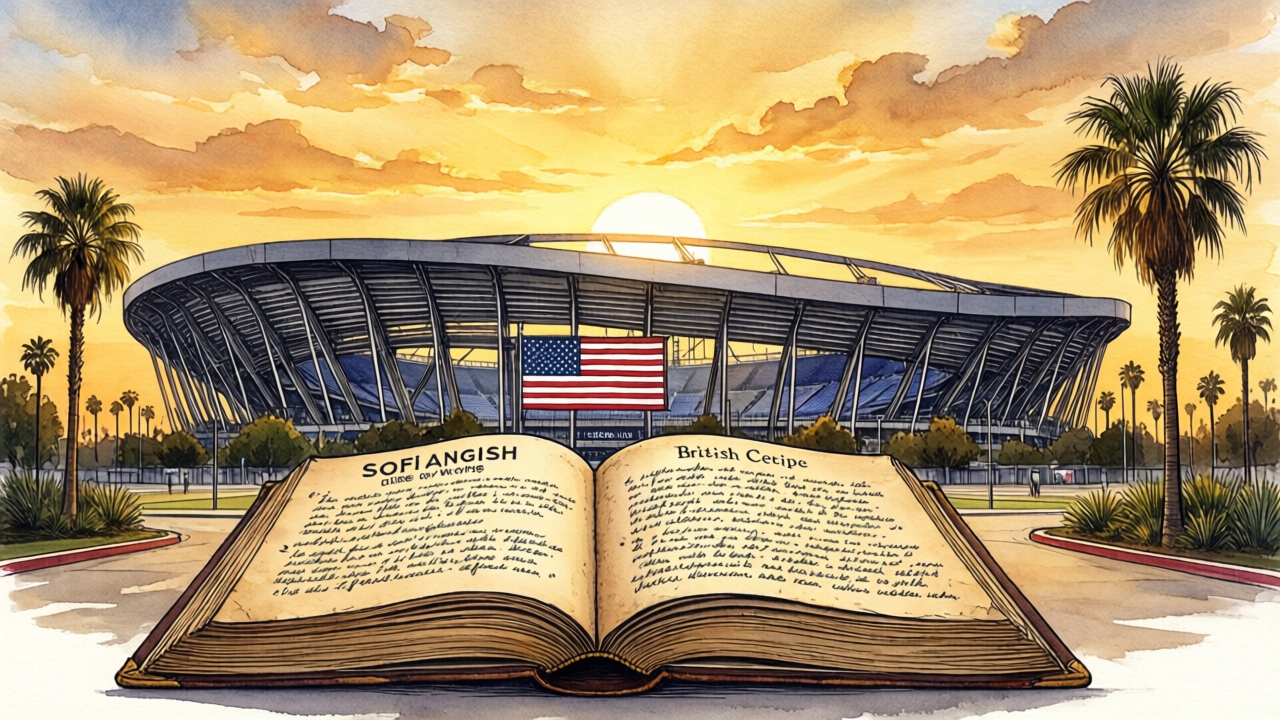
If you were going to build the most visually dramatic sports venue in history, you’d build SoFi Stadium. Opened in 2020 at a cost of $5.5 billion (yes, billion, with a ‘b’), it’s located in Inglewood — a city so small it has fewer people than most Premier League stadium crowds.
The stadium was designed by HOK and looks rather like something Ridley Scott would have built for a film set in 2077. The undulating glass roof, the canyon-like façade, the fact that the whole thing sits inside a wider entertainment district called The Venue — it’s a stadium that would still be impressive even if it were hosting darts tournaments instead of football.
For the World Cup, SoFi drops to a capacity of 69,650 — slightly fewer seats than its NFL configuration to accommodate the wider FIFA-standard pitch. It will host eight matches across the tournament, including USA’s opening game on Friday, 12 June 2026. The stadium also hosted Super Bowl LVI in 2022 (Cincinnati Bengals 24, Los Angeles Rams 23 — in overtime, of course) and is scheduled to host the opening ceremony and swimming events for the 2028 Olympics.
The owner, E. Stanley Kroenke, also owns the Arsenal Football Club, the LA Galaxy, and the Denver Broncos, which means he has somehow managed to own a significant portion of both American and British sports simultaneously. The man is basically a sporting monopolist with excellent taste in stadium architecture.
The only criticism of SoFi is that it’s essentially indoors — the roof keeps the Pacific breeze at bay, which means you’re watching World Cup football in what amounts to a very expensive air-conditioned room. Purists argue you should feel the sun and salt air during a summer tournament. But then again, nobody complained about watching the 2022 World Cup in Qatar, where “air-conditioned room” was the entire selling point.
The Food: Tacos, Traffic, and Survival
LA’s food scene is approximately 80% taco-adjacent, and the remaining 20% is people arguing about which taco spot is the best. The city’s Mexican food culture isn’t an accent — it’s the main language. The taco was voted LA’s most iconic dish in a Time Out readers’ poll, which is about as controversial as saying “water is wet” at a swimming pool.
Mariscos Jalisco, a food truck founded by Don Javier’s brother Don Juan, is widely credited with inventing the shrimp taco with a crispy, beer-battered shell and a squeeze of lime — and it’s been doing it from a truck for decades. There is also Tacos Don Cuco, a family-run institution in Boyle Heights that’s been slapping meat onto tortillas since 1955, and Angel’s Tijuana Tacos, which does Tijuana-style grilled and sheared meats with avocado salsa.
The city also has a thriving Korean food scene in Koreatown — bossam (boiled pork wraps), bibimbap, and Korean fried chicken that would put a London chicken shop to shame. The fusion of Korean and Mexican cuisine — Korean BBQ tacos — is genuinely an LA invention, which says everything you need to know about the city’s cultural DNA.
So. Recipe time. Because nothing says “Los Angeles” quite like a food truck taco that you eat while standing in a parking lot, and I have somehow decided that this is the perfect dish to represent a city that can’t agree on where its centre is.
Recipe: LA-Style Shrimp Tacos (Inspired by Mariscos Jalisco)
These are the tacos that put LA street food on the map — crispy beer-battered shrimp folded into warm corn tortillas with cabbage, lime, and a fiery salsa. The trick is in the batter: light, crispy, and barely clinging to the shrimp. If it’s too thick, you’ve basically made a fried prawn cracker, and nobody wants that.
Ingredients:
- 400g raw shrimp (peeled, deveined, tails removed)
- 12 small corn tortillas
- 1 cup all-purpose flour
- 1 teaspoon baking powder
- ½ teaspoon salt
- ½ cup beer (any kind — this isn’t a tasting session)
- ½ cup ice-cold water
- 1 head green cabbage, finely shredded
- 1 avocado, sliced
- Lime wedges
- Fresh cilantro, chopped
- Hot sauce (Salsa Verde or Cholula both work)
For the Salsa Verde:
- 200g tomatillos, husked and halved
- 1 jalapeño
- 2 cloves garlic
- ¼ cup cilantro
- Salt to taste
Method:
-
Make the salsa verde first. Roast the tomatillos, jalapeño, and garlic in a hot dry pan (no oil) until charred in spots — about 10 minutes. Transfer to a blender with the cilantro and salt, blend until roughly smooth. Taste. Adjust. This is the foundation of the whole taco, so don’t rush it.
-
Prepare the batter. Whisk together the flour, baking powder, and salt. Slowly add the beer and ice-cold water, whisking until you have a thin, slightly lumpy batter. The batter should coat a spoon but drip off easily. If it’s thick, add more water. Thin is the goal.
-
Heat the oil. You’ll need a shallow fryer or a heavy-based pan with about 1cm of oil. Heat to 170°C (340°F). If you don’t have a thermometer, test it by dropping in a drop of batter — it should sizzle and float immediately.
-
Fry the shrimp. Dip each shrimp into the batter, letting the excess drip off, then carefully place into the hot oil. Fry for 60-90 seconds per side until golden and crispy. The shrimp should curl slightly but not turn into tiny C-shapes — that means you’ve overcooked them. Drain on kitchen paper.
-
Warm the tortillas. Dry-fry each tortilla for 15-20 seconds per side in a hot pan until slightly charred and pliable. This is non-negotiable — cold tortillas crack, and cracked tortillas are just edible confetti.
-
Assemble. Place 3-4 crispy shrimp on each tortilla, top with shredded cabbage (this adds the crunch the batter can’t), sliced avocado, a squeeze of lime, and a drizzle of salsa verde. Garnish with cilantro.
-
Eat standing up. This is the most important step. There is something philosophically wrong with sitting down at a table to eat a taco. Tacos are meant to be consumed in a state of controlled mess, ideally while standing in a parking lot and wondering why your GPS thinks you’ve been driving for forty minutes to cross three miles.
Serving note: These are best eaten immediately. The batter loses its crispiness within minutes, and the tortillas go cold. There is no such thing as “leftover tacos” — if you have leftovers, you’ve failed at some fundamental level of taco management.
Why LA Works (Despite Itself)
There is a stereotype that Los Angeles is all surface and no substance. And to some extent, that’s fair — the city literally has a theme park called “Hollywood” where tourists pay to walk past replicas of buildings that don’t exist. But LA is also the city that invented the food truck revolution, has more diverse cuisines per square mile than probably any city outside of London (and probably London is losing ground), and built a stadium that looks like it belongs in a sci-fi movie.
For the World Cup, LA will be one of the most visited host cities — not just for the football, but because people want to say they were in LA during the World Cup. The question is whether they’ll make it to the match on time, given that the 405 freeway doesn’t care about FIFA schedules.
SoFi Stadium is a venue for the ages. Los Angeles is a city for the patient. Between them, they’ll make for some memorable matches — assuming the fans can find parking.