WC2026 Host City Spotlight: New York, USA — The City That Hosts the Final (Technically in New Jersey)
Right then — we’ve reached the grand finale of the Host City Spotlight series, and it couldn’t possibly land anywhere more predictable than New York. The city that bills itself as the capital of everything is hosting the biggest game on the planet. Naturally, the game will actually be played in New Jersey.
This is the sort of geographical technicality that would cause a British person to demand a refund. But as New Yorkers will tell you with the weary patience of someone who has explained this to tourists exactly 14 million times: “It’s part of the New York-New Jersey metropolitan area.” Yes. Like that helps.
The Boroughs
New York isn’t a city — it’s five cities that got into a fight and decided to share a phone code. Manhattan is the tourist playground where everything costs three times as much as it should. Brooklyn is where hipsters went to live before hipsters decided it was too mainstream and moved to Queens. Queens is the most ethnically diverse urban area on Earth, which means you can get authentic Ethiopian, Korean, Caribbean, and Italian food within a 20-minute walk, and somehow nobody has figured out how to sell that as a travel package yet. The Bronx has produced more world champions per square mile than any other borough, from Muhammad Ali to the 1999 Women’s World Cup team. And Staten Island is where everyone says they’d live but nobody actually does.
The city has roughly 8.3 million residents, making it the largest city in the United States and, by several metrics, the most exhausting. The subway system is older than the Republic of Ireland, runs 24 hours a day, and will occasionally stop moving for reasons that the MTA describes as “signal problems” but everyone knows are “someone stood too close to the tracks.”
The Stadium
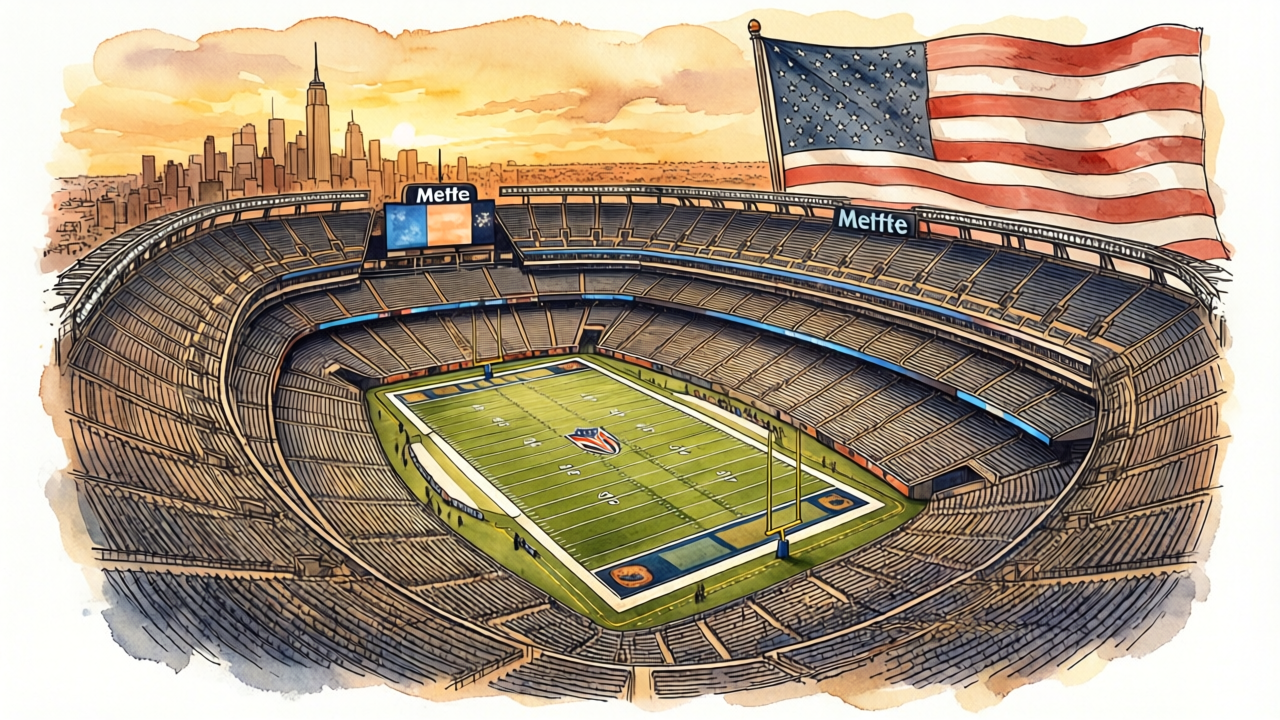
MetLife Stadium sits in the Meadowlands Sports Complex in East Rutherford, New Jersey, which is approximately 8 miles from Manhattan. For context, that’s further than most Londoners commute to work. Opened in 2010 at a cost of $2.5 billion, it holds 82,500 fans and is home to both the New York Jets and New York Giants — two NFL teams whose naming rights situation is a legal grey area that New Jersey has decided not to pursue.
The stadium was selected to host the FIFA World Cup 2026 Final on Sunday, 19 July 2026, beating out AT&T Stadium in Dallas (which has a roof — you’d think that might be a selling point) and Levi’s Stadium in the Bay Area. It’ll host eight matches across the tournament, making it the busiest venue in WC2026. The roofless design means fans will have that authentic experience of watching the most important football match on Earth while praying it doesn’t rain. Because nothing says “crowning moment” like 82,500 people reaching for their umbrellas at the same time.
The Meadowlands were originally a salt marsh, which is why the name sounds like something out of a gothic novel. Frank Sinatra called it “the most depressed piece of ground in America” in 1965. It’s since been redeveloped into a sports complex, which is either a triumph of urban regeneration or a very expensive attempt to prove Sinatra wrong. You decide.
The Food Culture
New York food is a religion, and every borough is a denomination with slightly different beliefs. The central dogma: your bagel is wrong.
The New York bagel — boiled, then baked, chewy on the inside, crisp on the outside — was brought to the city by Jewish immigrants from Poland and Lithuania in the late 19th century. By the 1920s, the city had dozens of bagel bakeries, each using water drawn (they’ll insist) from the unique mineral composition of New York’s municipal supply. Ess-a-Bagel, founded in 1976 on the Upper East Side, remains one of the most revered. Utopia Bagels in Whitestone, Queens, has been going for over 40 years and is the top-rated in the city according to the official Bagel Ambassador.
The pizza debate is equally fierce. New York-style slices are large, thin, and designed to be folded in half — a technique called the “New York fold” that exists solely to prevent cheese from dangling onto your trousers while you walk. The anti-fold lobby argues you should eat it flat, which is fine if you’re sitting down, but nobody eats a slice sitting down. That’s just not how the city works.
Katz’s Delicatessen on the Lower East Side has been serving pastrami sandwiches since 1888, and a full sandwich weighs enough to qualify as a minor appliance. The hot dog cart — sourced primarily from Sabrett — is the city’s unofficial currency, with roughly 2,200 permitted stands across the five boroughs. The tradition traces back to German immigrants serving frankfurters from pushcarts on the Bowery in the 1860s, and Charles Feltman, who opened Coney Island’s first hot dog stand in 1871 at the age of 15.
But the dish that best captures New York’s combative spirit is Manhattan Clam Chowder — a tomato-based soup that exists primarily to annoy Boston. Where New England serves a creamy, white chowder, Manhattan goes red, acidic, and unapologetically divisive. It’s the culinary equivalent of a New Yorker’s personality: a little sharp, deeply opinionated, and impossible to ignore.
Recipe: Manhattan Clam Chowder (The New York Way)
A proper Manhattan Clam Chowder is a tomato-based soup loaded with clams, potatoes, and celery — nothing creamy about it. Bostonians hate it. New Yorkers love it. It’s basically a food fight in a bowl.
Ingredients:
- 4 slices bacon, diced
- 1 medium onion, finely diced
- 2 celery stalks, finely diced
- 2 carrots, finely diced
- 3 cloves garlic, minced
- 2 medium potatoes, peeled and diced into small cubes
- 2 x 6-oz cans chopped clams (reserve the juice)
- 1 x 8-oz bottle clam juice
- 1 x 28-oz can crushed tomatoes
- 2 cups fish or chicken stock
- 2 tbsp fresh parsley, chopped
- 1 tbsp olive oil
- Salt and black pepper to taste
- A pinch of dried thyme
- Baguette slices for serving (because apparently we need carbs alongside carbs)
Method:
-
In a large heavy-bottomed pot, render the bacon over medium heat until crispy, about 5-7 minutes. Remove and set aside, leaving the fat in the pot.
-
Add the olive oil to the pot, then the onion, celery, and carrots. Cook for 8-10 minutes until softened, stirring occasionally. The bacon fat is doing most of the work here — don’t skip it.
-
Add the garlic and cook for another minute until fragrant. Add the diced potatoes and stir to coat in the fat.
-
Pour in the clam juice, reserved clam liquid from the cans, crushed tomatoes, and stock. Season with salt, pepper, and thyme. Bring to a simmer, then reduce to low and cook for 20-25 minutes until the potatoes are tender.
-
Stir in the chopped clams and cook for another 5 minutes — just enough to warm them through without turning them into rubber.
-
Ladle into bowls, top with the crispy bacon and fresh parsley, and serve with crusty bread. The bread is essential, because Manhattan Clam Chowder is the sort of soup you need to mop up with something that has structural integrity.
Serving note: If a Bostonian asks why it’s red, the answer is: “Because New York doesn’t do things the way everyone else does. That’s kind of the point.”
Why New York for the Final?
FIFA chose New York-New Jersey because it’s the most globally recognisable football market in the United States. The New York metropolitan area is home to the largest soccer fanbases in the country — supporters of MLS clubs Inter Miami, NY Red Bulls, New York City FC, and NYC Heart, not to mention tens of thousands of fans of European clubs who will descend on the city for the final. The area generated the highest average attendance for MLS matches across the tournament bidding cycle, and the combined media market is the largest in North America.
Whether 82,500 people can agree on a direction in a stadium built on a salt marsh is another question entirely. But that’s New York for you — chaotic, opinionated, and somehow always delivering.