It’s arguably the most tantalising fixture of the tournament so far — defending champions Argentina, carrying the weight of a continent on Lionel Messi’s shoulders, against Algeria, a nation that has waited 23 years for a World Cup group stage and brought Riyad Mahrez, Sofyan Amrabat, and their new coach Vladimir Petković to the party. The two countries have never met before, so there’s no history to draw on, only narrative.
On one side: the team that won the 2022 World Cup in Qatar, the players who paraded with the trophy in Buenos Aires, the footballing equivalent of a reigning heavyweight champion who still has to prove themselves at every weigh-in. On the other: the Fennecs, North Africa’s most decorated side, who’ve reached the Round of 16 twice before (2010 and 2014) and come within a whisker of the quarters. They didn’t get the 48-team expansion just to watch from the sidelines again.
And then there’s the food angle, which is where this gets interesting. Argentina and Algeria share something deeper than most World Cup pairings — a colonial-era migration corridor that runs across the Mediterranean. Hundreds of thousands of Algerians settled in Buenos Aires in the late 19th and early 20th centuries, bringing their cooking with them. The Argentine dish chorizo a la criolla has Algerian roots. The word chacarero comes from North African Arabic. You can taste the Maghreb in Argentina if you know where to look.
The Fusion Concept
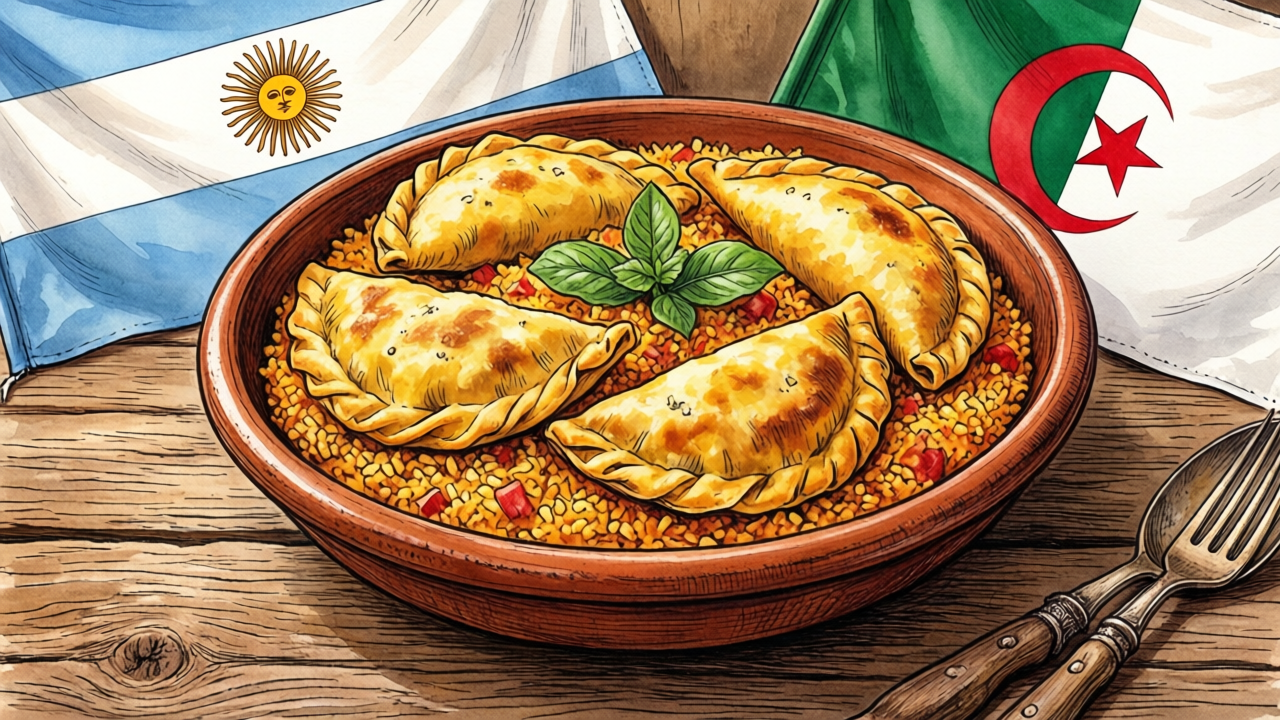
So the recipe bridges both cuisines: empanadas — Argentina’s most iconic handheld food — stuffed with a filling that’s part North African tagine, part Argentine asado. Harissa-spiced lamb with preserved lemon and olives, wrapped in golden dough, served alongside a bright chimichurri that cuts through the richness. It’s the culinary equivalent of what happens when these two teams meet — South American technique meets North African spice.
Harissa Empanadas with Chimichurri Couscous
For the filling (serves 4 — makes 12 empanadas)
- 500g lamb mince (or beef, if you’re Argentine and sensitive about this)
- 1 large onion, finely chopped
- 2 garlic cloves, minced
- 1 tbsp harissa paste (or more if you like it hot — Algerians do)
- 1 tsp ground cumin
- 1 tsp smoked paprika
- ½ tsp cinnamon (yes, cinnamon — it’s the North African secret weapon)
- 100g green olives, halved
- 1 preserved lemon, zest only, finely chopped (the pulp is too salty)
- Juice of half a lemon
- Fresh coriander and parsley, chopped
- Salt and black pepper
- 12 empanada discs (store-bought is fine — this isn’t a test of your rolling-pin technique)
- 1 egg, beaten (for the wash)
For the chimichurri couscous
- 200g couscous
- 250ml boiling vegetable stock
- 3 tbsp extra virgin olive oil
- 2 tbsp red wine vinegar
- 3 garlic cloves, finely minced
- Handful of fresh parsley, finely chopped
- Handful of fresh oregano (dried is acceptable in an emergency)
- 1 tsp dried chilli flakes
- ½ cup toasted pine nuts
- Salt to taste
Method
Step 1 — The filling
- Heat a splash of olive oil in a large pan over medium-high heat. Brown the lamb mince, breaking it up with a wooden spoon — you want it properly caramelised, not grey and weeping.
- Add the onion and cook for 5 minutes until softened. Throw in the garlic for the last minute so it doesn’t burn.
- Stir in the harissa, cumin, smoked paprika, and cinnamon. Cook for another 2 minutes until the spices are fragrant — this is the moment where the dish starts to smell like something worth eating.
- Fold in the olives, preserved lemon zest, and lemon juice. Season with salt and pepper. Remove from heat and stir through the chopped herbs. Let it cool completely — hot filling makes soggy empanadas, and nobody wants that.
Step 2 — Assembly
- Preheat your oven to 200°C (180°C fan).
- Place a spoonful of filling in the centre of each empanada disc. Don’t overfill — you’re not making a parcel for a picnic.
- Fold the disc in half to form a half-moon shape. Press the edges together with a fork to seal — the crimped edge is traditional and looks decent on a plate.
- Brush the tops with beaten egg for a golden finish. Make a small slit in the top of each one — this lets steam escape and prevents the kind of kitchen disaster that ends with empanada filling on the ceiling.
Step 3 — The chimichurri couscous
- Put the couscous in a heatproof bowl. Pour over the boiling stock, cover with cling film, and leave for 5 minutes. Fluff with a fork when done.
- Meanwhile, mix together the olive oil, red wine vinegar, garlic, parsley, oregano, and chilli flakes. This is your chimichurri — the Argentine salsa that somehow works with North African couscous because both cultures understand that oil, acid, and herbs are the foundation of decent food.
- Drizzle the chimichurri over the fluffed couscous and toss through. Stir in the toasted pine nuts for crunch.
Step 4 — Bake and serve
- Bake the empanadas for 15-20 minutes until golden brown. They should be crisp on the outside and steaming when you cut into one.
- Serve the empanadas on a bed of chimichurri couscous, with extra chimichurri on the side for dipping. If you have a glass of Malbec or a bottle of Algerian beer (Jupiter, if you can find it), you’re properly set.
There’s something fitting about a dish that refuses to pick a side — two culinary traditions that shouldn’t work together on paper, but in practice create something neither could manage alone. Much like the game itself, where Messi’s individual brilliance will need the collective structure of Algeria’s disciplined defensive system to give it shape. Or at least, that’s the theory. The football, like the empanadas, will tell us whether it holds together in the oven.