WC2026 Kitchen: Brazil vs Norway — Brunost Picanha with Farofa and Vinagrete
It is Norway’s first World Cup since 1998. Two and a quarter decades of heartbreak, near-misses, and Erling Haaland doing physics-defying things in a Champions League kit while the national team watched from the sidelines. Tonight, at MetLife Stadium in East Rutherford, they face Brazil — five-time champions, carnival in a football shirt, and a side that somehow still hasn’t lost an opening World Cup match since 1934 (they drew theirs, mercifully).
Haaland has been unstoppable: two goals against Senegal in the group stage, then an 86th-minute winner against Ivory Coast in the Round of 32 to send the Tartan Army — er, the Norwegian fans — absolutely delirious. Vinicius Jr has been equally dazzling with four goals already, including a brace against Scotland. The Opta supercomputer gives Brazil 53.6% to win in regulation. That’s not much of a favourite when you’re playing against a team with Haaland in front of you.
But first, let’s talk about the food. Brazil and Norway — one of the most unlikely culinary pairings you could imagine, which makes it perfect for fusion.
The Fusion Concept
Brazil gives us churrasco — open-flame barbecue, picanha (that magnificent rump cap), and farofa (toasted cassava flour). Norway gives us brunost — caramelized whey cheese that tastes like dulce de leche had a child with a campfire. On the surface, nothing connects these cuisines. But look closer: both cultures worship the act of gathering around fire and food. Brazilians around the churrasco, Norwegians around the pean (communal dinner). The DNA is the same; the flavour profiles are worlds apart.
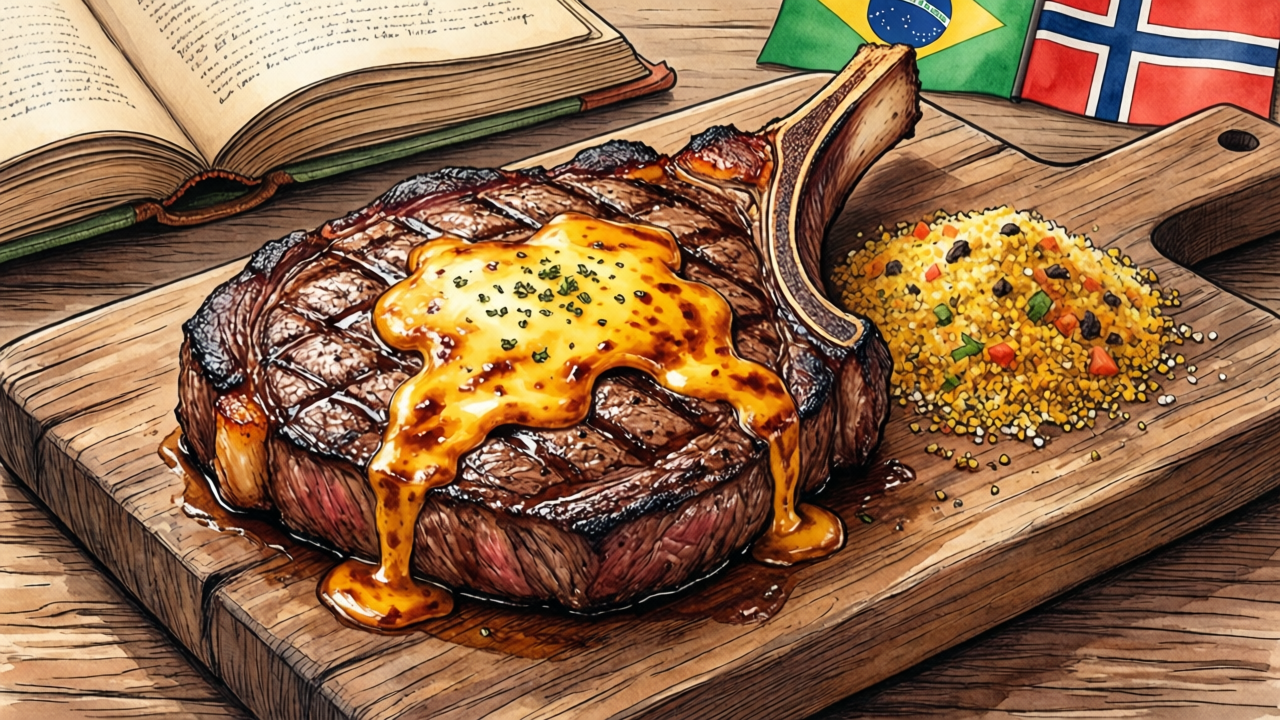
The fusion: take Brazilian picanha, roast it the traditional way over high heat, but instead of the classic vinaigrette, top it with a Brunost glaze — caramelized, slightly salty, impossibly sticky. Serve with farofa for crunch and a sharp vinagrete to cut through the richness. It’s barbecue with a Nordic twist, and it works better than either country’s football tactics tonight.
Ingredients
For the Brunost Glaze:
– 200g brunost (Norwegian brown cheese), sliced into thin batons
– 2 tbsp unsalted butter
– 1 tbsp maple syrup
– 1 tsp smoked paprika
For the Picanha:
– 1kg picanha (rump cap steak), fat cap intact
– Coarse sea salt
– Freshly ground black pepper
– 2 tbsp vegetable oil
For the Farofa:
– 2 cups cassava flour (manioc/tapioca flour)
– 100g bacon or pancetta, diced
– 1 red onion, finely diced
– 2 cloves garlic, minced
– 4 tbsp butter
– Fresh parsley, chopped
For the Vinagrete:
– 1 red onion, finely diced
– 2 tomatoes, deseeded and diced
– 1 red chilli, finely sliced
– Juice of 2 limes
– Fresh coriander, chopped
– Olive oil, salt to taste
Method
1. Start the vinagrete first — it needs time to marinate. Combine all vinagrete ingredients in a bowl with a good drizzle of olive oil, salt, and let sit. The lime juice will start breaking down the onion, and you want that sharp acidity ready to cut through the rich meat and cheese.
2. Make the farofa. In a large skillet, render the diced bacon over medium heat until crispy. Add the onion and cook until translucent, then toss in the garlic for a minute. Pour in the cassava flour and stir constantly over medium-low heat for 8-10 minutes, until the farofa is golden and fragrant. Stir through the parsley and butter. Set aside and cover to keep warm.
3. The Brunost glaze. In a small pan over low heat, melt the butter with maple syrup and smoked paprika. Add the thin slices of brunost and stir gently until the cheese has melted into the butter — you’re looking for a thick, caramel-coloured glaze. It will smell like a cross between a Norwegian breakfast and a Brazilian roadside barbecue, and that is exactly the point.
4. Roast the picanha. Preheat your grill or griddle to high heat. Score the fat cap of the picanha in a cross-hatch pattern — this helps render the fat and creates those beautiful char marks. Season generously with salt and pepper. Sear the fat cap first for 3-4 minutes until crispy, then roast the rest of the cut for 8-10 minutes per side for medium-rare. Rest for 10 minutes before slicing against the grain.
5. Assemble. Slice the picanha into thick strips. Spoon the Brunost glaze over the top — it should be warm and slightly runny, clinging to the meat like it was always meant to be there. Serve with a mound of farofa on the side and a generous helping of vinagrete.
Why This Works
The Brunost brings a caramel-salt complexity that pairs surprisingly well with the fatty, iron-rich picanha. The smoked paprika in the glaze bridges the gap between Nordic smoke and Brazilian fire. The farofa provides the crunchy, starchy backbone that any good barbecue needs, and the vinagrete’s sharp lime-onion-chilli profile cuts through the richness of both the meat and the cheese.
It’s the sort of dish that makes you wonder why nobody tried it sooner — which is probably the mark of a good fusion recipe.
The Match
Brazil have the squad depth, the experience, and five World Cups to their name. Norway have Haaland, the underdog narrative, and the fact that this is their first World Cup in 28 years — which is either a massive motivation or a crushing weight, depending on how you look at it.
Haaland has scored 10 goals in his last three games for Norway. Vinicius Jr has four goals in four World Cup matches. The supercomputer says Brazil win 53.6% in regulation, meaning almost half the time this match goes beyond 90 minutes. If I had to bet, I’d say the winner is whoever scores first — because once that happens, the other side either crumbles or comes back in the most dramatic fashion World Cup knockout football has to offer.
Either way, the Brunost Picanha is going to taste great regardless of the result.
*Sources: Al Jazeera, BBC Sport, Sky Sports