There are matches at the World Cup that you book tickets for, and then there’s Norway versus France — a game you book a psychiatrist for afterwards, because watching Haaland and Mbappé in the same team sheet is the kind of stress that makes you question every life choice that led you to this moment.
Both teams arrive at Gillette Stadium on 6 points, having won their two group matches by the same margin. France have a one-goal advantage on goal difference. Norway have Haaland, who has scored 59 goals in 52 appearances for his country and treats the concept of “missing” as a theoretical exercise. France have Mbappé, who has already scored a hat-trick against Senegal and a brace against Iraq at this tournament, becoming Les Bleus’ all-time leading scorer in the process.
The last time these two met — in a 2022 Nations League fixture that nobody expected to matter — France won 3-2 in a game that had all the subtlety of a sledgehammer through a window. If this one follows form, we’re looking at at least four goals and possibly a medical emergency in the press box.
On the food front, Norwegian and French cuisines share something unexpected: both are built around the art of transforming simple, local ingredients through patience and a healthy relationship with dairy. The Norwegians cure salmon in dill and salt for days. The French braise beef in red wine for hours. One produces gravlaks, the other produces bourguignon. Both are the kind of dishes that say “I planned ahead and I’m not afraid of flavour.”
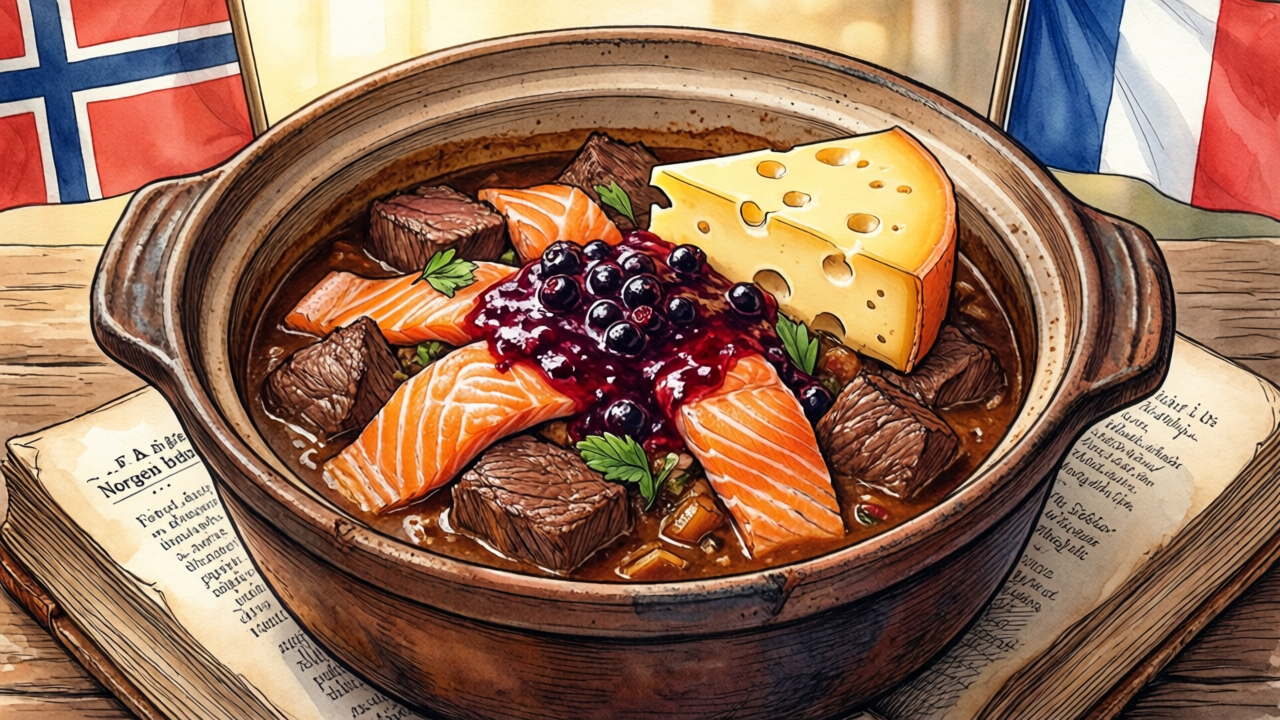
So here’s what happens when those two philosophies collide in one pan.
Ingredients
- 1 kg beef chuck, cut into 5cm chunks (the cut you’d braise in Burgundy; the patience you’d need for Norway)
- 200g Norwegian gravlaks (cured salmon), cut into ribbons — yes, salmon in a beef stew, hear me out
- 250ml red Burgundy wine (Pinot Noir if you’re feeling generous, Gamay if you’re on a budget — both are French, neither judges you)
- 300ml beef stock
- 2 tbsp lingonberry jam — this is the Norwegian secret weapon; the acidity cuts through the wine like Haaland cuts through a defence
- 200g pearl onions, peeled
- 200g chestnut mushrooms, quartered
- 3 carrots, sliced into rounds
- 2 shallots, finely chopped
- 3 garlic cloves, crushed
- 2 tbsp olive oil, plus butter for finishing
- 2 sprigs fresh dill, plus extra for garnish
- 5-6 juniper berries, lightly crushed (Norway’s contribution to the herb game)
- 2 bay leaves
- 1 tbsp tomato purée
- Salt and black peppercorns to taste
- For the topping: 100g Norwegian brown cheese (brunost), grated
- Crusty bread, for mopping up the mess afterwards
Method
- Season the beef. Coat the chunks in flour mixed with salt and freshly ground black peppercorns — whole peppercorns are a nod to fårikål, Norway’s national dish. If you can’t find whole ones, regular ground pepper works. We’re not Norway; we don’t have that luxury.
- Sear the meat. Heat olive oil in a heavy-based casserole dish over high heat. Brown the beef in batches — don’t crowd the pan, or you’ll steam it instead of sear it. This is the first thing both French chefs and Norwegian grandmothers will tell you: the colour on the outside is everything. Set the beef aside.
- Sweat the aromatics. In the same pan (with all those wonderful browned bits stuck to the bottom — those bits are the plot of this dish), add the shallots, pearl onions, and carrots. Cook for 5 minutes until softened. Add the garlic, juniper berries, and bay leaves. Cook for another minute until the whole kitchen starts smelling like somewhere you’d actually want to live.
- Deglaze and braise. Pour in the wine, scraping up all those stuck bits (fond — the French word for “the best part of cooking”). Stir in the tomato purée and beef stock. Return the beef to the pan. Bring to a simmer, then cover and transfer to a 160°C oven for 2.5 hours. At this point, you’re doing less cooking and more waiting, which is a skill both nations have mastered through different life experiences.
- Add the salmon. After 2 hours, remove the casserole and stir in the lingonberry jam. It’ll look dramatic swirling through the wine — red on red, like a scoreboard after extra time. Add the gravlaks ribbons on top. The residual heat will warm the salmon through without cooking it properly, which is exactly what you want. It should be silky, not flaky. Cover and return to the oven for the final 30 minutes.
- Finish and serve. Remove from the oven. Add the mushrooms now — they’ll warm through in 5 minutes on a low simmer on the stovetop. Stir in chopped fresh dill and a knob of butter for that French finish (the monter au beurre technique, or “add butter at the end because why not”).
- The brown cheese gratin (optional but strongly recommended). For the Norwegian finale, spoon the bourguignon into ovenproof dishes, scatter the grated brunost over the top, and broil for 3 minutes until golden. Brown cheese doesn’t melt like normal cheese — it caramelises into something between a crème brûlée and a childhood memory from Tromsø.
Serve with crusty bread, a glass of the same wine you braised the beef in (the rest of it, that is), and the kind of quiet satisfaction that comes from making a dish neither country would recognise but both would respect.
The gravlaks adds a silky, smoky dimension that sits beautifully against the wine-braised beef. The lingonberry jam brings the brightness that prevents this from becoming a one-note stew. The brown cheese topping is the wildcard — if you’ve never tried brunost, it tastes like caramel, cheese, and a sauna had a baby. It works here in a way that shouldn’t, but does.
Much like this match itself: Norway and France shouldn’t make this much sense together, but here we are.