WC2026 Kitchen: Panama vs England — Ceviche & Chips
It’s the last day of the group stage, and on paper, Panama vs England is the most mismatched fixture in the tournament. Panama enter this final match with zero points — they’ve lost both of their previous group games (0-1 to Ghana, 0-1 to Croatia) and are already eliminated. England sit top of Group L with 7 points after a 4-2 demolition of Croatia and a gritty 0-0 draw with Ghana. At MetLife Stadium in East Rutherford, New Jersey, this is less a competitive match and more an opportunity for Thomas Tuchel’s side to top the group and send Panama out on a high.
But from a food perspective, this is one of the most interesting pairings of the entire tournament. Panama and England share one culinary obsession: fish. The difference is that one country marinates it alive in citrus juice, and the other deep-fries it in batter the thickness of a phonebook.
The fusion concept
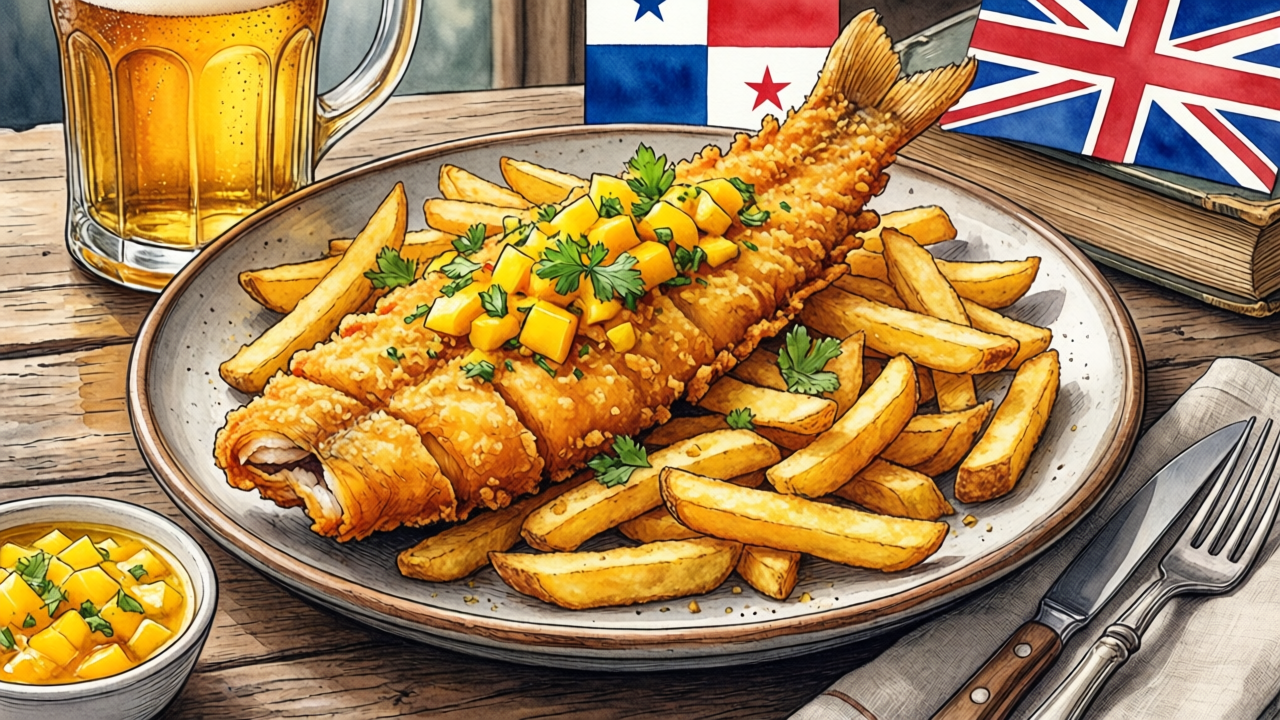
The beauty of a Panama-England crossover is that the DNA is already there. Both cultures treat fish as the star, not the garnish. Panamanian ceviche de corvina — white sea bass “cooked” in fresh lime juice with onion, cilantro, and a touch of habanero — is about brightness, acid, and freshness. British fish and chips is about crunch, salt, and comfort. Put them together and you get something that works on both sides: beer-battered fish with a ceviche-inspired mango-habanero salsa, coconut rice, and a coconut-lime aioli.
The batter honours the British tradition. The salsa honours Panama. The coconut rice is the bridge — tropical enough for the Caribbean coast, mild enough for the chippie.
Ceviche & Chips
Serves 4 | Prep: 20 min | Cook: 25 min
Ingredients
For the fish:
– 4 white fish fillets (cod, hake, or sea bass — corvina if you can find it)
– 150g plain flour
– 300ml lager or light beer (anything drinkable)
– 1 tsp baking powder
– Oil for deep-frying (peanut or sunflower)
– Sea salt and malt vinegar, for finishing
For the mango-habanero salsa:
– 2 ripe mangoes, diced
– 1 habanero pepper, finely diced (remove seeds if you’re British)
– ½ red onion, finely diced
– Juice of 3 limes
– Handful of fresh coriander (cilantro), chopped
– ½ tsp cumin
– Salt to taste
For the coconut rice:
– 200g long-grain rice
– 200ml coconut milk
– 200ml water
– Pinch of salt
For the coconut-lime aioli:
– 2 egg yolks
– 1 clove garlic, crushed
– 1 tsp Dijon mustard
– 200ml sunflower oil
– 2 tbsp coconut cream
– Juice of 1 lime
For the coconut chips (optional, if you want to go the full distance):
– 2 large potatoes, cut into thick chips
– Coconut oil for frying
Method
-
Make the salsa first — it needs time to meld. Combine the diced mango, habanero, red onion, lime juice, coriander, cumin, and salt in a bowl. Stir, taste, and adjust the heat level. Leave it to sit while you do the rest. The acid will gently break down the mango, giving it a ceviche-like brightness.
-
Cook the coconut rice — Rinse the rice, then combine with coconut milk, water, and salt in a pan. Bring to a boil, reduce to a simmer, cover, and cook for 15 minutes. Fluff with a fork when done. It should be fragrant and slightly sticky — the tropical counterpoint to the crispy fish.
-
Make the aioli — Whisk the egg yolks, garlic, and mustard together. Slowly drizzle in the sunflower oil while whisking constantly until thickened (this is the same technique as mayonnaise). Fold in the coconut cream and lime juice. Taste and adjust — you want coconut sweetness balancing the lime sharpness. If it splits, add a teaspoon of warm water and whisk again.
-
Prepare the batter — Mix the flour, baking powder, and a generous pinch of salt in a bowl. Slowly pour in the beer, whisking to a smooth batter with the consistency of single cream. Let it rest for 10 minutes — this relaxes the gluten and gives a lighter fry.
-
Fry the chips — Heat oil to 160°C. Lower in the potato chips and fry for 5 minutes, then remove and drain. Crank the heat to 180°C and fry again for 3-4 minutes until golden and crisp. Salt immediately. If you’re using coconut oil, you’ll get a subtle tropical note that pairs beautifully with the salsa.
-
Fry the fish — Pat the fillets dry and season with salt. Dip each fillet into the batter, coating evenly. Fry at 180°C for 4-5 minutes per side until the batter is golden and the fish flakes easily. The key is not to overcrowd the pan — fry in batches. Remove to a wire rack (not paper towels — the steam will soften the batter).
-
Plate it — Scoop coconut rice, pile the chips beside it, lay the battered fish on top, and ladle the mango-habanero salsa over the fish. A dollop of coconut-lime aioli on the side. Finish with a splash of malt vinegar if you’re feeling old-school.
Why it works
Both cuisines understand that fish is a canvas. Panamanian ceviche is essentially raw fish elevated by acid, heat, and fresh herbs — the fish provides the protein, the marinade provides the character. British fish and chips inverts the formula: the batter and the fry provide the character, the fish provides the canvas. Our fusion respects both approaches: the batter delivers the British crunch, while the mango-habanero salsa brings the Panamanian brightness. The coconut rice ties it together — it’s the kind of side that could sit on either side of the Atlantic without raising eyebrows.
The real genius is the aioli. Traditional tartar sauce is already a bridge — cream-based with pickles and herbs. By swapping in coconut cream and lime, we’re keeping the format recognisably British while making the flavour distinctly Panamanian.
The football context
This is one of those matches that feels almost ceremonial. Panama, coached by Thomas Christiansen, have been thoroughly outclassed in Group L. England, under Tuchel, have shown glimpses of the attacking brilliance that made their 4-2 thrashing of Croatia the match of the group stage so far. The 0-0 draw with Ghana showed a different side — stubborn, pragmatic, perhaps a touch fearful. But with top spot virtually guaranteed, there may be scope for some experimentation.
For Panama, it’s about dignity. They’ve qualified for the World Cup, they’ve played the game, and now they get to face the tournament’s biggest nation in a stadium built for the NFL. There’s a certain poetic symmetry to it.
Both countries love their fish. The rest is just detail.